Conflict dossier · #50 of 120
Dossier 50 — American Civil War (1861–1865)
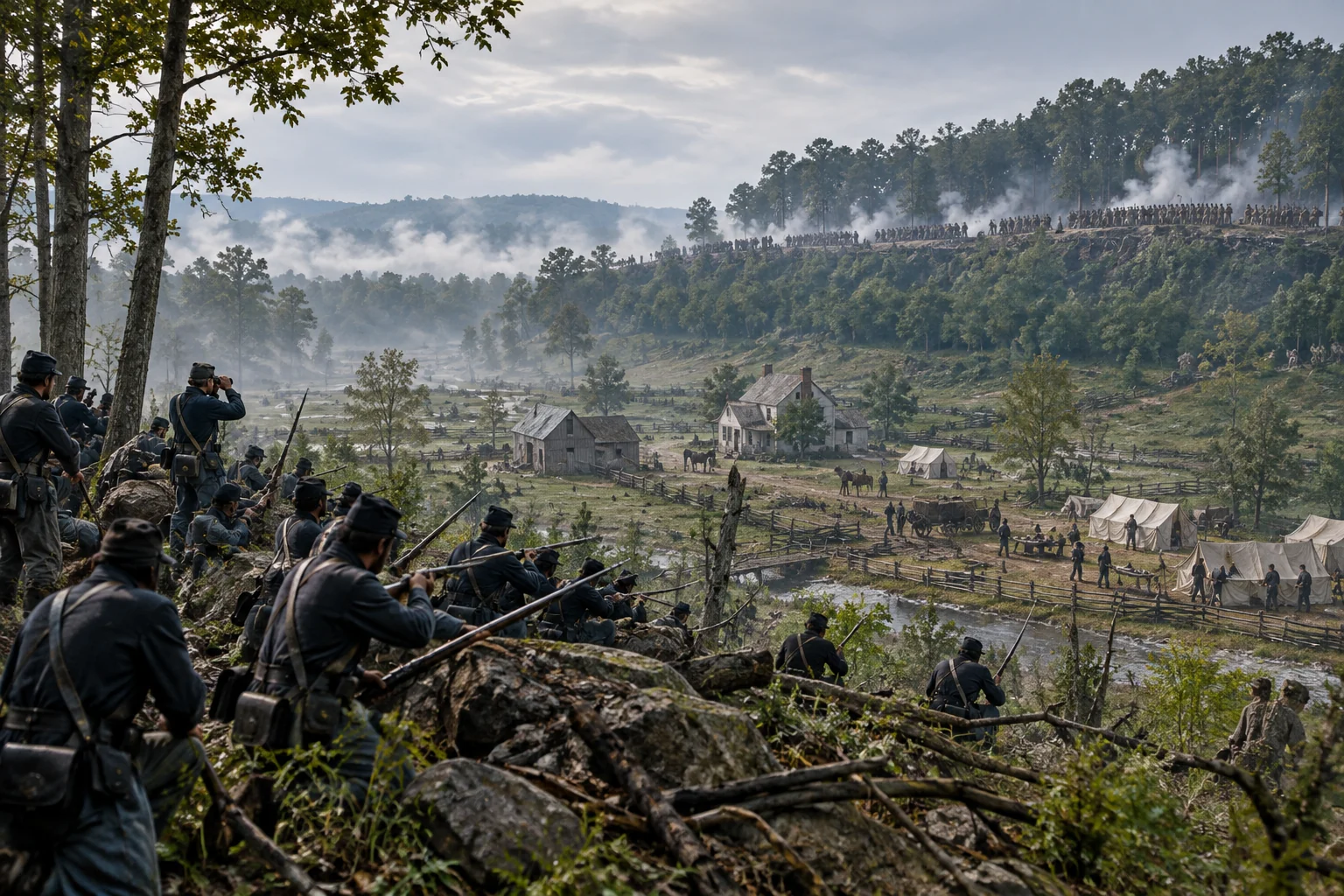
Early Modern Tier 1
Dossier 50 — American Civil War (1861–1865)
Theater: The United States — the Eastern theater (Virginia, Maryland, Pennsylvania), the Western theater (Tennessee, Mississippi, Georgia, the Carolinas), the Trans-Mississippi, and naval blockade operations along the Confederate coast and the Mississippi River. Belligerents: The Union (United States under Abraham Lincoln) vs. the Confederacy (eleven seceded Southern states under Jefferson Davis). Validation tier: Tier 1 (strong) — demographer J. David Hacker's census-based estimate is the named scholarly authority; the traditional 620,000 figure is superseded but still cited.
Overview
The war over slavery's future and the Union's survival, triggered by the secession of Southern states after Lincoln's 1860 election and the Confederate attack on Fort Sumter (April 1861). It became the first industrialized total war: railroads, telegraphs, rifled weapons, ironclads, and mass conscription. Union victory preserved the United States, abolished slavery (Emancipation Proclamation, 1863; Thirteenth Amendment, 1865), and ended at Appomattox (April 1865) after Sherman's march and Grant's overland campaign.
Causes (attributed)
- Slavery: historians treat the expansion and protection of slavery as the central cause of secession (the seceding states' own declarations cite it); the "states' rights" framing is treated in modern scholarship as the mechanism, not the substance.
- Sectional political breakdown: the failure of compromises (Missouri, 1850, Kansas-Nebraska), the Dred Scott decision, and Lincoln's election convinced Southern elites the federal government would strangle slavery.
- Contested: the war's inevitability; the relative weight of economic vs. ideological motives among non-slaveholding Southern soldiers; Lost Cause claims minimizing slavery's role are rejected by mainstream scholarship but persist in popular memory.
Course (brief, neutral)
The Confederacy won early eastern battles (Bull Run/Manassas, 1861); the Union's Anaconda Plan blockaded Southern ports while Grant took the Mississippi corridor (Vicksburg, July 1863) and Lee was repulsed at Gettysburg (July 1863) — the conventional turning point. Grant's 1864 Overland Campaign bled Lee's army in Virginia while Sherman took Atlanta and marched to the sea. Lee surrendered at Appomattox Court House (9 April 1865); Lincoln was assassinated five days later.
Casualties
- J. David Hacker (demographer, Binghamton University): 650,000–850,000 deaths, central estimate about 750,000 — based on census excess male mortality, not battlefield counts. This supersedes the traditional figure as the scholarly standard.
- Traditional figure: about 620,000 military deaths (still widely cited; based on 19th-century muster-roll accounting).
- Distinguish: Hacker's method captures excess deaths including disease and post-service mortality; it is not a count of battle deaths. Confederate records are incomplete, widening the band. Civilian deaths (including enslaved people) are poorly quantified.
Outcome and legacy
- Preservation of the Union; abolition of slavery (Thirteenth Amendment); Reconstruction (1865–1877) and its violent overthrow; the war established federal supremacy and modern American nationalism.
- Legacy: the war remains the central event of American historical memory — battlefield preservation, the Lost Cause myth vs. emancipationist memory, and ongoing disputes over Confederate monuments.
Historiography pulse
- Consensus: slavery as the war's cause; Gettysburg/Vicksburg as the turning point; Hacker's revised death toll as the current scholarly standard.
- Debates: the "needless war" thesis (was slavery's end achievable without war?); Grant vs. Lee generalship; the war as "total war" and its civilian toll in the South; Reconstruction's failure.
- Notable scholarship: J. David Hacker (demographic revision); James McPherson's synthesis. Links were not verified in this research pass.
UNVERIFIED list
- Any precise total (650,000–850,000 is a census-based band).
- Civilian deaths, including among enslaved populations.
- The traditional 620,000 as a complete count (known to undercount).
Sources
- Hacker estimate: https://discovere.binghamton.edu/news/civilwar-3826.html
- Overview: https://www.history.com/articles/american-civil-war-deaths
- Hacker methodology: https://phys.org/news/2011-06-historian-civil-war-dead.pdf