Conflict dossier · #19 of 120
19. An Lushan Rebellion (755–763)
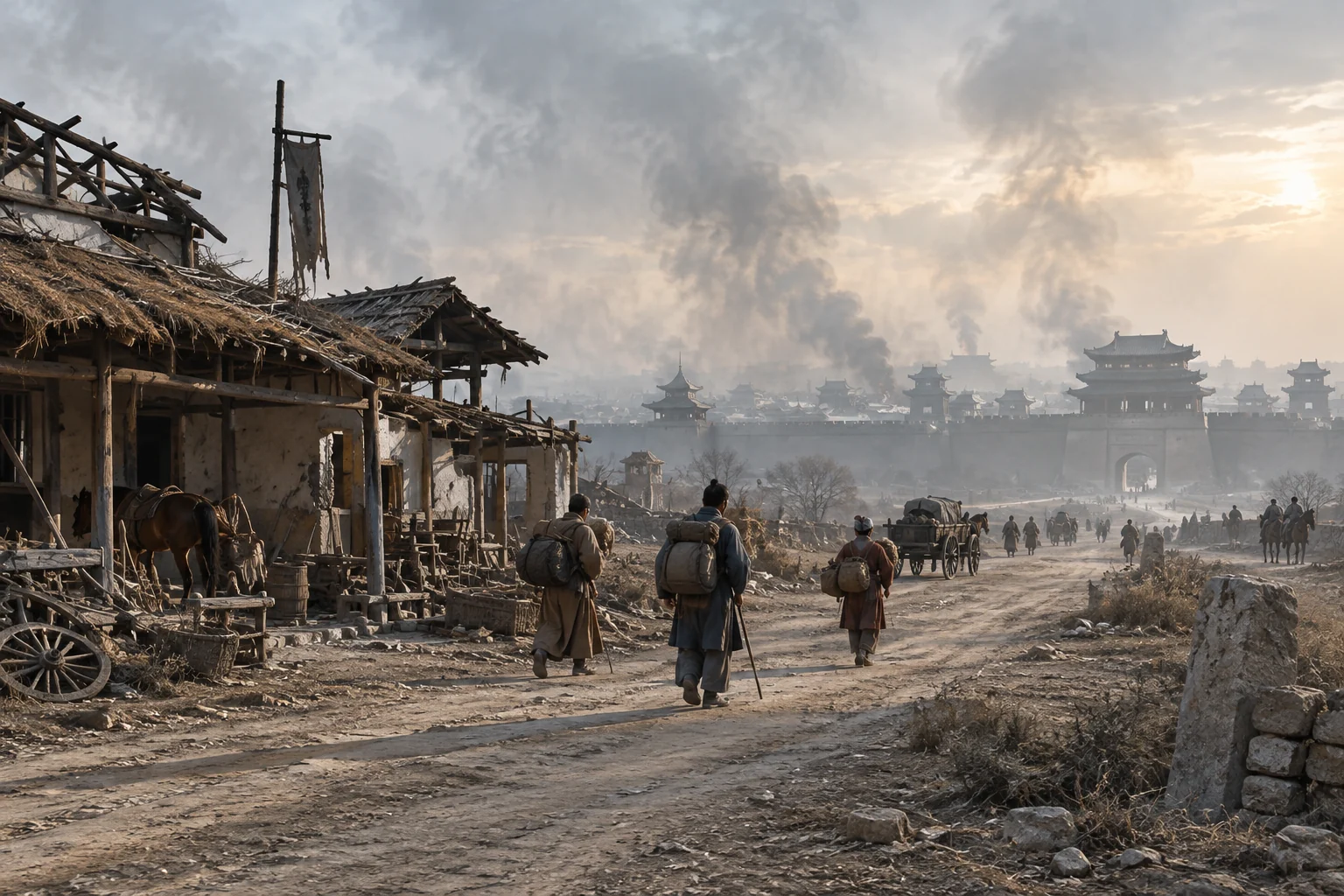
Medieval Tier 2
19. An Lushan Rebellion (755–763)
Overview
- Belligerents: The Tang dynasty (Emperor Xuanzong, then Suzong and Daizong), aided by Uyghur allies, vs. the rebel Yan state founded by the general An Lushan (later Shi Siming).
- Dates: 755–763.
- Theater: Northern and central China; both Tang capitals — Chang'an and Luoyang — fell to the rebels.
- Outcome: Tang victory and restoration, but at the cost of central authority; regional military governors (jiedushi) emerged permanently empowered.
Causes
An Lushan, a general of Sogdian–Turkic origin commanding large frontier armies, combined personal ambition with structural conditions: over-concentration of military power in frontier commands, court factionalism, and the weakening of central control under the aging Xuanzong. Attribution: modern historians treat the rebellion as the product of the Tang military system and court politics rather than a single grievance.
Course
An Lushan rebelled in late 755, proclaimed the Yan dynasty in 756, and seized Luoyang and Chang'an; Xuanzong fled to Sichuan and Yang Guifei was executed at Mawei. An Lushan was murdered by his own son in 757; Shi Siming continued the rebellion until his own assassination in 761. Tang forces, with Uyghur cavalry support, gradually retook the capitals, and the last rebel holdouts were suppressed by 763.
Casualties
- The famous figures are registration data, not death counts: the 755 census recorded 52,919,309 persons; the 764 registration recorded about 16.9 million — a decline of roughly 36 million registered persons.
- Scholars including Hans Bielenstein and Charles Patrick Fitzgerald have criticized literal demographic readings: the gap reflects administrative collapse, tax-registration failure, excluded populations, lost provinces, and mass migration as well as mortality.
- Matthew White revised a popular 36-million toll down to 13 million, but even that remains an estimate.
- Safest treatment: 13–36 million claimed/inferred, UNVERIFIED, with explicit warning that the upper bound conflates missing registrations with deaths.
- UNVERIFIED: any precise death toll; the 36-million figure as a mortality count.
Outcome & Legacy
The rebellion permanently weakened Tang central power, entrenched regional military governors, accelerated economic and demographic shifts toward the south, and ended Tang influence in Central Asia. It is conventionally treated as the turning point from the High Tang to dynastic decline.
Historiography Pulse
- Consensus on the structural significance; ongoing debate on the demographic catastrophe's true scale.
- Bielenstein and Fitzgerald represent the skeptical demographic school.
- Documentaries: general Tang-dynasty documentary coverage; no flagship An Lushan documentary identified — noted as a gap.
- Validation tier: Tier 2 — course, dates, and consequences rest on strong evidence; casualty scale heavily contested.
Sources
- https://en.wikipedia.org/wiki/An_Lushan_rebellion
- https://arxiv.org/pdf/1311.1850v1.pdf
- https://www.degruyter.com/document/doi/10.1515/9789882204638-004/pdf?licenseType=free
- https://openwa.pressbooks.pub/mcleanworldcivilization/chapter/decline-of-the-tang-dynasty/
Images (8 views — files in images/an-lushan-rebellion/)
| File | View |
|---|---|
| 01-hero-battle-art.jpg | Tang battle art (cavalry) |
| 02-theater-map.jpg | Rebellion theater map |
| 03-changan.jpg | Chang'an/Tang Xi'an site |
| 04-armor.jpg | Tang armor and weapons (museum) |
| 05-tomb-figures.jpg | Tang tomb warrior figures |
| 06-yang-guifei.jpg | Yang Guifei (Tang court art) |
| 07-luoyang.jpg | Luoyang / Longmen Grottoes |
| 08-scroll.jpg | Tang scroll painting of soldiers |