Conflict dossier · #46 of 120
Dossier 46 — Anglo-Afghan Wars (1839–1842; 1878–1880; 1919)
Early Modern Tier 2
Dossier 46 — Anglo-Afghan Wars (1839–1842; 1878–1880; 1919)
Theater: Afghanistan — Kabul, Kandahar, Jalalabad, Ghazni; the Khyber and Bolan passes; frontier actions in British India. Belligerents: The British Empire (British and East India Company/Indian Army forces) vs. Afghan rulers and tribal forces — the Barakzai emirs (Dost Muhammad Khan, Sher Ali Khan, Abdur Rahman Khan) and, in 1919, Amanullah Khan's Afghanistan. Validation tier: Tier 2 (moderate) — the 1842 retreat is well documented; Afghan losses and any three-war aggregate are unknown.
Overview
Three wars by which Britain attempted to control Afghanistan as a buffer against Russian influence in Central Asia (the "Great Game"). The First War (1839–1842) ended in the catastrophic British retreat from Kabul; the Second (1878–1880) ended with a British military victory but a political settlement confirming Afghan internal autonomy under British control of foreign policy; the Third (1919) was a brief border war after which Afghanistan regained full control of its foreign affairs.
Causes (attributed)
- Great Game rivalry: British fear of Russian influence in Kabul; the British decision to replace Dost Muhammad with the exiled Shah Shuja (First War); the Russian mission to Kabul and Sher Ali's refusal of a British mission (Second War).
- Frontier security: British India's need for a stable, friendly Afghanistan as a buffer state.
- Contested: whether any of the wars achieved lasting strategic gains; Afghan nationalist historiography treats all three as victories of resistance; British imperial historiography long treated the Second War as a success.
Course (brief, neutral)
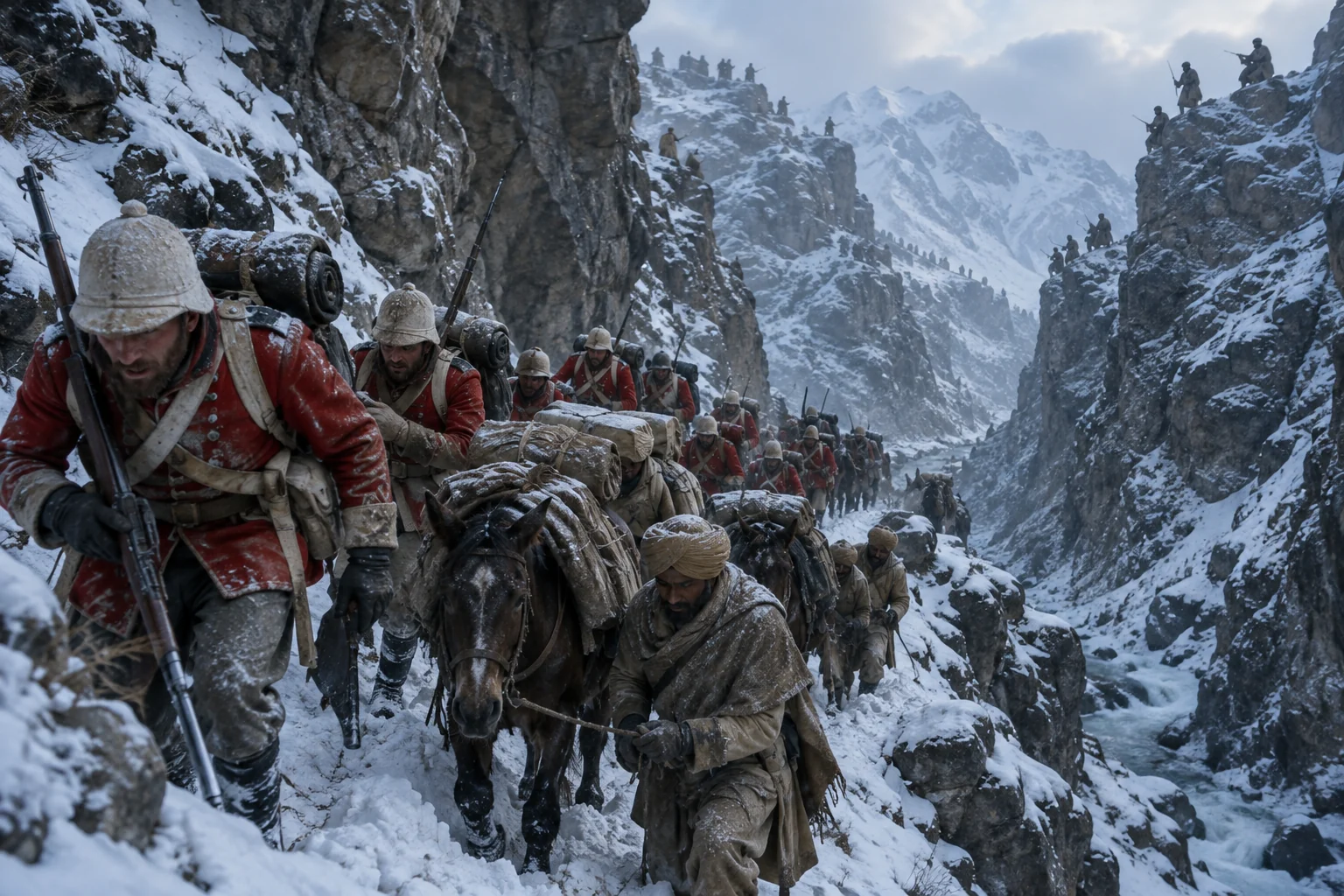
First War: a British-Indian army occupied Kabul (1839) and installed Shah Shuja; the 1841 uprising besieged the garrison, which negotiated a withdrawal; the column of about 4,500 troops and 12,000 camp followers was annihilated in the January 1842 retreat through the passes. A punitive expedition later reoccupied Kabul briefly. Second War: after Sher Ali rejected a British mission, British forces invaded on three axes, occupied Kabul and Kandahar; Abdur Rahman was recognized as emir under the Treaty of Gandamak (1879), which gave Britain control of Afghan foreign policy. Third War (1919): Amanullah invaded British India after seizing the throne; weeks of border fighting ended with the Treaty of Rawalpindi, recognizing Afghanistan's independence in foreign affairs.
Casualties
- First War retreat (1842): the Kabul column comprised roughly 4,500 troops and 12,000 camp followers; not all deaths are directly documented, and some prisoners survived — commonly summarized as near-total annihilation, but precise death counts are UNVERIFIED.
- Second and Third Wars: British/Indian losses are recorded in regimental histories but no consolidated scholarly total surfaced; Afghan military and civilian losses are unknown.
- No three-war aggregate exists in the sources surfaced; any aggregate is UNVERIFIED.
Outcome and legacy
- Afghanistan remained independent but, after 1880, with Britain controlling its foreign relations until 1919; the Durand Line (1893) fixed the Afghan-Indian frontier.
- Legacy: the 1842 retreat became the archetype of imperial disaster in British memory; the wars established Afghanistan's reputation as resistant to foreign occupation — a framing invoked in later conflicts.
Historiography pulse
- Consensus: the First War as a political intelligence failure; the Second as a military success with limited political returns; the Third as the end of British tutelage.
- Debates: the scale of the 1842 catastrophe (survivor counts vary); Afghan vs. British casualty accounting; the Great Game as genuine strategic rivalry vs. imperial paranoia.
- Notable scholarship: links were not verified in this research pass.
UNVERIFIED list
- Precise death toll of the 1842 Kabul retreat (4,500 + 12,000 column size is consistent; deaths not directly documented).
- Afghan losses in all three wars.
- Any combined three-war aggregate.
Sources
- Retreat figures and context: https://web.archive.org/web/20210728032706/https://www.statista.com/chart/25400/military-deaths-in-foreign-interventions-in-afghanistan/
- 19th-century campaigns: https://www.thefreelibrary.com/Fighting+the+Afghans+in+the+19th+century%3A+Bruce+Collins+considers+the...-a081764496
- Overview: https://sprinpub.com/sjahss/article/download/sjahss-2-8-2-10-25/312