Conflict dossier · #35 of 120
Dossier 35 — Anglo-Spanish War (1585–1604)
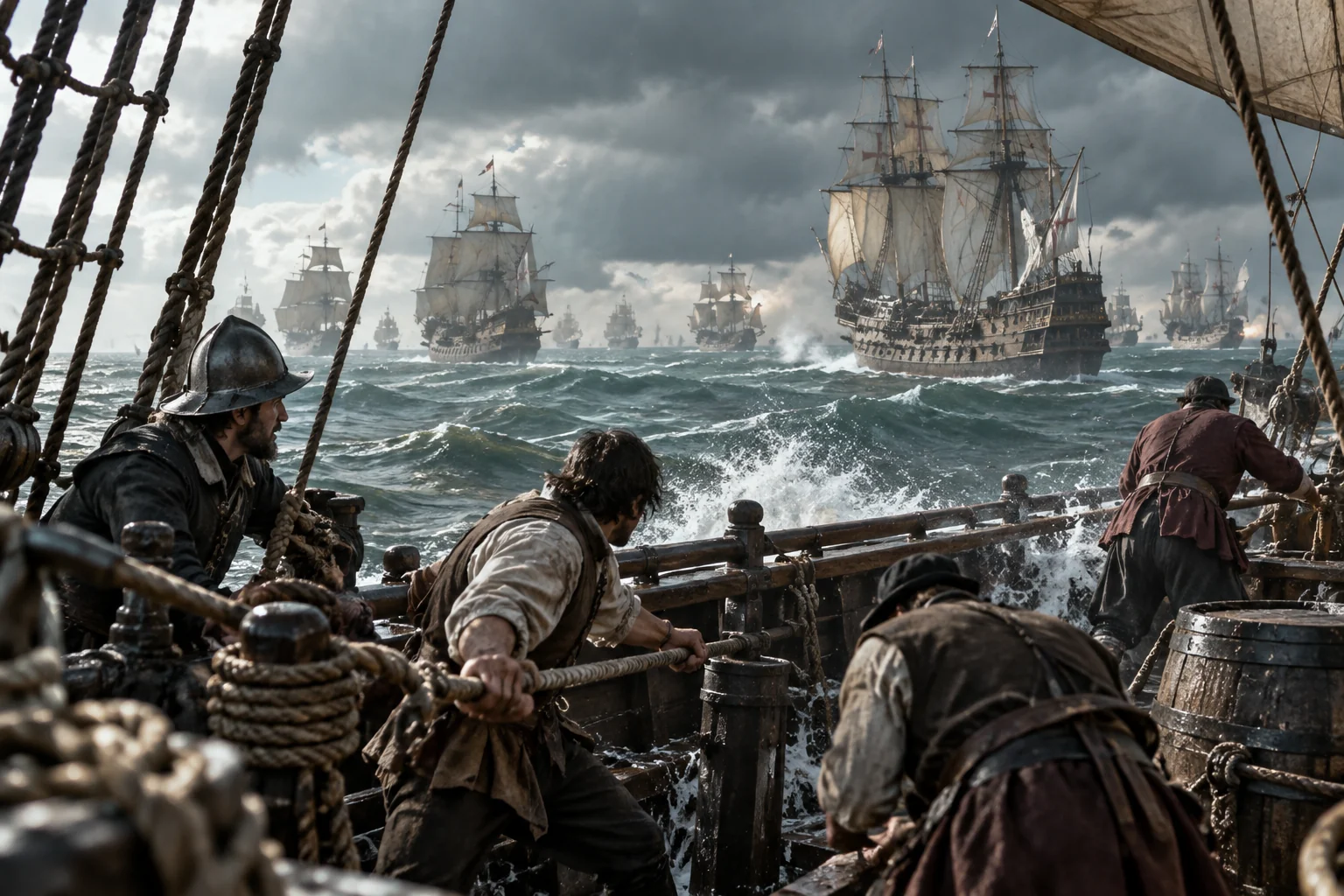
Early Modern Tier 3
Dossier 35 — Anglo-Spanish War (1585–1604)
Theater: The English Channel, the Atlantic, the Caribbean, the Azores, Ireland, and the Spanish Netherlands (naval and privateering war with limited land operations). Belligerents: England (Elizabeth I), with Dutch rebel allies, vs. Habsburg Spain (Philip II, then Philip III). Validation tier: C (low) — no grounded whole-war aggregate; Armada losses are documented; English losses are largely disease-based and poorly quantified.
Overview
An undeclared, then declared, naval and privateering war arising from England's support for the Dutch Revolt, English privateering against Spanish shipping (notably Francis Drake), and religious antagonism. Its set pieces are the Spanish Armada's attempted invasion of England (1588) and the English counter-Armada (1589). It ended with the Treaty of London (1604) under James I — a negotiated stalemate.
Causes (attributed)
- English support for the Dutch Revolt: Elizabeth I's Treaty of Nonsuch (1585) committed English troops to the Netherlands; Spain treated this as an act of war.
- Privateering and trade rivalry: English privateers (Drake's circumnavigation 1577–1580, the raid on Cádiz 1587) attacked Spanish treasure fleets and colonial ports; Spain responded with embargoes on English trade.
- Religion and dynastic politics: Catholic Spain backed plots against Elizabeth (e.g., the Babington Plot, 1586, leading to Mary, Queen of Scots' execution in 1587); Philip II framed the 1588 Armada as a Catholic crusade. Contested: the relative weight of religion vs. commercial-strategic rivalry in Spanish decision-making is debated; neither is presented here as the sole settled cause.
Course (brief, neutral)
Philip II assembled the "Invincible Armada" (c. 130 ships) to escort the Duke of Parma's army across the Channel in 1588. English fireships, gunnery, and storms broke the Armada's formation at Gravelines; the survivors were wrecked around Scotland and Ireland. England's 1589 counter-Armada under Drake and Norris failed with heavy losses. The war continued as a grinding privateering and raiding conflict (English raids on Cádiz 1596; Spanish landings in Ireland culminating at Kinsale, 1601, where the Irish-Spanish force was defeated). Exhaustion on both sides produced the Treaty of London (1604).
Casualties
- Spanish Armada (1588): approximately 11,000–20,000 Spanish dead (from combat, shipwreck, and exposure) — the commonly cited band from secondary sources; precise figures are UNVERIFIED.
- English losses: substantial but poorly quantified; many English sailors died of disease and privation after 1588 rather than in battle. No grounded English whole-war total was found.
- No dependable aggregate for the full 1585–1604 war exists in the sources consulted.
- Do not substitute: Armada losses for whole-war losses; Irish theater deaths are usually counted within the Nine Years' War (1593–1603), not this war.
Outcome and legacy
- The Treaty of London (1604) restored the pre-war status quo: England withdrew support for the Dutch (effectively), Spain accepted English maritime activity; neither side achieved its war aims. Historians generally treat it as a stalemate favoring England's survival.
- Legacy: the Armada's defeat entered English national mythology as providential deliverance ("God blew, and they were scattered" — a commemorative medal inscription, not a contemporary quote of record); in Spain, the war is remembered as part of the wider, costlier struggle against England and the Dutch. Both national traditions have mythologized the 1588 campaign; modern scholarship (e.g., Colin Martin, Geoffrey Parker, The Spanish Armada) stresses logistics and weather over divine intervention.
Historiography pulse
- Consensus: 1588 was a Spanish operational failure, not an English naval triumph in a single decisive battle; the war as a whole was indecisive.
- Debates: the size of the Armada's losses; whether Elizabethan privateering constituted state policy or licensed piracy; the war's place in the "decline of Spain" narrative.
- Notable scholarship: Geoffrey Parker & Colin Martin, The Spanish Armada (revised ed.); Neil Hanson, The Confident Hope of a Miracle. (Links were not verified in this research pass.)
UNVERIFIED list
- Any aggregate death total for the full 1585–1604 war.
- Precise Spanish Armada death toll (11,000–20,000 is the cited band).
- English disease/privateering-campaign deaths (unquantified).
- Irish theater casualty attribution between this war and the Nine Years' War.
Sources
- Casualty grounding searches (the 2026-09-23 research pass): Armada 11,000–20,000 Spanish dead; English disease deaths substantial; 1604 negotiated stalemate.
- Historiography: Parker & Martin, The Spanish Armada (link was not verified in this research pass).
Images
Sources
- Casualty grounding searches (the 2026-09-23 research pass): Armada 11,000–20,000 Spanish dead; English disease deaths substantial; 1604 negotiated stalemate
- Historiography: Parker & Martin, The Spanish Armada (link was not verified in this research pass