Conflict dossier · #58 of 120
Balkan Wars (1912–1913)
20th Century Tier 1
Balkan Wars (1912–1913)
Overview
- Belligerents: First Balkan War (Oct 1912 – May 1913): Greece, Serbia, Montenegro, Bulgaria (the Balkan League) vs. the Ottoman Empire. Second Balkan War (June – July 1913): Bulgaria vs. Greece, Serbia, Romania, and the Ottoman Empire.
- Dates: 8 October 1912 – 18 July 1913 (First Balkan War; Montenegro opened hostilities 8 Oct, others followed; Treaty of London 30 May 1913) and 16 June – 31 July 1913 (Second Balkan War; Treaties of Bucharest, Istanbul, Athens).
- Theater: Balkan Peninsula — Macedonia, Thrace, Albania, Epirus, Dobruja.
Causes — attributed
- Standard academic account (1914-1918-online.net International Encyclopedia of the First World War): the wars resulted from the incomplete emergence of nation-states on Ottoman Europe's territory, rising ethnic nationalism, Ottoman inability to reform or govern satisfactorily, and irredentist claims (Serbia's "Greater Serbia," Bulgarian claims in Macedonia/Thrace).
- Tomasz Lenkiewicz (Annales Universitatis Mariae Curie-Skłodowska, 2024) lists: Ottoman failure to reform; the Empire's "wounded" state after losing Libya to Italy (1911) and Albanian revolts; Great Power quarrels failing to ensure reforms; and oppression of Christian populations driving Balkan states to impose their own solution.
- Scholarship on Young Turk policy (in Yavuz & Blumi, eds., War and Nationalism, 2013): the CUP government was one contributing factor, not the sole cause; the 1908 revolution changed Macedonia's status quo and accelerated Balkan states' war preparations.
- Second Balkan War: triggered by Bulgaria's dissatisfaction with the division of the spoils — Serbia, Greece, and Bulgaria could not agree on Macedonia's partition; Romania joined over Dobruja, and the Ottoman Empire re-entered to recover Edirne/Adrianople.
- Scribd-published research note: Bulgaria's post-1913 shift toward the Central Powers and Serbia's isolation against Austria-Hungary made the wars a direct prelude to the July Crisis of 1914.
Course
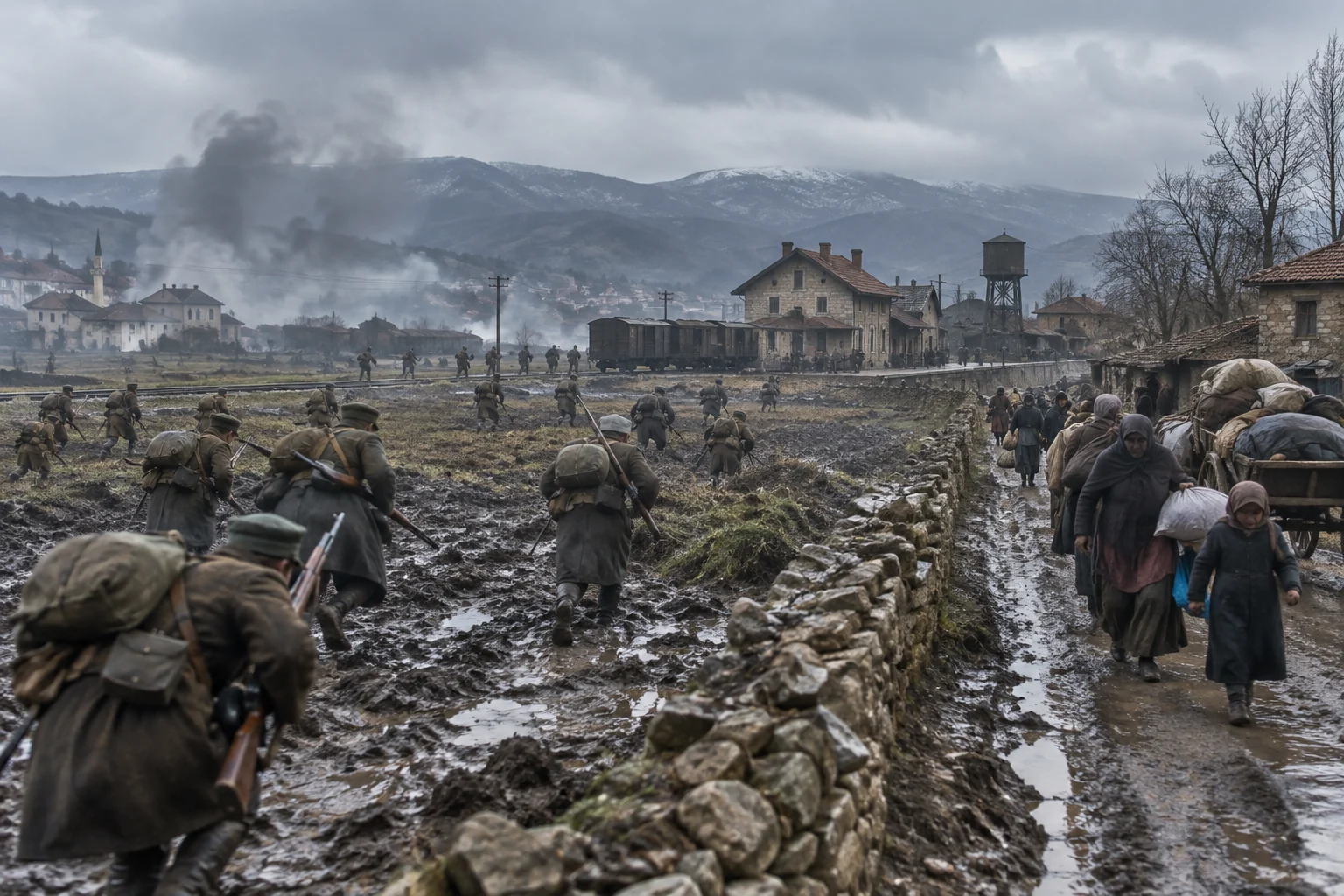
- First Balkan War: the Balkan League mobilized rapidly; Ottoman armies collapsed on three fronts — Bulgaria advanced in Thrace (Kirk Kilisse/Lüleburgaz), Serbia took Kosovo and Macedonia, Greece seized Epirus and Thessaloniki. Montenegro opened the war at Shkodër. An armistice came in December 1912; after the Young Turk coup (January 1913) fighting resumed; Edirne/Adrianople fell to Bulgaria in March 1913. The Treaty of London (30 May 1913) stripped the Ottomans of nearly all European territory west of the Midia-Enos line; Albanian independence was recognized.
- Second Balkan War: on 16 June 1913 Bulgaria attacked its former allies over Macedonia. Serbia and Greece repelled the attacks; Romania invaded from the north; the Ottoman Empire recovered Edirne. Bulgaria sued for peace. Treaties of Bucharest (10 August 1913) and Constantinople/Istanbul (29 September 1913) redrew the map: Bulgaria lost nearly all its First War gains; Serbia gained Vardar Macedonia; Greece gained southern Macedonia and Epirus; Romania gained Southern Dobruja.
Casualties — ranges with named sources
- Richard Hall's synthesis (via Edit Bregu, Academic Journal of Business, Administration, Law and Social Sciences, 2021): First Balkan War — Bulgaria ~14,000 killed, ~19,000 died of epidemics; Greece 5,169 killed; Serbia at least 20,000 killed (fighting and epidemics); Montenegro 2,800 dead. Second Balkan War — Bulgaria ~18,000 killed + ~15,000 died of epidemics; Greece ~2,500 dead; Serbia ~9,000 dead + ~5,000 died of epidemics; Montenegro 240 dead.
- 1914-1918-online.net (International Encyclopedia of the First World War): Bulgarians ~65,000 dead; Greeks 9,500; Montenegrins 3,000; Serbs at least 36,000; Ottomans up to 125,000 dead; "tens of thousands" of civilians died of disease.
- Boris Urlanis (Voini i Narodo-Naselenie Europi, 1960, via Scribd research note): 122,000 killed in action, 20,000 dead of wounds, 82,000 dead of disease across both wars.
- Civilian/deportation figures are heavily contested: Wikipedia's infobox cites 632,000–1,500,000 Ottoman Muslim civilian deaths and ~120,000–270,000 Albanian civilians killed (per Balkan Academia / various scholars); these ranges are politically charged and disputed. Serbian Social Democrat politician Kosta Novaković claimed over 120,000 Albanians killed and 50,000 expelled in 1912–13 (cited in Wikipedia, "Massacres of Albanians in World War I"). These civilian figures are UNVERIFIED — treat as contested.
Outcome & legacy
- The Ottoman Empire lost ~83% of its European territory (excluding Istanbul's immediate hinterland), effectively ending its status as a European great power.
- Serbia emerged nearly doubled in territory and population — the dominant South Slav state; this alarmed Austria-Hungary and drew Russia into unconditional support of Serbia, trapping Russian foreign policy ahead of 1914 (per the Scribd research note).
- The wars introduced "Balkanization" into the political vocabulary and featured ethnic cleansing by all sides; the International Encyclopedia of the First World War notes all parties committed grave atrocities against civilians, "inspired later atrocities including war crimes during the 1990s Yugoslav Wars."
- Set the stage for the July Crisis and WWI: Bulgaria's alignment with the Central Powers, Serbia's emboldenment, and Austria-Hungary's determination to contain Serbia.
Historiography pulse
- Academic consensus: a landmark study point — M. Hakan Yavuz & Isa Blumi (eds.), War and Nationalism: The Balkan Wars, 1912–1913, and Their Sociopolitical Implications (2013); Richard C. Hall, The Balkan Wars 1912–1913: Prelude to the First World War (2000), the standard English-language military history.
- Major debates: (a) the weight of Great Power diplomacy vs. Balkan agency; (b) nationalist historiographies in each Balkan state vs. Ottoman/Turkish accounts; (c) the scale and responsibility for civilian atrocities — figures vary by an order of magnitude and remain the most contested element (Tier 3 within an otherwise Tier 1 dossier).
Validation tier
Tier 1 on causes, course, and outcome (multi-source academic consensus); Tier 3 on civilian casualty and expulsion figures (single-school or politically contested, flagged).
UNVERIFIED points
- Ottoman Muslim civilian deaths: 632,000–1,500,000 — contested, politically charged, unverifiable.
- Albanian civilian deaths (~120,000–270,000) and expulsions (60,000–300,000) — contested between Serbian and Albanian historiographies.
- Exact Ottoman military deaths: estimates range to 125,000 (encyclopedia) vs. Urlanis totals; no single agreed figure.
Sources
- International Encyclopedia of the First World War, "Balkan Wars 1912-1913" — https://encyclopedia.1914-1918-online.net/wp-content/uploads/2023/01/ams/958228/pdf//1914-1918-Online-balkan_wars_1912-1913-2014-10-08.pdf
- Edit Bregu, "A retrospective look at the Balkan wars of 1912-1913" (IIPCCL, 2021) — https://feqd.umb.edu.al/upload/docs/retrospective-look-at-the-balkan-wars-1912-1913.pdf
- Tomasz Lenkiewicz, "Balkanization" article (Annales UMCS, 2024) — http://bc.umcs.pl/Content/49297/czas27923_9_2024_6.pdf
- Yavuz & Blumi (eds.), War and Nationalism — https://www.academia.edu/38870011/M_Hakan_Yavuz_and_Isa_Blumi_Ed_War_and_Nationalism_The_Balkan_Wars_1912_1913_and_Their_Sociopolitical_Implications
- Siti Alwaliyah Mansor et al., "The first Balkan war, 1912-1913: An analysis from British records" — https://www.researchgate.net/publication/328393988_The_first_balkan_war_1912-1913_An_analysis_from_british_records
Images
Sources
- International Encyclopedia of the First World War, "Balkan Wars 1912-1913"
- Edit Bregu, "A retrospective look at the Balkan wars of 1912-1913" (IIPCCL, 2021
- Tomasz Lenkiewicz, "Balkanization" article (Annales UMCS, 2024
- Yavuz & Blumi (eds.), War and Nationalism
- Siti Alwaliyah Mansor et al., "The first Balkan war, 1912-1913: An analysis from British records"