Conflict dossier · #75 of 120
Bangladesh Liberation War (26 March – 16 December 1971)
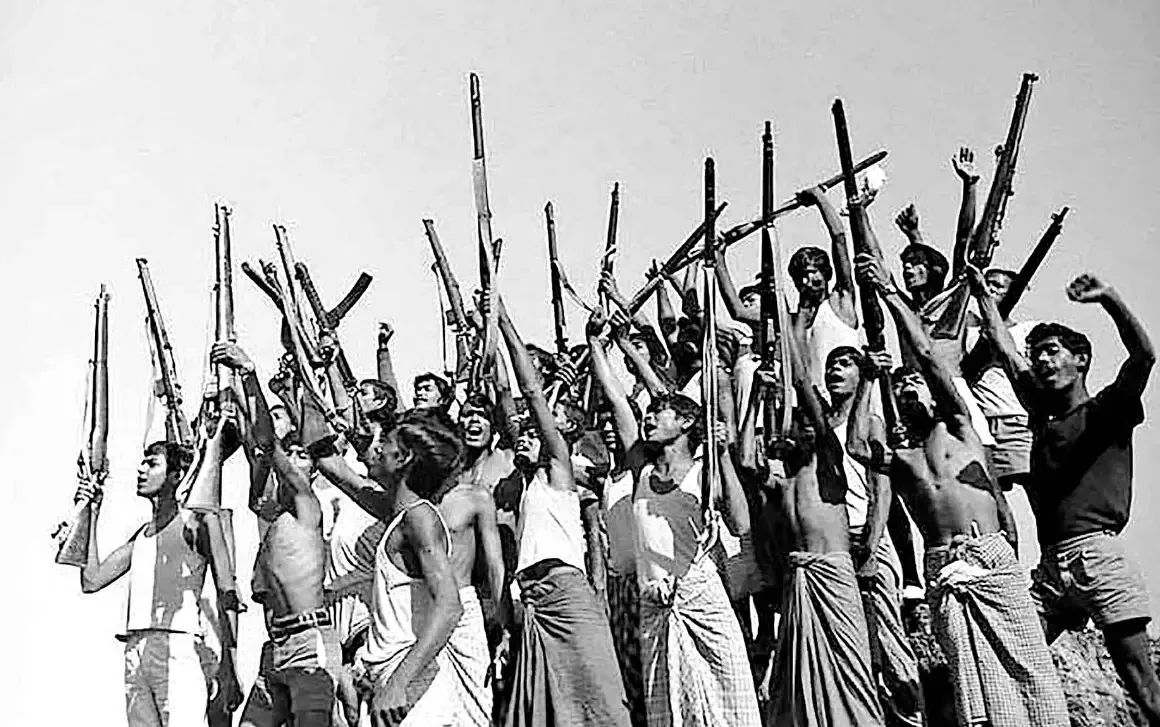
20th Century Tier 2
Bangladesh Liberation War (26 March – 16 December 1971)
Overview
- Belligerents: Pakistani military (under President Gen. Yahya Khan, Eastern commander Lt. Gen. A. A. K. Niazi) and allied paramilitaries (Razakars, Al-Badr, Al-Shams) vs. the Mukti Bahini (Bengali liberation forces) and, from 3 December 1971, the Indian Armed Forces (Eastern Command under Lt. Gen. Jagjit Singh Aurora).
- Theater: East Pakistan (now Bangladesh); concluded with a two-front Indo-Pakistani war.
- Outcome: Decisive Indian/Bangladeshi victory; Pakistani surrender at Dhaka's Race Course on 16 December 1971 (~93,000 POWs); independence of Bangladesh.
Causes (attributed)
- Scholars attribute the war to decades of political and economic domination of East Pakistan by West Pakistan: the Bengali Language Movement, the Six-Point Movement, and the 1970 election in which Sheikh Mujibur Rahman's Awami League won an absolute majority but was denied power — this sequence is the consensus trigger.
- Pakistan's 25 March 1971 "Operation Searchlight" crackdown in Dhaka is documented as the immediate precipitant; Pakistani sources at the time framed it as restoring order against secession, a framing rejected by Bangladeshi and most international scholarship.
- India's intervention is attributed by Indian accounts to the refugee burden (~10 million Bengalis fled to India) and strategic opportunity; Pakistani accounts frame it as pre-planned aggression — the refugee crisis as a humanitarian fact is undisputed.
Course (brief, neutral)
After Operation Searchlight (25–26 March 1971), Bengali officers and soldiers mutinied, forming the Mukti Bahini; a government-in-exile proclaimed independence. Pakistani forces, reinforced, retook the cities by mid-1971 while guerrilla war continued in the countryside; atrocities against Bengali civilians (documented by journalists including Anthony Mascarenhas and Archer Blood's "Blood Telegram") drove millions into India. India trained and armed the Mukti Bahini, then launched a full invasion on 3 December 1971 after Pakistani preemptive air strikes; a 13-day campaign ended with Pakistan's surrender in the East. West Pakistan lost the western-front fighting diplomatically; the Simla Agreement (1972) followed.
Casualties (named sources; heavily contested)
- The death toll is one of the most contested of any 20th-century war.
- Bangladesh's official claim: ~3 million killed (attributed to Sheikh Mujibur Rahman; some allege the figure originated via Soviet press — Karim, Bangladesh's first foreign secretary, alleged the source was Pravda).
- Pakistan's Hamoodur Rahman Commission: ~26,000 civilian casualties (Pakistani official inquiry — widely seen as a low-end outlier).
- R. J. Rummel (Statistics of Democide): ~1.5 million.
- Richard Sisson and Leo Rose: ~300,000 killed by all parties (and they deny a genocide occurred — contested).
- Sarmila Bose (Dead Reckoning, 2011): 50,000–100,000 (highly controversial; strongly criticized by other scholars and journalists).
- Obermeyer/Murray/Gakidou (British Medical Journal, 2008): 125,000–505,000 civilians, based on demographic methods; notes this exceeds Uppsala/PRIO's 58,000.
- Sydney Schanberg (reporting January 1972): foreign diplomats and independent observers estimated "several hundred thousand to more than a million."
- Sexual violence: 200,000–400,000 women raped (widely cited range; exact figure UNVERIFIED).
- Refugees: 8–10 million fled to India (consensus figure).
- Working range used here: ~300,000 to 3 million total deaths; no settled figure. Present only as a contested range.
Outcome & legacy
- Bangladesh became independent; Mujib became its founding leader (assassinated 1975).
- Pakistan lost over half its population; the defeat discredited the military and led to Zulfikar Ali Bhutto's civilian rule and the 1973 constitution.
- India emerged as the region's dominant power; the war's refugee crisis shaped international humanitarian norms.
- The genocide question remains politically live: Bangladesh's International Crimes Tribunal (from 2010) prosecuted 1971-era collaborators; Pakistan officially disputes the genocide characterization.
Historiography pulse
- Academic consensus: a massive, systematic campaign of killing and sexual violence by the Pakistani military and allied militias occurred in 1971; the scale is debated, not the fact.
- Major debates: the death toll (300k vs. 3M camps, with demographic studies landing mid-range); whether "genocide" is the correct legal/historical term (Donald Beachler's 2007 Patterns of Prejudice article surveys this); the role and culpability of Bengali reprisals against Biharis.
- Notable works: Anthony Mascarenhas, The Rape of Bangla Desh (1971, contemporary reportage); Gary Bass, The Blood Telegram (2013, on U.S. policy); Sarmila Bose, Dead Reckoning (2011, controversial revisionist); the film/documentary record and the Liberation War Museum, Dhaka.
Validation tier
Tier 2 — strong multi-source evidence for the war's course, atrocity pattern, and outcome; casualty figures Tier 3 (heavily contested, no systematic count). Flagged as contested throughout.
UNVERIFIED points
- Total death toll (range 300,000–3,000,000; each endpoint contested).
- The 3-million figure's provenance (official Bangladeshi claim; scholarly basis disputed).
- Rape statistics (200,000–400,000 — order-of-magnitude range, not a count).
- Pakistani military's internal decision-making (Hamoodur Rahman Commission is the main source and is seen as self-exculpatory).
Sources
- Donald Beachler, "The politics of genocide scholarship: the case of Bangladesh," Patterns of Prejudice 41(5), 2007: https://cbgr1971.org/files/AcademicArticlesGenocide/politicsGenocideBangladeshcbgr.pdf
- Refugee mortality study (Open University): https://oro.open.ac.uk/103699/3/103699.pdf
- Reference.org Bangladesh genocide summary: https://reference.org/facts/bangladesh_genocide/8RVUvjea
- Medium summary of Rummel/Sisson-Bose debate: https://medium.com/@in-tasin/1971-the-forgotten-genocide-of-bangladesh-fb1fd4b2ebb9