Conflict dossier · #31 of 120
31. Byzantine–Ottoman Wars to the Fall of Constantinople (1299–1453)
Medieval Tier 1
31. Byzantine–Ottoman Wars to the Fall of Constantinople (1299–1453)
Overview
- Belligerents: The Byzantine Empire (Palaiologan dynasty) — at times allied with or against Serbs, Bulgarians, Venetians, Genoese, Hungarians, and various Anatolian beyliks — vs. the Ottoman beylik/empire under Osman I, Orhan, Murad I, Bayezid I, and Mehmed II. Phase-by-phase third parties: Catalan Company (early 1300s), Timur (1402 intervention), crusader coalitions (Nicopolis 1396, Varna 1444).
- Dates: c. 1299 (Osman's emergence; Battle of Bapheus dated 1299 or 1302 — contested) – 29 May 1453 (fall of Constantinople).
- Theater: Northwestern Anatolia (Bithynia), the Balkans (Thrace, Macedonia, Serbia, Bulgaria, Greece), the Aegean, and Constantinople itself.
- Outcome: Complete Ottoman victory; extinction of the Byzantine Empire; Constantinople becomes the Ottoman capital (Istanbul).
Causes
Structural drivers identified by modern Ottomanists: Ottoman possession of the Anatolian-Balkan frontier nearest Constantinople; Byzantine civil wars (1341–1347, 1352–1357) in which both sides hired Ottoman troops as mercenaries, handing the Ottomans Gallipoli (1354) and a permanent European bridgehead; the Black Death (1347) weakening Byzantine manpower and revenues; and Venice/Genoa prioritizing trade with the Ottomans over crusade. Ideological legitimation on the Ottoman side is debated: the classic "ghaza thesis" (Paul Wittek — the early Ottomans as ghazis, warriors of the faith) has been substantially revised by scholars such as Rudi Lindner and Heath Lowry, who argue early Ottoman expansion was driven by tribal politics, plunder, and Byzantine frontier collapse more than holy war. Attribution: ghaza framing is the later Ottoman dynastic tradition and Wittek's 1930s interpretation; the revision is modern scholarship, still contested.
Course
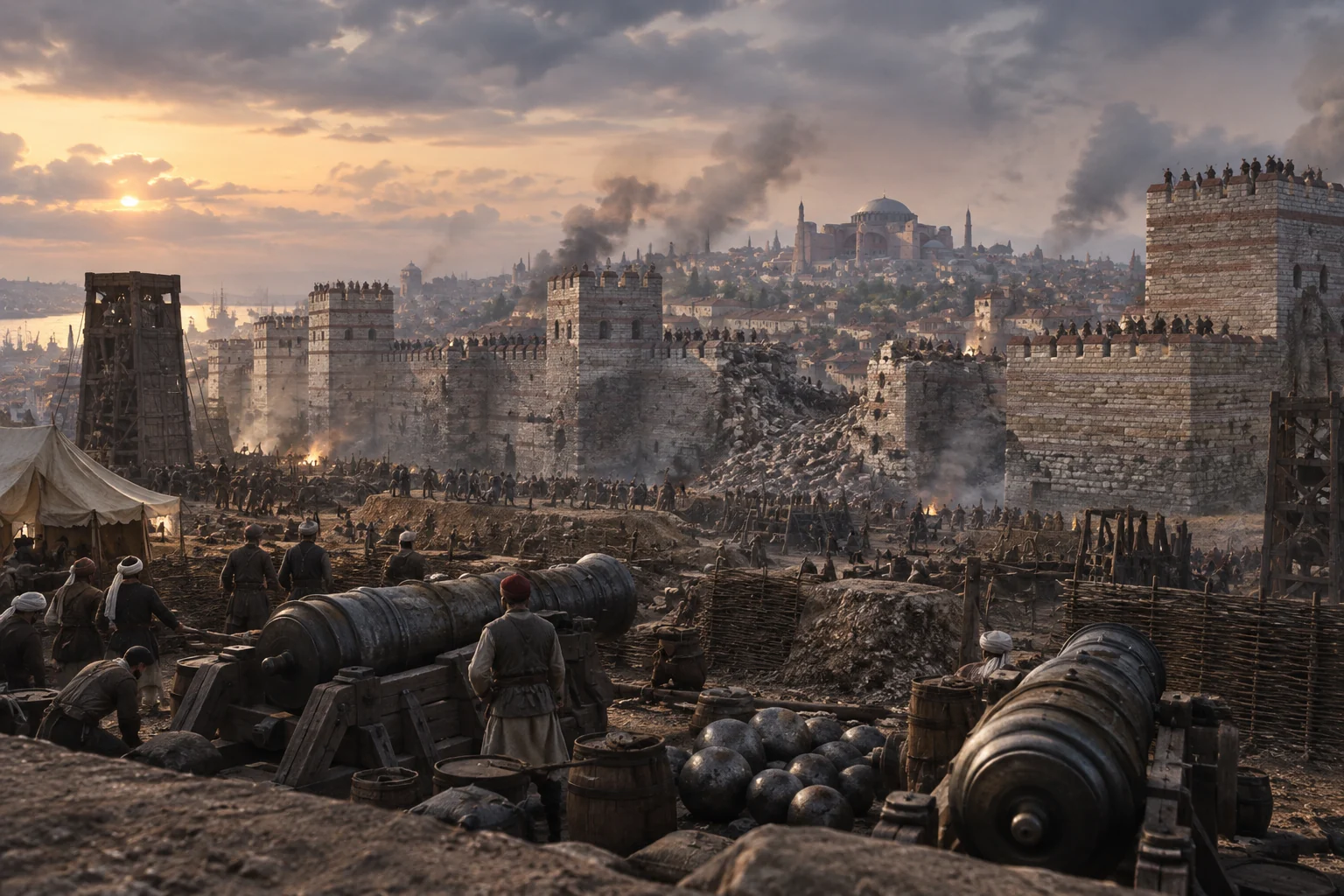
Bapheus (1299 or 1302, date contested): Osman's defeat of a Byzantine force — the emergence marker of the Ottoman state. Orhan takes Bursa (1326) and Nicaea (1331); Pelekanon (1329) ends Byzantine field armies in Asia. Gallipoli (1354) gives the Ottomans Europe. Kosovo (1389): Murad I killed but Serbian power broken. Bayezid besieges Constantinople (1394–1402) until Timur crushes him at Ankara (1402), plunging the Ottomans into the Interregnum (1402–1413) — Byzantium's reprieve. Murad II resumes pressure; crusades fail at Nicopolis (1396) and Varna (1444). 1453: Mehmed II's 53-day siege (6 April – 29 May) with massive cannon; Constantine XI dies in the final assault. Byzantine remnants (Morea 1460, Trebizond 1461) fall shortly after.
Casualties
- The 1453 siege: tertiary sources give ~4,000 Byzantine military dead and ~10,000 civilian dead, with Ottoman losses unknown (sources: medievalchronicles.com; thechroniclesofhistory.com). Defenders numbered ~7,000 against ~80,000 Ottomans (smartechmolabs.com). These figures rest on the contemporary accounts of George Sphrantzes, Doukas, and Kritovoulos — partisans on both sides.
- UNVERIFIED: aggregate casualties across 154 years of intermittent war; the exact date of Bapheus (1299 vs 1302) — revive the 1299 dating via a 2017 re-reading of Pachymeres, but consensus is unsettled (see IJHSS 2017 study).
- The plague of 1346–1347 killed "most of the city's population" (medievalchronicles.com) — a non-battle demographic catastrophe intertwined with the war's course.
Outcome & Legacy
End of the Byzantine Empire (and, conventionally, of the Middle Ages in European periodization); the Ottomans become a transcontinental empire; Greek scholars fleeing to Italy are credited by traditional historiography with fueling the Renaissance; disrupted overland trade routes are linked to the European push for sea routes to Asia. Hagia Sophia converted to a mosque; the Greek Orthodox Church retained under Ottoman millet administration (Gennadius Scholarius appointed patriarch).
Historiography Pulse
- Steven Runciman's The Fall of Constantinople 1453 (1965) remains the classic narrative; revisionist Ottomanists (Colin Imber, Heath Lowry, Rudi Lindner) have dismantled the ghaza thesis and the 1299 founding orthodoxy's certainty.
- The Bapheus dating debate (1299 Gibbon vs. 1302 von Hammer-Purgstall, with a 2017 reassessment reviving 1299) exemplifies how thin the early Ottoman source base is — Ottoman origins rest almost entirely on Byzantine chroniclers (Pachymeres) and much later Ottoman dynastic traditions.
- Turkish national historiography treats 1299 as the founding year of the Ottoman state; the contested dating matters to national commemoration.
- Documentaries: general Ottoman-rise/1453 documentary coverage; no single flagship documentary identified — noted as a gap.
- Validation tier: Tier 1 for the war's course and outcome; Tier 2 for the early phase (1299–1330, thin sources, contested dating) and casualty figures.
Sources
- https://en.wikipedia.org/wiki/Battle_of_Bapheus
- https://ijhssnet.com/journals/Vol_7_No_8_August_2017/4.pdf (2017 study reviving the 1299 Bapheus dating via Pachymeres)
- https://www.thoughtco.com/byzantine-ottoman-wars-fall-of-constantinople-2360739
- https://www.medievalchronicles.com/medieval-history/medieval-history-periods/byzantine-empire/fall-of-constantinople/
- http://thechroniclesofhistory.com/2018/12/22/the-fall-of-constantinople-the-fifty-seven-day-siege-1453/
- https://smartechmolabs.com/the-fall-of-constantinople-1453/
- https://medium.com/@home912944/the-siege-of-constantinople-the-battle-that-changed-history-f467500c905d
Images (8 views — files in images/byzantine-ottoman-wars/)
| File | View |
|---|---|
| 01-hero-theodosian-walls.jpg | Theodosian Walls, Constantinople/Istanbul (tasteful hero) |
| 02-theater-map.jpg | Theater map: Byzantine vs Ottoman territory 1299–1453 |
| 03-siege-1453-miniature.jpg | Contemporary miniature of the 1453 siege |
| 04-hagia-sophia.jpg | Hagia Sophia |
| 05-mehmed-ii-portrait.jpg | Mehmed II portrait (Bellini tradition) |
| 06-rumeli-hisari.jpg | Rumeli Hisarı fortress |
| 07-galata-tower.jpg | Galata Tower / Golden Horn |
| 08-manzikert-battlefield.jpg | Manzikert battlefield (1071 context site) |