Conflict dossier · #62 of 120
Chaco War (1932–1935)
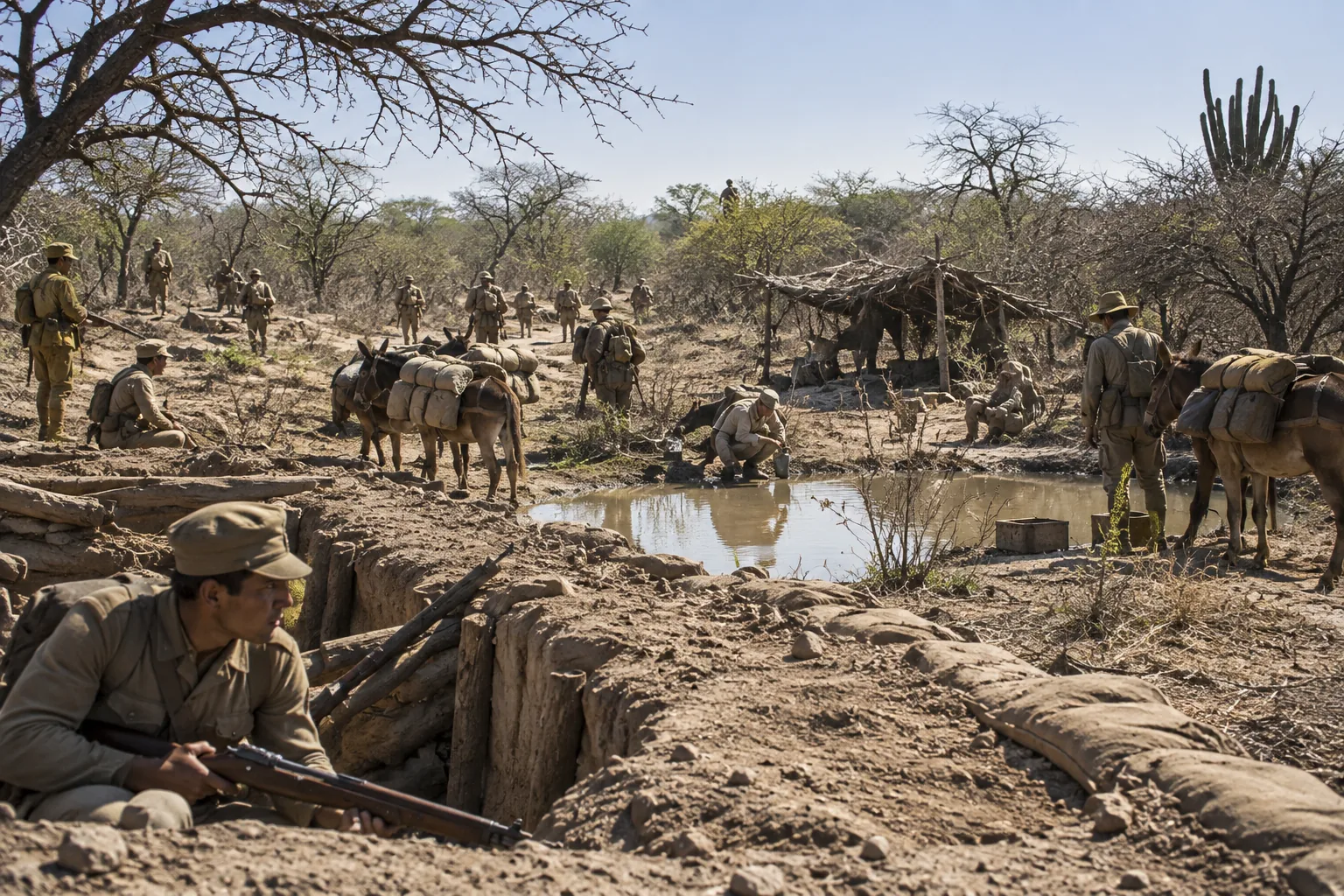
20th Century Tier 1
Chaco War (1932–1935)
Overview
- Belligerents: Bolivia (led by President Daniel Salamanca) vs. Paraguay (led by President Eusebio Ayala; commander General José Félix Estigarribia)
- Dates: 1932–1935; armistice 12/14 June 1935; peace treaty signed in Buenos Aires 1938 (approved by Paraguayan referendum)
- Theater: Gran Chaco Boreal — arid scrubland, swamps, and thorny forest between the Pilcomayo River and the Paraguay River
Causes — attributed
- General historical consensus (globalsecurity.org; war-memorial.net): a border dispute over the Chaco Boreal dating to the mid-19th century, escalated by Bolivia's post-War of the Pacific (1883) desire for Atlantic access via the Paraguay River, and speculation over oil deposits (Standard Oil discoveries in Bolivia; Royal Dutch Shell interest in Paraguay).
- Popular Bolivian belief (attributed, not established): US and British corporate interests — Standard Oil (Bolivia side) and Royal Dutch Shell (Paraguay side) — backed the war. globalsecurity.org states explicitly: "Historians have still to uncover definitive proof to support this popular Bolivian conspiracy theory." This dossier presents it as a widely held belief, not a verified cause.
- Proximate triggers (guidebolivia.com): fortified lines and frequent border incidents in the 1920s; President Salamanca's 1931 decision to reinforce Bolivian troops; a Bolivian patrol's seizure of Fort Carlos López in June 1932 and the escalating retaliation cycle. war-memorial.net dates the outbreak to Salamanca's order to attack the Paraguayan garrison at Vanguardia in 1932.
- The war has been called a "South American version of World War I" for its trench warfare and battleground conditions (Cynthia R. Rush, Executive Intelligence Review, via Scribd).
Course
Bolivia, confident its 3 million population could overwhelm Paraguay's 800,000, attacked in 1932. Paraguayan forces under Estigarribia — adapted to the Chaco climate — won at Boquerón (September 1932) and Campo Grande, captured Bolivian forts, and pushed west. Bolivia cycled through commanders (Kundt, Peñaranda). Despite numerical superiority, Bolivian altiplano conscripts suffered from heat, disease, and thirst. After Paraguay's near-capture of the Bolivian oil fields at Ingavi (June 1935), a neutral-nations commission (Argentina, Brazil, Chile, Colombia, Peru, the US) secured the armistice (June 1935); two years of negotiations produced the 1938 Buenos Aires peace treaty.
Casualties — ranges with named sources
- thefreelibrary.com (La Guerra del Chaco, citing historians): 50,000–80,000 Bolivian dead; 30,000–50,000 Paraguayan dead. "Two Paraguayans and three Bolivians died for each square mile" of the Chaco.
- war-memorial.net: 92,661 battle deaths.
- issr.ungjournals.org (Chesterton review): ~92,000 Bolivians and Paraguayans lost their lives.
- globalsecurity.org: "nearly 100,000 men died."
- guidebolivia.com: 55,000 Bolivians and 35,000 Paraguayans died.
- commonplacefacts.com (2025): Bolivia 56,000–65,000 dead (~2% of population); Paraguay ~36,000 dead (~3% of population).
- Cynthia R. Rush (EIR, via Scribd): 52,000 Bolivians and 40,000 Paraguayans.
Outcome & legacy
- Paraguay retained ~three-quarters of the Chaco (about 20,000 sq. miles / 52,000 sq. km); Bolivia gained navigation rights on the Paraguay and Paraná rivers.
- The war bankrupted both governments and devastated a generation — Bolivia's and Paraguay's combined losses were proportionally among the worst of any 20th-century war relative to population.
- Cultural legacy: the war bolstered the Guaraní language's status in Paraguay (constitutional equality with Spanish) and the rehabilitation of Francisco Solano López in Paraguayan historiography (Chesterton review, issr.ungjournals.org).
- The Chaco War discredited Bolivia's military and political elite, contributing to later instability; for Paraguay it became a defining national trauma and pride.
Historiography pulse
- Academic consensus: a border-sovereignty war driven by nationalism and resource speculation; the oil-company conspiracy theory is widely believed but unproven.
- Major debates: (a) the actual role of Standard Oil and Royal Dutch Shell — "definitive proof" still lacking (globalsecurity.org); (b) whether the war was primarily about oil or about national honor and river access; (c) Paraguayan vs. Bolivian national historiographies of victory/blame.
- Notable scholarship: Bruce W. Farcau, The Chaco War (1996), the standard English military history; David Zook, The Conduct of the Chaco War (1960); Chesterton's work on the Chaco frontier in Paraguayan identity.
Validation tier
Tier 1 on causes (disputed oil-theory noted as unproven), course, outcome; Tier 2 on casualties (convergent ~90,000–100,000 total band across named sources, ranges preserved).
UNVERIFIED points
- The Standard Oil/Royal Dutch Shell orchestration theory: no definitive proof; UNVERIFIED as a cause.
- Exact death tolls: ranges of 92,000–100,000 total; no single authoritative figure.
Sources
- globalsecurity.org, "Chaco War 1932-1935" — https://www.globalsecurity.org/military/world/war/chaco-war.htm
- war-memorial.net, "Chaco War" — https://www.war-memorial.net/Chaco-War-3.72
- guidebolivia.com, "The war of Chaco" — https://www.guidebolivia.com/divers/histoire/gb_chaco.htm
- The Free Library, "La Guerra del Chaco: fighting in El Infierno Verde" — https://www.thefreelibrary.com/La+Guerra+del+Chaco:+fighting+in+El+Infierno+Verde:+Part+II:+tanks,...-a0371469811
- Chesterton review (ISSR, Ung Journals) — https://issr.ungjournals.org/articles/510/files/63d77ee0518ca.pdf
- Commonplace Fun Facts, "The Chaco War" (2025) — http://commonplacefacts.com/2025/12/10/chaco-war-postage-stamp/