Conflict dossier · #48 of 120
Dossier 48 — Crimean War (1853–1856)
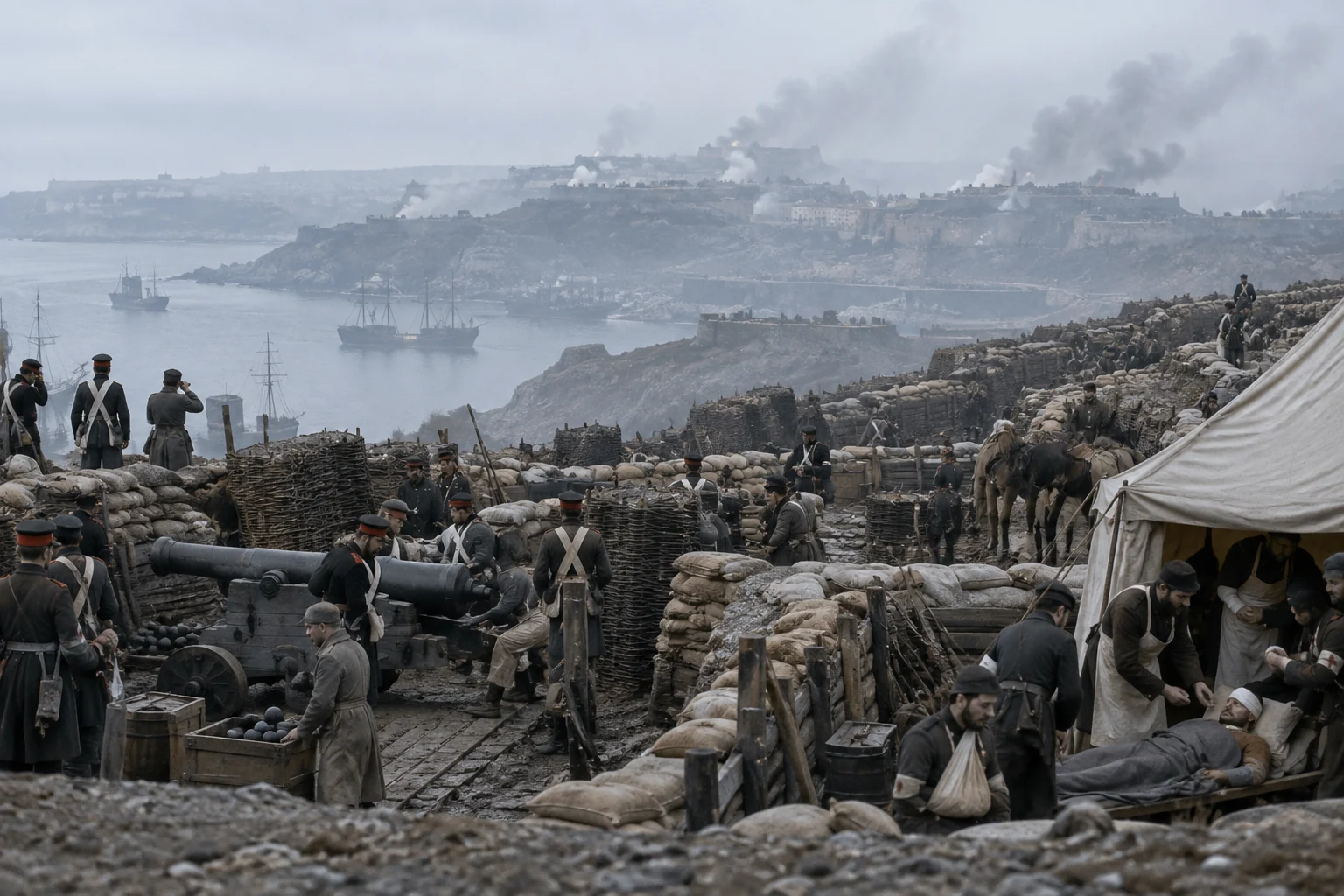
Early Modern Tier 1
Dossier 48 — Crimean War (1853–1856)
Theater: The Crimean Peninsula (Sevastopol, Balaklava, Inkerman, the Alma), the Danubian principalities, the Caucasus, the Baltic Sea, the White Sea, and the Pacific (Petropavlovsk). Belligerents: The Russian Empire vs. an alliance of the Ottoman Empire, the French Empire, the British Empire, and the Kingdom of Sardinia (from 1855). Validation tier: Tier 1 (strong) — named historian John Sweetman gives per-belligerent death figures; Russian totals remain disputed across a wide band.
Overview
The war began as a Russo-Ottoman conflict over the Danubian principalities and the Sultan's Christian subjects; Britain and France joined in March 1854 to check Russian power. After early Danubian and Caucasian fighting, the Allies invaded the Crimea, won the Alma (September 1854), and settled into the siege of Sevastopol — the war's center. The war ended with the Treaty of Paris (1856): Russia lost the Danube delta and southern Bessarabia, the Black Sea was neutralized, and the Ottoman Empire's integrity was guaranteed. Disease killed far more than battle on all sides.
Causes (attributed)
- Eastern Question: Russia's claim to protect Orthodox Christians in the Ottoman Empire and its occupation of the Danubian principalities (1853) threatened the European balance (fsmitha.com).
- Anglo-French strategic fears: Britain feared Russian pressure on the route to India; France under Napoleon III sought prestige and Catholic protectorate rights.
- Contested: the war's necessity — some historians treat it as a war of miscalculation (the Vienna settlement's failure); the "religious" trigger (the Holy Places dispute) vs. great-power rivalry as the real driver.
Course (brief, neutral)
Russia occupied the Danubian principalities (1853); the Ottomans declared war; the Russian destruction of the Ottoman fleet at Sinope (November 1853) brought Britain and France in. The Allies landed in the Crimea (September 1854), won the Alma, then besieged Sevastopol for nearly a year — flanked by the battles of Balaklava (the Charge of the Light Brigade, October 1854) and Inkerman (November 1854). Sevastopol fell in September 1855 after the French captured the Malakoff. Nicholas I died (March 1855); Alexander II sought peace. The Treaty of Paris was signed in March 1856.
Casualties
- John Sweetman, The Crimean War (Osprey, 2001), p. 89 (cited in PMC article): Britain 21,097 dead; France more than 100,000 dead; Turkey — casualties not clear; Sardinia 2,050 dead; Russia a minimum 110,000 dead.
- Russian total (disputed band): estimates range from about 143,000 dead (Clodfelter-style low) to 450,000–522,000+ dead in higher compilations; one compilation gives 630,000 dead. The spread reflects different inclusions of disease deaths.
- Ottoman losses: commonly cited at roughly 45,400 dead (compilation), but Ottoman record-keeping was poor — treat as provisional.
- Distinguish: in all cases disease deaths vastly exceeded battle deaths (e.g., French: 20,240 combat vs. 75,375 non-combat deaths in the compilation).
Outcome and legacy
- Treaty of Paris (1856): Russia ceded the Danube delta and southern Bessarabia, abandoned the protectorate claim, and accepted Black Sea neutralization (no warships or fortifications); the Ottoman Empire was admitted to the European concert.
- Legacy: the war exposed Russian backwardness and prompted Alexander II's Great Reforms (including the 1861 emancipation of the serfs); it professionalized nursing (Florence Nightingale), pioneered war photography (Roger Fenton) and war correspondence (William Howard Russell), and introduced the Victoria Cross.
Historiography pulse
- Consensus: disease as the war's great killer; the siege of Sevastopol as the decisive operation; the war as a logistical and medical catastrophe for all sides.
- Debates: the true Russian death toll (110,000 vs. 450,000+); whether the war achieved anything commensurate with its cost; the "blundering" British command narrative vs. revisionist defenses.
- Notable scholarship: John Sweetman, The Crimean War (Osprey, 2001). Links were not verified in this research pass.
UNVERIFIED list
- The high-end Russian totals (450,000–630,000) — inclusion criteria unclear.
- Ottoman death totals (poor records).
- Civilian deaths, including the displacement of nearly 200,000 Crimean Tatars (displacement documented; deaths not counted).
Sources
- Sweetman figures via PMC: https://pmc.ncbi.nlm.nih.gov/articles/PMC5554787/
- Overview: https://en.wikipedia.org/wiki/Crimean_War
- Narrative: http://www.fsmitha.com/h3/h38-br6.htm
- British account: https://historion.net/great-britain-and-her-queen/chapter-iv-crimean-war
Images
Sources
- Sweetman figures via PMC
- Overview
- Narrative
- British account