Conflict dossier · #14 of 120
Dacian Wars (101–106 CE)
Ancient Tier 1
Dacian Wars (101–106 CE)
Overview
- Belligerents: the Roman Empire under Trajan (16 legions plus auxiliaries and allied Iazyges, Marcomanni, Quadi) vs. the Dacian kingdom under Decebalus, with Roxolani, Buri, and Bastarnae allies.
- Dates: First Dacian War 101–102 CE; Second Dacian War 105–106 CE. (Domitian's earlier Dacian war, 86–88 CE, ended in an unsatisfactory peace with subsidies to Decebalus — the background grievance.)
- Theater: Dacia — the Carpathian basin (modern Romania), across the Danube from Moesia.
Causes — attributed
- Cassius Dio (writing a century later) presents Trajan's motive as ending the humiliation of Domitian's subsidized peace and seizing Dacia's gold (the Roșia Montană mines).
- Modern scholars (e.g., the Trajan's Column scholarship; Ioana Oltean) agree on mixed motives: Dacia's wealth, Decebalus's treaty-breaking and harboring of deserters, and Trajan's need for a legitimizing military achievement early in his reign. The Column's narrative — the authoritative visual source — is imperial propaganda presenting a war of justified retribution.
Course
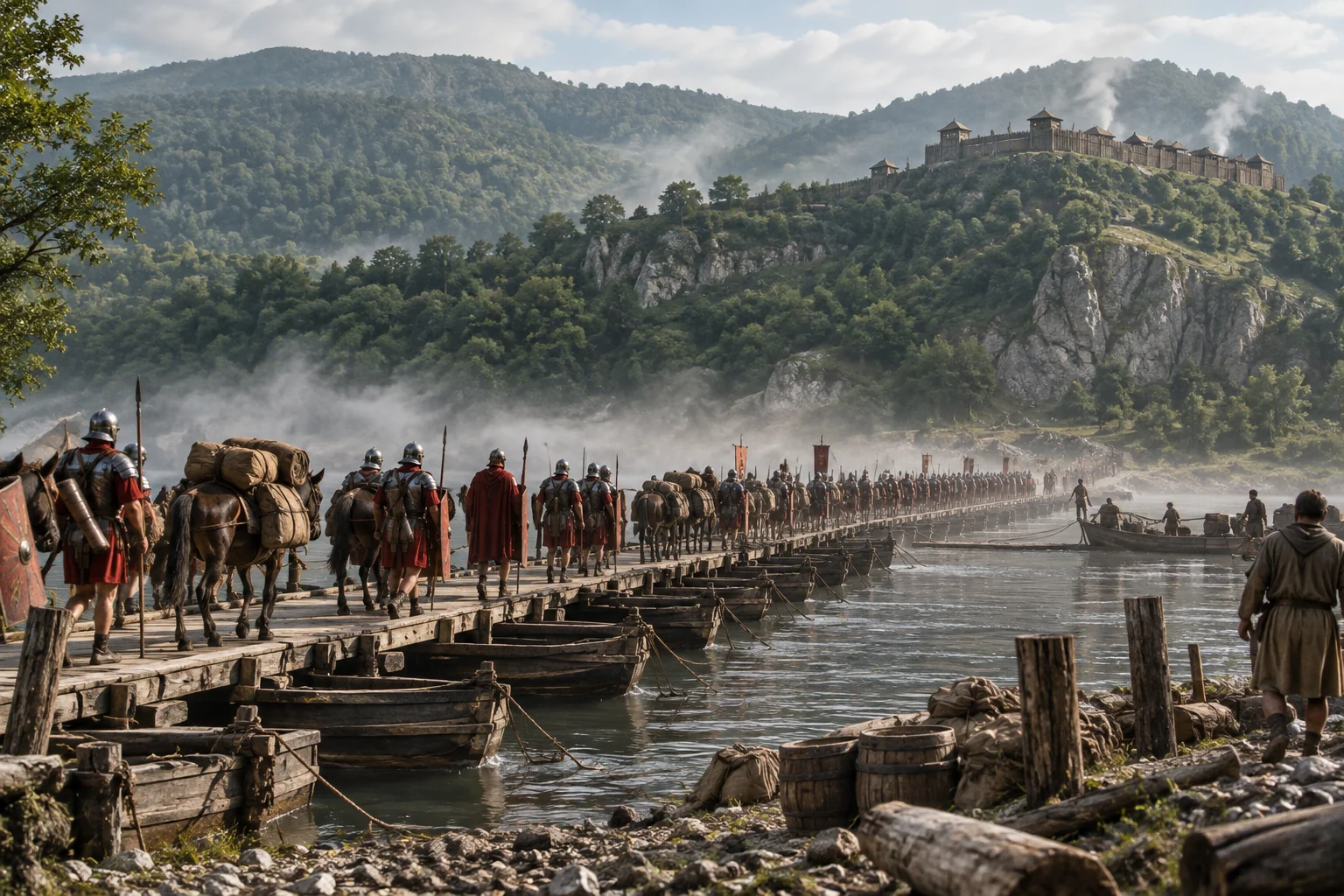
101–102: Trajan bridges the Danube (pontoon bridge depicted on the Column), wins at Tapae, advances on Sarmizegetusa; Decebalus sues for peace — harsh terms (surrender of weapons, engineers, territory). Decebalus rearms and breaks the treaty. 105–106: Trajan returns with overwhelming force (15+ legions), builds the permanent Drobeta bridge (Apollodorus of Damascus); Sarmizegetusa is besieged, its water supply cut, and stormed; the Dacian nobility's suicide (the "mushroom" episode on the Column); Decebalus flees, is cornered by the cavalryman Tiberius Claudius Maximus, and cuts his own throat (per Dio and the Column); his head is taken to Rome. Dacia becomes a Roman province (106) — the only Trajanic conquest retained long-term (abandoned under Aurelian, c. 271).
Casualties
- A contemporary claimed Trajan took 500,000 prisoners — reported via Cassius Dio's tradition and repeated in modern summaries (https://europe.factsanddetails.com/article/entry-356.html); scholars treat the figure as inflated triumphal rhetoric.
- Deaths: "the two wars must have killed tens of thousands" is the careful modern formulation (same source); no ancient or modern source gives a verified death toll (UNVERIFIED).
- Aftermath spectacle: ~10,000 Dacian captives were brought to Rome for the 123 days of gladiatorial games celebrating the victory (per the contemporary tradition).
- The wars qualify on consequence: Rome's last great expansion, the annexation that made Romania Latin-speaking.
Outcome & legacy
Dacia was annexed, colonized, and Latinized — the origin of the Romanian language and people (the Daco-Roman continuity thesis, politically charged in modern Romanian historiography — handled with attribution). Trajan's Column (113 CE) became the canonical visual record of Roman warfare and a foundational monument of European art. Decebalus became a Romanian national hero (the 40-meter rock sculpture at the Iron Gates, completed 2004, is modern, not ancient).
Historiography pulse
- Academic consensus: the wars' course is unusually well documented visually (Trajan's Column's ~155 scenes) and textually (Dio); the Column is propaganda, not reportage.
- Major debates: (1) the scale of the Dacian population and the "empty Dacia" question — whether Trajan exterminated/deported the Dacians wholesale (the Column's final scenes suggest devastation; continuity theorists argue for survival); (2) the reliability of the 500,000 prisoners figure; (3) the Daco-Roman continuity thesis.
- Notable scholarship: the Column commentaries (Cichorius; Lepper & Frere); Ioana Oltean on Dacia; the Adamclisi Tropaeum Traiani studies.
Validation tier
Tier 1 for events (Dio + Column + archaeology); Tier 2 for casualty ranges (tens of thousands killed; 500,000 prisoners as contested ancient claim).
UNVERIFIED points
- The 500,000 prisoners figure (single ancient claim).
- Any verified death toll for the two wars.
- The extent of Dacian extermination vs. survival (continuity debate unresolved).
- Details of Decebalus's death beyond Dio/Column (suicide to avoid capture — broadly accepted).
Sources
- Cassius Dio, Roman History 68 — primary narrative.
- Trajan's Column (Rome, 113 CE) — visual primary source, propagandistic.
- Tiberius Claudius Maximus's funerary stele (Philippi) — corroborates Decebalus's pursuit.
- Tropaeum Traiani, Adamclisi — victory monument.
- Trajan's Dacian Wars — https://en.wikipedia.org/wiki/Trajan%27s_Dacian_Wars ; https://europe.factsanddetails.com/article/entry-356.html
- Smarthistory on the Column — https://smarthistory.org/column-of-trajan/
Images
Sources
- Cassius Dio, Roman History 68 — primary narrative
- Trajan's Column (Rome, 113 CE) — visual primary source, propagandistic
- Tiberius Claudius Maximus's funerary stele (Philippi) — corroborates Decebalus's pursuit
- Tropaeum Traiani, Adamclisi — victory monument
- Trajan's Dacian Wars
- Smarthistory on the Column