Conflict dossier · #18 of 120
18. Early Muslim Conquests (629–750)
Medieval Tier 2
18. Early Muslim Conquests (629–750)
Overview
- Belligerents: The Rashidun and then Umayyad caliphates vs. the Byzantine Empire, the Sasanian Empire, and various North African, Iberian (Visigothic), Central Asian, and South Asian polities.
- Dates: c. 629 (Mu'ta) through the mid-8th century; the Umayyad fall in 750 marks the conventional end of the expansion phase.
- Theater: Arabia, the Levant, Egypt, North Africa, Iberia, Mesopotamia, Persia, Transoxiana, and the Indus valley.
- Outcome: One of history's fastest and largest imperial expansions; creation of a polity stretching from Iberia to the Indus.
Causes
Attribution is essential. Fred Donner argues the conquests were the expansion of a newly organized state whose members — whom he calls "Believers" rather than projecting a fully separate confessional "Muslim" identity onto the earliest conquerors — were mobilized by a new monotheistic movement. Robert Hoyland, examining contemporary and non-Muslim evidence, interrogates the labels "Arab," "Muslim," "Believer," and Muhājirūn. Factors cited across scholarship include: state formation and religious mobilization, tribal politics, economic opportunities (booty, land, stipends), and the vulnerability of Byzantium and Sasanian Persia after their 602–628 war. No single-factor explanation commands consensus; causes and the causes of success are distinct questions (Donner).
Course
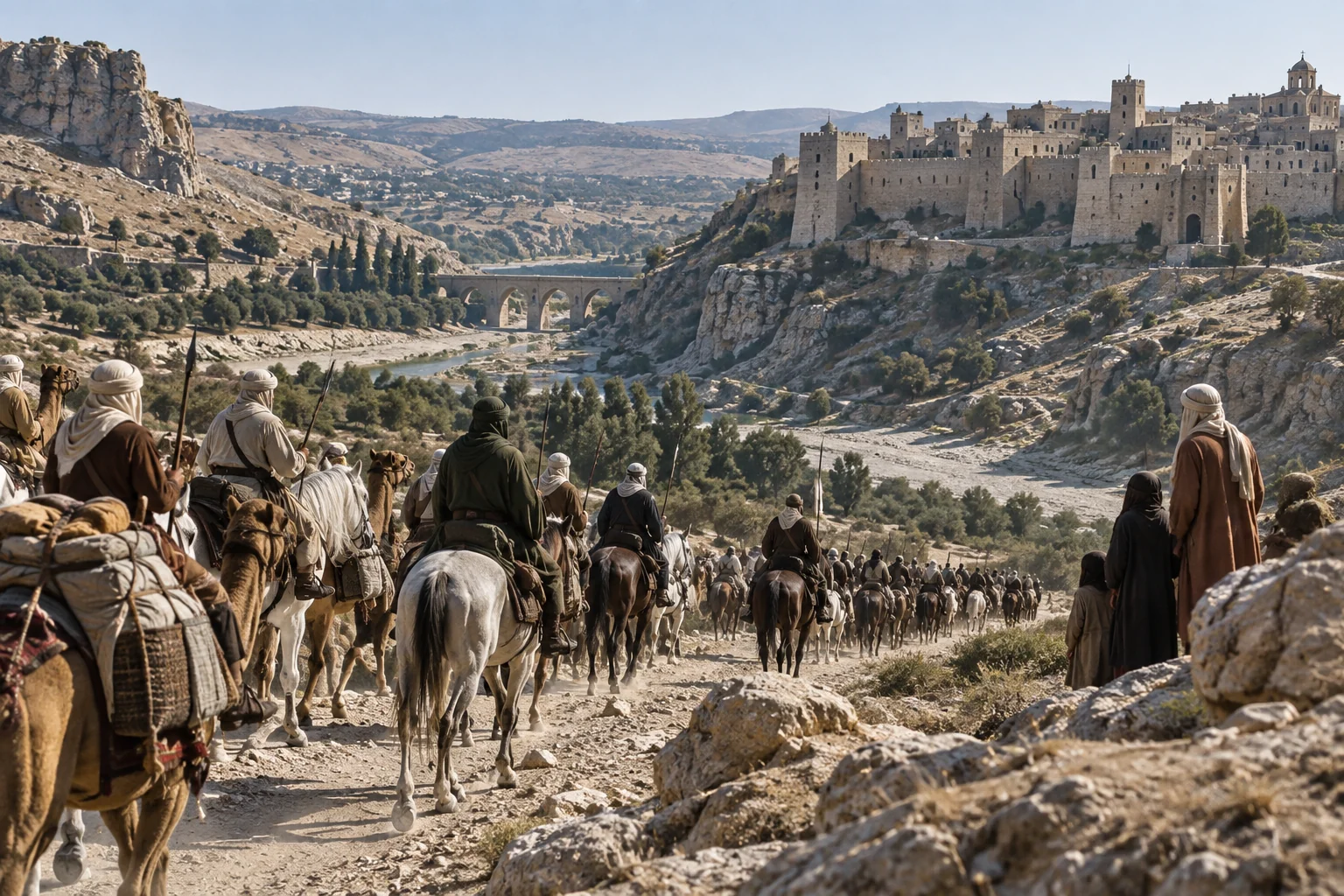
After early raids and the battles of Ajnadayn, Yarmouk (636), and al-Qadisiyyah (636–637), Arab armies took Syria, Palestine, Egypt (639–642), and Mesopotamia; the Sasanian Empire was destroyed at Nahavand (642) and its last shah killed in 651. Under the Umayyads, expansion continued into North Africa, Iberia (711), Transoxiana, and Sindh (711–712), until checked at Constantinople (717–718) and Tours/Poitiers (732).
Casualties
- No defensible aggregate death toll exists. Ideological claims circulating online of 100–300 million deaths are methodologically unusable and are UNVERIFIED — rejected, not merely caveated.
- Battle figures in medieval Arabic chronicles are often inflated; modern historians treat them as literary rather than statistical.
- UNVERIFIED: any total for the conquests as a whole; literal readings of chronicler battle figures.
Outcome & Legacy
The conquests created the Islamic world as a political and cultural zone, Arabized and Islamized the Middle East and North Africa over centuries, and permanently redrew the map of the eastern Mediterranean and western Asia. The 750 Abbasid revolution shifted the center of gravity to Baghdad.
Historiography Pulse
- Fred Donner (The Early Islamic Conquests; the "Believers" thesis) and Robert Hoyland (In God's Path) anchor the modern debate on identity and motivation.
- Active scholarly debate: the confessional identity of the earliest conquerors, the relative weight of religious vs. material motives, and the reliability of the Arabic literary tradition vs. contemporary non-Muslim sources.
- Validation tier: Tier 2 — broad course and chronology rest on strong evidence from multiple scholarly schools; aggregate casualties unknowable; some causal interpretation contested.
Sources
- https://www.middleeastmedievalists.com/wp-content/uploads/2017/11/UW-25-Hoyland.pdf?fbclid=IwAR29du9bqEY0AuMli56We_hmyqA5wdNN8ZFipRHceUMr6TedW6Hh1vKOfUE
- https://cspcontents.s3.eu-west-1.amazonaws.com/master/samples/978-1-5275-6821-1-sample.pdf
- https://github.com/light-upon-light/light-upon-light.github.io/blob/HEAD/_pages/sword.md
Images (8 views — files in images/early-muslim-conquests/)
| File | View |
|---|---|
| 01-hero-battle-art.jpg | Battle art (Yarmouk 636) |
| 02-expansion-map.jpg | Expansion map 632–750 |
| 03-dome-rock.jpg | Dome of the Rock, Jerusalem |
| 04-coin.jpg | Umayyad coinage |
| 05-guadalete.jpg | Battle of Guadalete 711 (Iberia) |
| 06-taq-kasra.jpg | Taq Kasra, Ctesiphon ruins |
| 07-manuscript.jpg | Medieval Islamic manuscript battle illumination |
| 08-cordoba.jpg | Great Mosque of Córdoba |