Conflict dossier · #76 of 120
Ethiopian Civil War (12 September 1974 – 28 May 1991)
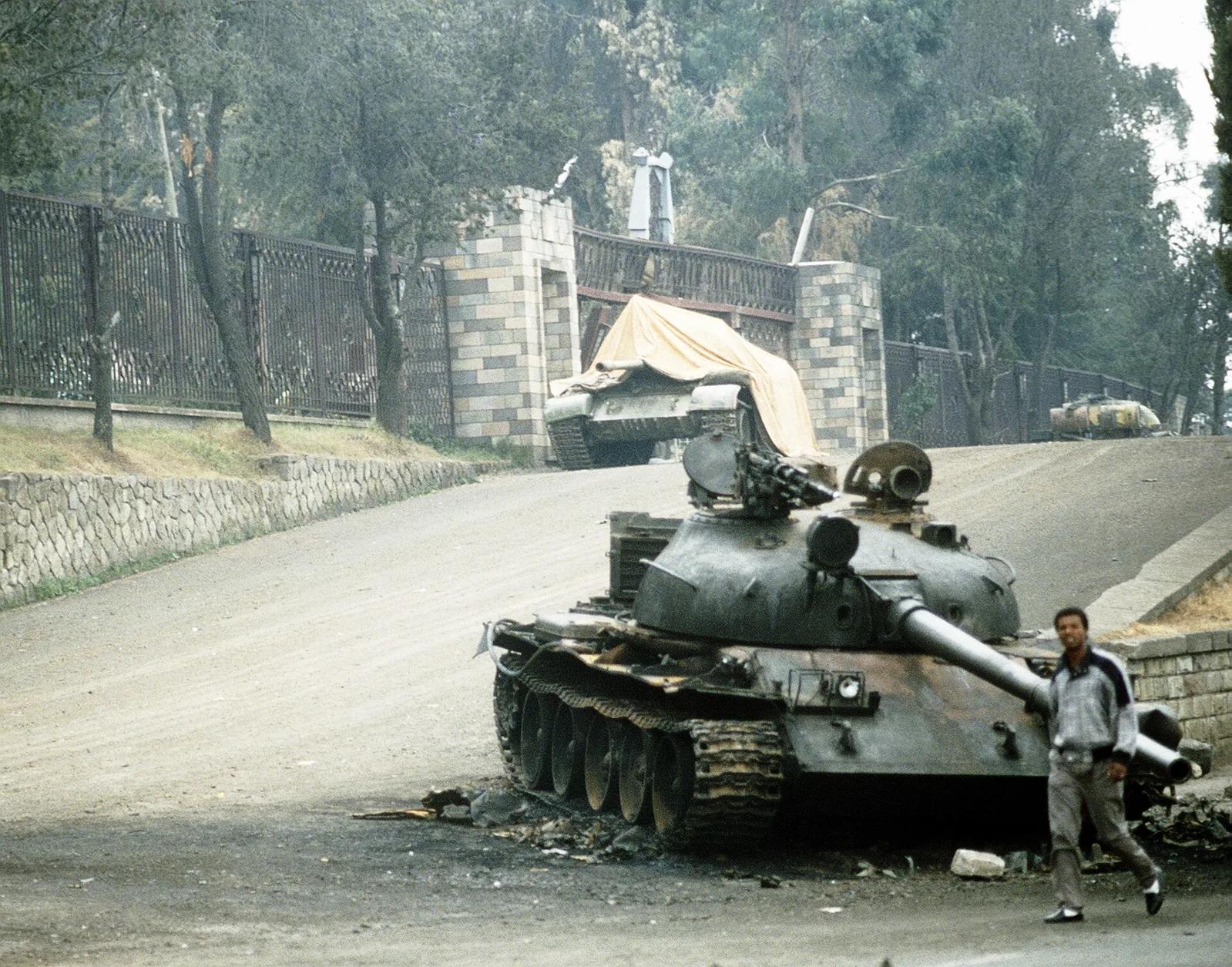
20th Century Tier 1
Ethiopian Civil War (12 September 1974 – 28 May 1991)
Overview
- Belligerents: The Derg (Provisional Military Government, later People's Democratic Republic of Ethiopia under Mengistu Haile Mariam), backed by the Soviet Union, Cuba, and East Germany, vs. a shifting array of rebels: Eritrean separatists (EPLF, ELF), Tigrayan People's Liberation Front (TPLF), Oromo and Somali fronts (notably the Western Somali Liberation Front, backed by Somalia in the 1977–78 Ogaden War), and rival leftist factions (EPRP, MEISON).
- Theater: Ethiopia, with major fronts in Eritrea, Tigray, Ogaden, and the cities (Red Terror).
- Outcome: Derg overthrown; EPRDF (TPLF-led coalition) took Addis Ababa in May 1991; Eritrea's independence followed after a 1993 referendum.
Causes (attributed)
- Scholars (e.g., Gebru Tareke, Bahru Zewde) attribute the war to the 1974 revolution that deposed Emperor Haile Selassie amid famine, oil-shock inflation, and military mutinies; the Derg's radical land reform and "Ethiopia First" nationalism then alienated both the old order and rival revolutionaries.
- The Eritrean war predated the Derg (ELF insurgency from the 1960s); historians note the Derg inherited and intensified it, with the EPLF arguing that annexation was never legitimate — a position Ethiopia's governments rejected.
- The 1977–78 Ogaden War is attributed to Siad Barre's irredentist "Greater Somalia" drive, exploiting Ethiopia's revolutionary chaos; Soviet-Cuban intervention on Ethiopia's side is documented.
- The 1983–85 famine's role is debated: Human Rights Watch (Alex de Waal's reporting) argues Derg counter-insurgency policies — forced resettlement, food denial — turned drought into mass death; others stress drought and war disruption as primary.
Course (brief, neutral)
The Derg seized power in 1974, executed imperial officials, and launched the Red Terror (1976–78) against rival leftists, killing tens of thousands in the cities. It fought the Eritreans to a bloody stalemate, defeated the Somali invasion in the Ogaden (1977–78) with Soviet-Cuban help, but never subdued the EPLF or TPLF. Massive offensives in the 1980s failed; the 1983–85 famine killed hundreds of thousands and delegitimized the regime internationally. Soviet aid ended with Gorbachev's retrenchment; the EPLF and TPLF/EPRDF coordinated offensives in 1990–91, Mengistu fled in May 1991, and the EPRDF entered Addis Ababa.
Casualties (named sources; contested in parts)
- Total: "at least 1.4 million people dead, with 1 million related to famine and the remainder from violence" (Wikipedia, "Casualties and impact of the Ethiopian Civil War").
- Famine 1983–85: minimum 400,000 dead (Human Rights Watch, citing its 1991 reporting — "not counting those killed by resettlement"); commonly cited up to 1–1.2 million including the full drought period (figures vary; the upper end is UNVERIFIED as a precise count).
- Combat: at least 100,000 soldiers killed (HRW); Eritrean dyad battle deaths ~99,000 per UCDP/PRIF (low–high range 43,620–146,897 across datasets for the broader Ethiopian conflicts per war-memorial.net's UCDP compilation); Bercovitch & Jackson estimate 200,000 in the Eritrean war 1965–1993.
- Ogaden: ~25,000 civilians killed in 1980 reprisals (Africa Watch, cited via justice.gov country report); 70,000–80,000 combatants and civilians killed in Eritrea 1978–81 (Mayfield 1995, cited via justice.gov).
- Red Terror urban killings: tens of thousands (estimates vary; exact figure UNVERIFIED).
Outcome & legacy
- Eritrean independence (1993) after a 30-year war; Ethiopia became landlocked.
- EPRDF rule under Meles Zenawi (1991–2012) brought ethnic federalism and growth but also authoritarianism; the Derg's crimes were tried in Ethiopian courts (Mengistu convicted in absentia of genocide in 2006 — a verdict scholars debate as legally stretched).
- The famine reshaped global humanitarian fundraising (Live Aid, 1985); resettlement and villagization left lasting demographic scars.
Historiography pulse
- Academic consensus: the Derg's militarized, Soviet-backed state simultaneously fought multiple insurgencies it could not win; the famine was at minimum massively worsened by state policy.
- Major debates: whether the 1983–85 famine was primarily drought or deliberate counter-insurgency (de Waal's "famine crimes" thesis vs. structural explanations); the genocide conviction of Mengistu; Eritrean vs. Ethiopian nationalist historiographies of the 30-year war.
- Notable works: Gebru Tareke, The Ethiopian Revolution: War in the Horn of Africa (2009); Alex de Waal's HRW reporting and Famine Crimes; the Red Terror Martyrs Memorial Museum in Addis Ababa.
Validation tier
Tier 1 — multi-source consensus on dates, belligerents, famine's scale order, and outcome. Famine death toll Tier 2 (400,000 minimum documented; upper estimates contested).
UNVERIFIED points
- Precise famine death toll (400,000–1,200,000 range).
- Red Terror death toll (no systematic count).
- Exact attribution of famine mortality between drought and state policy (debated).
Sources
- https://en.wikipedia.org/wiki/Casualties_and_impact_of_the_Ethiopian_Civil_War
- https://www.hrw.org/reports/pdfs/e/ethiopia/ethiopia.919/b3intro.pdf (HRW on famine and war)
- https://www.prif.org/fileadmin/Daten/Publikationen/Prif_Working_Papers/Anhänge/Ethiopia__EPLF__1964-1991.pdf (UCDP/PRIF Eritrean dyad data)
- https://www.justice.gov/file/273266/dl?inline= (U.S. DOJ country report citing Africa Watch/Mayfield)