Conflict dossier · #69 of 120
First Indochina War (1946–1954)
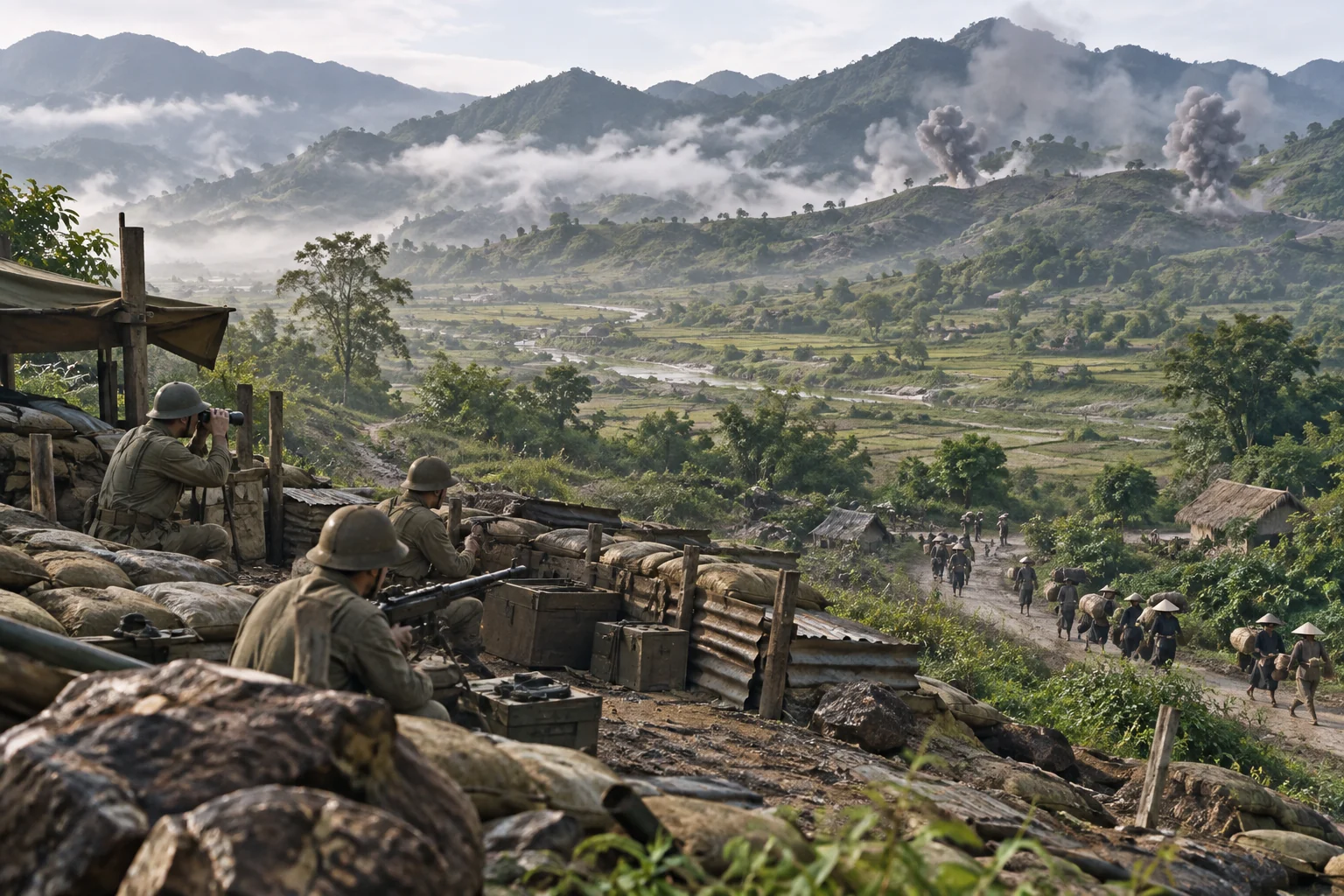
20th Century Tier 1
First Indochina War (1946–1954)
Overview
- Belligerents: Việt Minh / Democratic Republic of Vietnam (Hồ Chí Minh, Võ Nguyên Giáp; Pathet Lao, Khmer Issarak allies; supported by China and the USSR) vs. the French Union (France's Far East Expeditionary Corps; the State of Vietnam under Bảo Đại; Kingdoms of Laos and Cambodia; supported by the US after 1950).
- Dates: 19 December 1946 – 11 August 1954 (Geneva Accords signed 20–21 July 1954; ceasefire effective 11 August)
- Theater: French Indochina — Vietnam, Laos, Cambodia; decisive battle at Điện Biên Phủ (March–May 1954).
Causes — attributed
- General historical consensus (historytools.org; Wikipedia): a decolonization war — the Việt Minh's August Revolution (1945) and declaration of independence collided with France's determination to restore its Indochinese empire; the breakdown of the Fontainebleau negotiations and the Haiphong incident (November 1946) triggered open war on 19 December 1946.
- Scholars attribute the war's internationalization to the Cold War: the US recognized the French-backed State of Vietnam in 1950 and funded up to 80% of the French war effort by 1954 (encyclopedia2.thefreedictionary.com), while China (after 1949) armed and trained the Việt Minh — making Indochina a proxy theater.
- Academic debate: the degree to which Hồ Chí Minh sought negotiated independence vs. revolutionary war from the start; the US role — whether American funding made the war unwinnable for France or merely prolonged it; Bernard Fall's classic accounts (Street Without Joy, 1961; Hell in a Very Small Place, 1966) frame it as a colonial war France could not win politically.
Course
Guerrilla war in the countryside (1946–49) gave way to conventional operations after Chinese aid arrived: Giáp's border offensive (1950), the Red River Delta battles (1951), Nà Sản and the northwest campaigns (1952–53). France, under General Henri Navarre, built the fortified air-land base at Điện Biên Phủ to draw Giáp into a set-piece battle; Giáp instead besieged it with massed artillery (13 March – 7 May 1954). The garrison surrendered (2,293 French dead, ~6,500 wounded, 11,721 captured — historytools.org; ~60% of French POWs died in captivity — Wikipedia). The Geneva Conference (May–July 1954) ended the war: Vietnam temporarily partitioned at the 17th parallel pending 1956 reunification elections (never held); Laos and Cambodia gained independence; France withdrew.
Casualties — ranges with named sources
- French Union: 74,220 dead (20,685 Frenchmen), 64,127 wounded (Wikipedia); historytools.org: "the war had already cost 92,000 dead on the French side" before Điện Biên Phủ; factsanddetails.com: "About 94,000 French troops died" (NYT, 2013); State of Vietnam: 58,877 dead or missing (Wikipedia).
- Việt Minh: 175,000–300,000 dead or missing (Western historians' estimate — Wikipedia); 191,605 dead or missing (Vietnamese government figure — Wikipedia); factsanddetails.com: "by conservative estimates, about 300,000 Vietnamese fighters" killed.
- Điện Biên Phủ alone: French 2,293 killed; Việt Minh 8,000–25,000 casualties (historytools.org); Vietnamese government reported 4,020 dead, 9,118 wounded, 792 missing; Mark Moyar (Triumph Forsaken): 22,900 Việt Minh casualties (Wikipedia).
- Civilians: 150,000+ killed (simple.wikipedia.org — attributed); Nhan Dan (North Vietnamese newspaper) claimed 466,000 French colonial losses — a propaganda figure, UNVERIFIED (encyclopedia2.thefreedictionary.com).
Outcome & legacy
- Việt Minh victory; dissolution of French Indochina; Vietnam partitioned at the 17th parallel; the Geneva Accords' unheld 1956 elections set the stage for the Second Indochina (Vietnam) War.
- France's defeat ended its Southeast Asian empire and traumatized French politics (the war's unpopularity helped bring down the Fourth Republic).
- The US inherited France's role, increasing aid to South Vietnam — the direct bridge to the Vietnam War.
- Điện Biên Phủ became the iconic symbol of anti-colonial victory worldwide.
Historiography pulse
- Academic consensus: a nationalist-communist war of independence that France lost politically before losing militarily; US funding internationalized it.
- Major debates: (a) Việt Minh casualty figures — Western estimates vs. Hanoi's official 191,605 (Tier 2–3); (b) whether the Geneva partition was intended as temporary by all parties; (c) the US decision to back France — Cold War logic vs. anti-colonial principles; (d) Mark Moyar's revisionist defense of the South Vietnamese state in Triumph Forsaken (2006) is contested by mainstream historians.
- Notable scholarship: Bernard Fall, Street Without Joy (1961) and Hell in a Very Small Place (1966); Fredrik Logevall, Embers of War (2012, Pulitzer Prize); the French Catroux Commission report on the defeat.
Validation tier
Tier 1 on causes, course, outcome; Tier 2 on French and Việt Minh casualty ranges (named sources, ranges preserved); Tier 3 on civilian deaths and the Nhan Dan 466,000 claim (flagged).
UNVERIFIED points
- Việt Minh total deaths: 175,000–300,000 (Western) vs. 191,605 (Hanoi) — no reconciled figure.
- Civilian deaths: 150,000+ is an attributed floor, not a settled count.
- Nhan Dan's 466,000 French losses: propaganda figure, UNVERIFIED.
Sources
- Wikipedia, "First Indochina War" — http://en.wikipedia.org/wiki/First_Indochina_War
- HistoryTools.org, "The First Indochina War" — https://www.historytools.org/stories/the-first-indochina-war-how-vietnamese-revolutionaries-expelled-the-french-and-drew-in-the-americans
- Facts and Details, "French Indochina War (1946-54)" — https://factsanddetails.com/southeast-asia/Vietnam/sub5_9a/entry-3341.html
- Wikipedia, "Battle of Dien Bien Phu" — https://en.wikipedia.org/wiki/Battle_of_Dien_Bien_Phu
- The Free Dictionary (Soviet Encyclopedia), "Indochina War" — https://encyclopedia2.thefreedictionary.com/_/mdict.aspx?h=1&word=Indochina+War