Conflict dossier · #13 of 120
First Jewish–Roman War (66–73 CE)
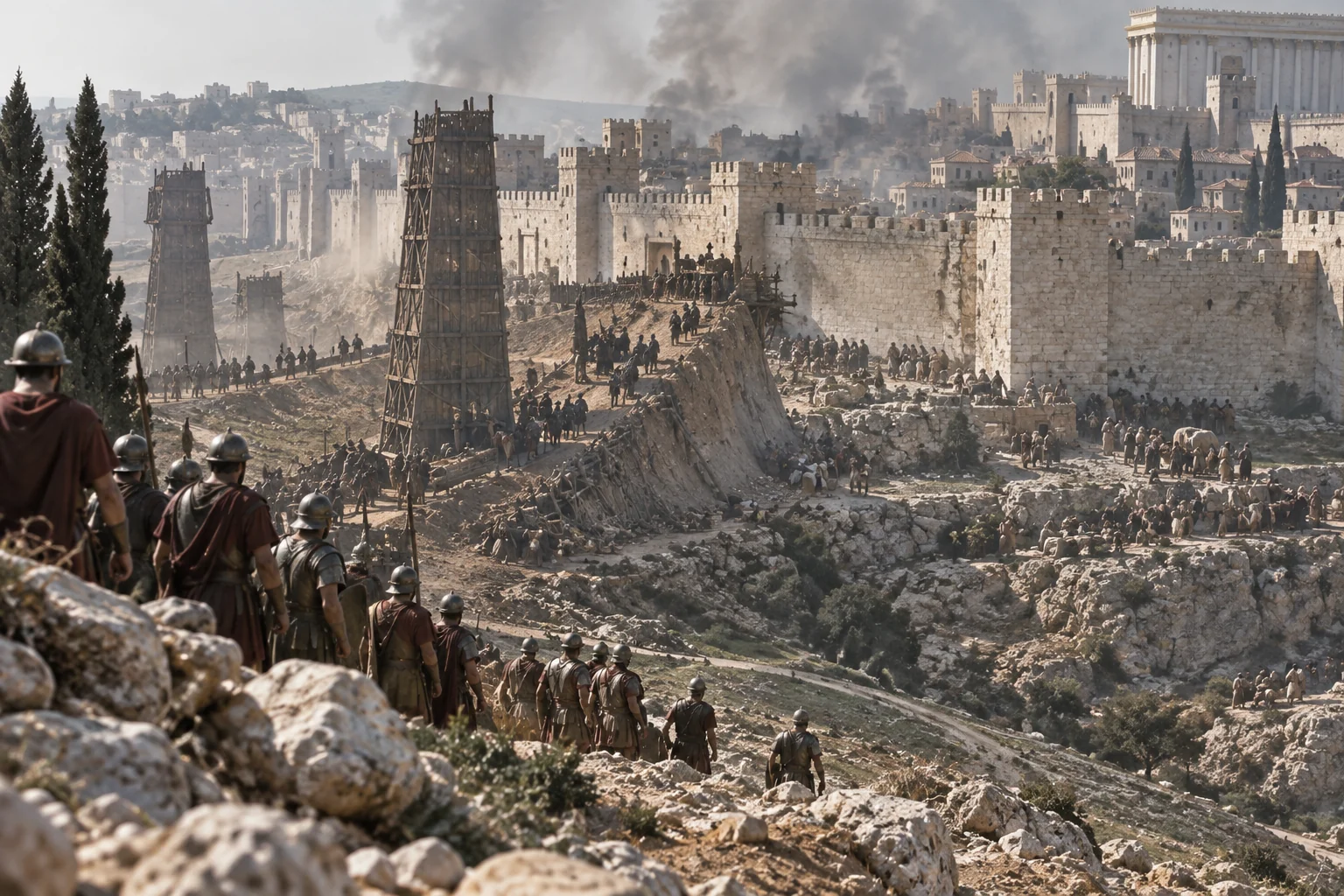
Ancient Tier 1
First Jewish–Roman War (66–73 CE)
Overview
- Belligerents: the Roman Empire (Legio V Macedonica, X Fretensis, XV Apollinaris under Vespasian, then Titus; later Lucilius Bassus and Flavius Silva) vs. Jewish rebel factions in Judaea — Zealots, Sicarii, and the rival commands of John of Gischala, Simon bar Giora, and Eleazar ben Simon.
- Dates: 66 CE (revolt begins; Cestius Gallus defeated at Beth Horon) to 73 CE (fall of Masada); Jerusalem fell in 70 CE.
- Theater: Judaea — Jerusalem, the Galilee, the Judean desert fortresses.
Causes — attributed
- Josephus (The Jewish War) — himself a rebel commander turned Roman client — blames a mix of Roman procuratorial misrule (he singles out Gessius Florus), Jewish factional extremism, and messianic fervor; his account is shaped by his need to exonerate the Jewish people while condemning the rebels.
- Modern scholars (e.g., Martin Goodman, Rome and Jerusalem; Seth Schwartz) emphasize structural causes: the fiscal pressure of Roman taxation, the provocations of successive procurators, social banditry in the Galilee, and the destabilizing interaction between Roman administrative failure and Jewish apocalyptic expectation. Goodman argues the revolt was not inevitable and required specific triggers in 66.
- Jewish infighting — the three rebel factions burning each other's food stores during the siege — is presented by Josephus as a major cause of the defeat; modern scholars accept factionalism as real while noting Josephus's interest in blaming the rebels rather than Rome.
Course
66: Florus's provocations spark riots; the Temple sacrifices for the emperor cease; Cestius Gallus's punitive expedition is routed at Beth Horon. 67–68: Vespasian systematically reduces the Galilee (Jotapata falls; Josephus captured); civil war in Rome pauses operations (68–69, Year of the Four Emperors). 70: Titus besieges Jerusalem — the city, crowded with Passover pilgrims and riven by factional fighting, starves; the Temple is destroyed (August 70); the city falls. 71–73: mop-up — Herodium, Machaerus, and finally Masada (73), where Josephus reports the defenders' mass suicide.
Casualties
- Siege of Jerusalem (70 CE): Josephus claims 1,100,000 dead — "widely considered exaggerated" by modern scholars (https://en.wikipedia.org/wiki/Siege_of_Jerusalem_(70_CE)). Seth Schwartz estimates Roman Palestine's total population at ~1 million (roughly half Jewish), making Josephus's figure demographically impossible for the city; Guy Rogers estimates 20,000–30,000 dead in Jerusalem; Charles Murison suggests Josephus's 1.1 million may refer to total war losses. Tacitus gives 600,000 besieged.
- Captives: Josephus reports 97,000 taken empire-wide during the war and sold into slavery — broadly cited, single-source.
- No verified aggregate death toll (UNVERIFIED). The war qualifies by decisive consequence: the destruction of the Second Temple, the central event of Jewish history after the Exodus.
- Genocide scholar Adam Jones has characterized the Roman suppression as genocidal in intent and effect — a scholarly characterization, attributed, not a legal finding.
Outcome & legacy
The Second Temple was destroyed; Jerusalem was systematically demolished; the Temple cult ended permanently, forcing Judaism's transformation into rabbinic Judaism (Yavneh). The Arch of Titus in Rome commemorated the victory; Judaea Capta coinage advertised it. The war became the central trauma of Jewish memory (Tisha B'Av) and a live reference point in modern Israeli national narrative (Masada).
Historiography pulse
- Academic consensus: Josephus is indispensable and deeply compromised — a participant writing under Flavian patronage; archaeology (the Burnt House, Masada, Yodfat) broadly confirms the destruction narrative while the Masada mass-suicide account remains debated.
- Major debates: (1) Josephus's casualty figures; (2) the historicity of the Masada mass suicide (archaeology supports a siege and deaths; the collective-suicide pact rests on Josephus alone); (3) Goodman's "not inevitable" thesis vs. structural-conflict models.
- Notable scholarship/documentary: Martin Goodman, Rome and Jerusalem (2007); Seth Schwartz's demographic work; the Masada excavations (Yigael Yadin).
Validation tier
Tier 1 for events (Josephus + archaeology + Tacitus/Suetonius); Tier 2 for casualty ranges (modern demographic estimates vs. Josephus).
UNVERIFIED points
- Josephus's 1,100,000 figure (rejected as stated; Rogers's 20,000–30,000 is the leading alternative for Jerusalem).
- The 97,000 captives beyond Josephus.
- The Masada mass-suicide narrative as Josephus tells it.
- Any aggregate war death toll.
Sources
- Flavius Josephus, The Jewish War — primary, compromised.
- Tacitus, Histories 5 — the siege from the Roman side.
- Suetonius, Vespasian, Titus.
- Martin Goodman, Rome and Jerusalem: The Clash of Ancient Civilizations (Knopf, 2007).
- Siege of Jerusalem — https://en.wikipedia.org/wiki/Siege_of_Jerusalem_(70_CE)
- First Jewish–Roman War — https://en.wikipedia.org/wiki/First_Jewish-Roman_War
Images
Sources
- Flavius Josephus, The Jewish War — primary, compromised
- Tacitus, Histories 5 — the siege from the Roman side
- Suetonius, Vespasian, Titus
- Martin Goodman, Rome and Jerusalem: The Clash of Ancient Civilizations (Knopf, 2007
- Siege of Jerusalem
- First Jewish–Roman War