Conflict dossier · #54 of 120
Dossier 54 — First Sino-Japanese War (1894–1895)
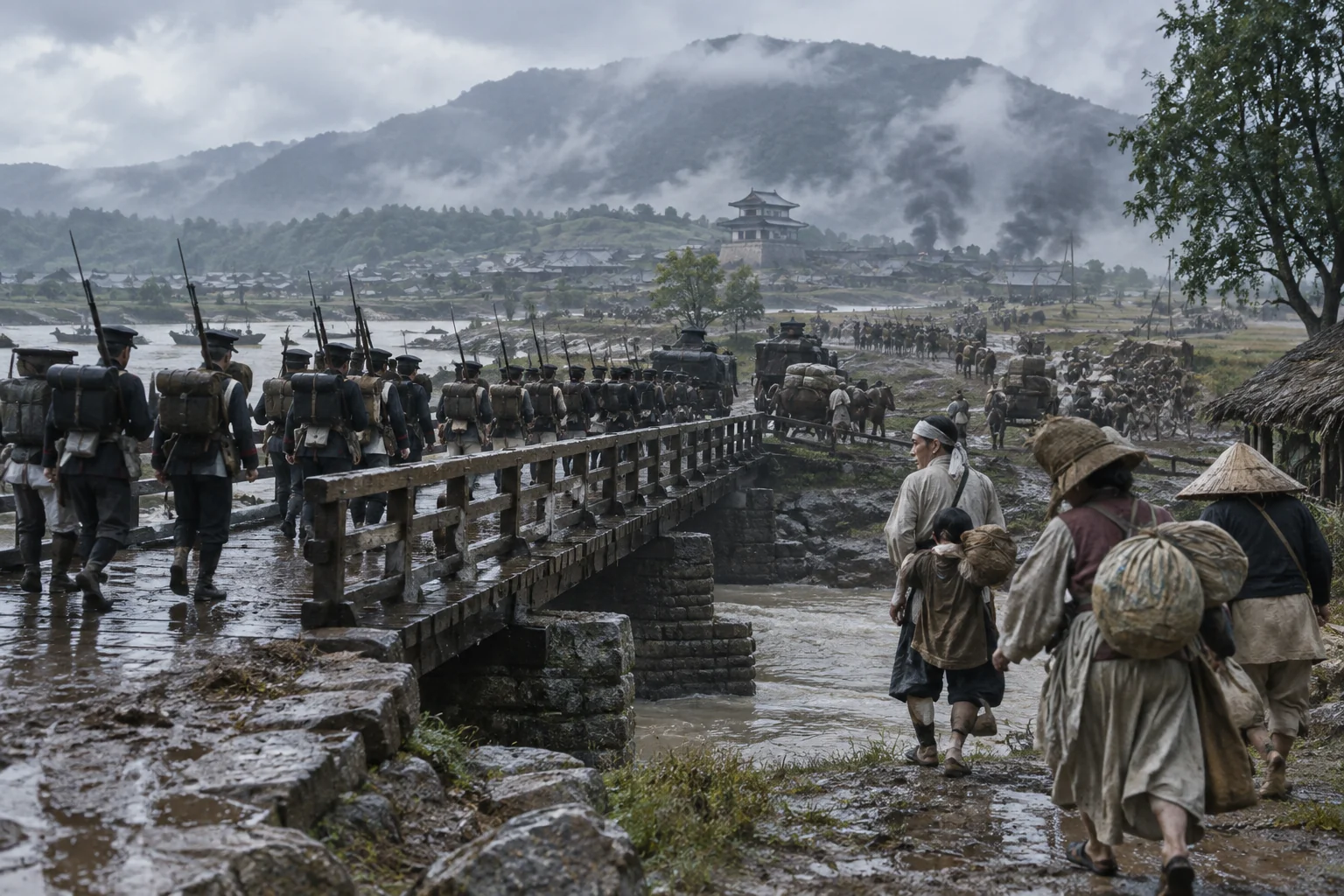
Early Modern Tier 2
Dossier 54 — First Sino-Japanese War (1894–1895)
Theater: Korea, Manchuria (Liaodong Peninsula), the Yellow Sea, and Taiwan (post-treaty resistance, 1895). Belligerents: The Empire of Japan (Imperial Japanese Army and Navy) vs. the Qing Empire (Beiyang Army and Beiyang Fleet). Validation tier: Tier 2 (moderate) — Japanese figures documented from official sources (including the 1911 Britannica's contemporary account); Chinese losses estimated.
Overview
Fought over control of Korea, the war demonstrated the success of Japan's Meiji modernization against a Qing state that had modernized only partially. Japan won every major engagement — Pyongyang, the Yalu River naval battle, Port Arthur, Weihaiwei — and the Treaty of Shimonoseki (17 April 1895) ceded Taiwan, the Pescadores, and (initially) the Liaodong Peninsula to Japan, recognized Korean independence, and imposed a large indemnity. The Triple Intervention (Russia, France, Germany) forced Japan to return Liaodong, storing up resentment that fed the Russo-Japanese War.
Causes (attributed)
- Korean rivalry: the Donghak Rebellion (1894) prompted both China and Japan to send troops to Korea under the Tianjin Convention's notification terms; Japan refused to withdraw alongside China and engineered a confrontation (thoughtco.com).
- Meiji vs. Self-Strengthening: Japan's comprehensive modernization vs. the Qing's limited Self-Strengthening Movement created a military gap that Japanese leaders were willing to test.
- Contested: Japanese vs. Chinese narratives of who provoked the clash at Pungdo/Seoul; the Port Arthur massacre (November 1894) — Japanese accounts cite discovered mutilated Japanese prisoners as provocation; Chinese historiography treats it as an atrocity, and Western accounts generally describe a massacre of the city's population.
Course (brief, neutral)
Japan seized Seoul and won at Seonghwan and Pyongyang (September 1894); the Yalu River naval battle (September 1894) destroyed the Beiyang Fleet's effectiveness. Japanese armies took Port Arthur (November 1894) and, crossing from there, besieged and captured the Weihaiwei naval base (February 1895), where Admiral Ding Ruchang committed suicide. With the fleet gone and Japanese forces in Manchuria, Li Hongzhang negotiated the Treaty of Shimonoseki (April 1895). Taiwan resisted Japanese takeover for five months (May–October 1895).
Casualties
- Japanese (contemporary official accounting): the 1911 Encyclopædia Britannica reports 4,177 dead (battle and disease) and 56,862 wounded or disabled by sickness, exclusive of the Formosa/Pescadores expeditions; GlobalSecurity's campaign account gives 1,005 killed, 4,922 wounded, and 16,866 disease deaths for the main operations. Taiwan operations added about 396 killed in action but over 10,000 disease deaths (Lavenberg collection, citing standard accounts).
- Chinese: commonly cited at about 35,000 killed or wounded (compilation); the 1911 Britannica states Chinese losses are "impossible to estimate."
- Port Arthur massacre: deaths among the city's population are widely asserted but not reliably counted — UNVERIFIED as a figure.
Outcome and legacy
- Treaty of Shimonoseki (1895): Korean independence from China; Taiwan, the Pescadores, and (until the Triple Intervention) Liaodong ceded to Japan; a large indemnity; treaty-port openings.
- Legacy: Japan's arrival as a great power; the Triple Intervention radicalized Japanese opinion toward Russia (leading to 1904–1905); in China the defeat discredited the Self-Strengthening Movement and fed the reformist and revolutionary movements that ended the Qing (1911).
Historiography pulse
- Consensus: the war as the verdict on partial vs. comprehensive modernization; the Triple Intervention as the war's most consequential diplomatic aftermath.
- Debates: the Port Arthur massacre's scale and characterization; whether the war was avoidable had the Qing court backed Li Hongzhang's navy adequately; Taiwanese resistance as anti-Japanese nationalism vs. Qing loyalism.
- Notable scholarship: S. C. M. Paine, The Sino-Japanese War of 1894–1895 (Cambridge UP, 2003). Links were not verified in this research pass.
UNVERIFIED list
- Chinese loss totals (1911 Britannica: "impossible to estimate").
- Port Arthur massacre death toll.
- Taiwanese resistance casualties beyond the Japanese disease figures.
Sources
- Overview: https://www.thoughtco.com/first-sino-japanese-war-1894-95-195784
- 1911 Britannica (contemporary figures): http://en.wikisource.org/wiki/1911_Encyclop%C3%A6dia_Britannica/Chino-Japanese_War
- Campaign detail: https://www.globalsecurity.org/military/world/war/sino-japanese.htm
- Taiwan aftermath: https://pages.uoregon.edu/jsmacollections/home/articles/war-prints-senso-e-/sino-japanese-war-1894---1895-.html
Images
Sources
- Overview
- 1911 Britannica (contemporary figures
- Campaign detail
- Taiwan aftermath