Conflict dossier · #42 of 120
Dossier 42 — French Revolutionary and Napoleonic Wars (1792–1815)
Early Modern Tier 1
Dossier 42 — French Revolutionary and Napoleonic Wars (1792–1815)
Theater: Europe-wide — France's land borders, Italy, the Low Countries, Germany, Spain and Portugal (Peninsular War), Egypt and the Levant (1798–1801), Russia (1812), and global naval theaters (Atlantic, Mediterranean, Caribbean, Indian Ocean). Belligerents: Revolutionary/Napoleonic France (with successive satellite states and allies: the Confederation of the Rhine, the Duchy of Warsaw, Italy, Spain until 1808, Denmark–Norway) vs. shifting coalitions of Britain, Austria, Prussia, Russia, Spain (after 1808), Portugal, Sweden, and the Ottoman Empire at various points. Validation tier: Tier 1 (strong) — multiple named historians' estimates exist, though they differ in scope.
Overview
Twenty-three years of near-continuous warfare that began with revolutionary France's wars against the First Coalition (1792) and continued under Napoleon Bonaparte through seven coalitions, ending with Waterloo (1815) and the Congress of Vienna. The wars spread revolutionary legal and administrative reforms across Europe, destroyed the Holy Roman Empire, and ended with the restoration of the Bourbon monarchy and a century-long great-power concert.
Causes (attributed)
- Revolutionary-ideological conflict: the French Revolution's challenge to monarchical legitimacy; the émigré agitation and the Declaration of Pillnitz (1791) raised war expectations on both sides.
- French expansionism: revolutionary and then Napoleonic France's drive for "natural frontiers" and hegemony; successive coalitions formed to contain French power.
- Contested: whether Napoleon was the wars' prime mover or the product of a structural great-power conflict; French nationalist historiography vs. the "coalition as containment" view; the Peninsular War's character as national liberation vs. reactionary guerrilla.
Course (brief, neutral)
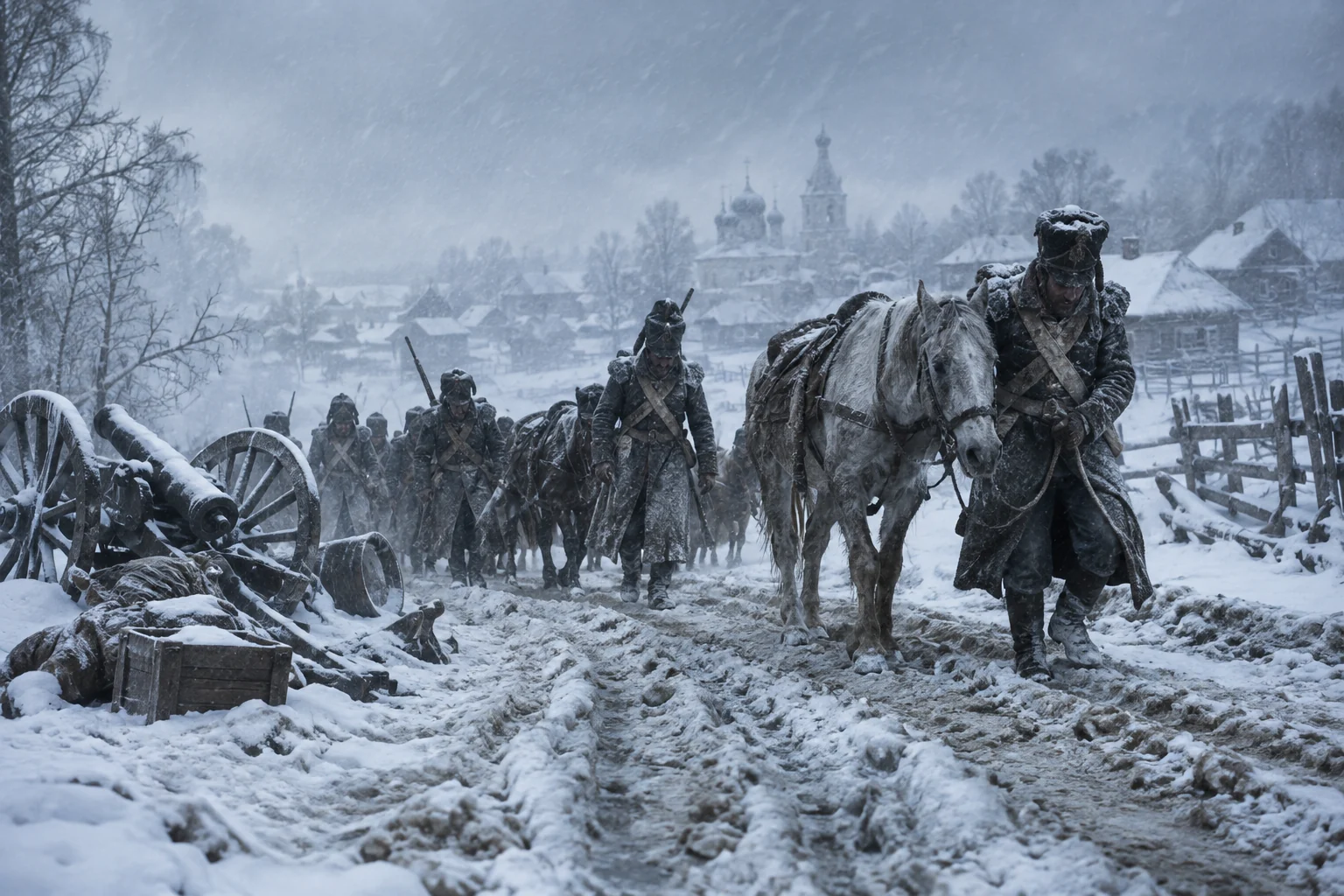
The First Coalition wars (1792–1797) ended with Campo Formio; the Second Coalition (1798–1802) with Lunéville and Amiens. The Napoleonic Wars proper (1803–1815) saw Austerlitz (1805), Jena-Auerstedt (1806), the Continental System, the Peninsular War (1808–1814), the Russian campaign (1812) and the retreat from Moscow, the German "War of Liberation" (1813, Leipzig), the 1814 campaign and first abdication, the Hundred Days, and Waterloo (18 June 1815).
Casualties
- David Gates: 5 million deaths (scope not specified in the surfaced summary).
- Charles Esdaile: 5–7 million deaths overall.
- Alan Schom: about 3 million military deaths.
- General compilation: 3.25–6.5 million military and civilian deaths.
- Jacques Houdaille (cited by the Fondation Napoléon, from archival sampling): 439,000 French soldiers and officers known dead; additional categories of uncertain losses (missing, deserters, prisoners) require careful interpretation and cannot simply be added.
- Present as a band (roughly 3–7 million) with named sources, not a single figure; civilian deaths from the Peninsular War, the Russian campaign's aftermath, and disease are the least quantified.
Outcome and legacy
- Congress of Vienna (1814–1815): restoration of monarchies, a reorganized Germany (German Confederation), an independent Netherlands, and Russian/Prussian/Austrian gains; France returned to 1792 borders (second Treaty of Paris).
- Legacy: the Napoleonic Code's spread; the end of the Holy Roman Empire (1806); the rise of German and Spanish nationalism; the "Concert of Europe"; the wars as the founding trauma and myth-source of modern French, German, British, Russian, and Spanish national identities.
Historiography pulse
- Consensus: the wars as the crucible of modern nationalism and mass conscription warfare; the Russian campaign and the Peninsular War as the twin drains on Napoleonic power.
- Debates: casualty totals (Gates vs. Esdaile vs. Schom); Napoleon's responsibility for the wars' scale vs. structural causes; the "genius vs. system" debate on his generalship; the Vendée and Spanish guerrilla violence in national memories.
- Notable scholarship: David Gates, Charles Esdaile, Alan Schom; the Fondation Napoléon's casualty research (Houdaille). Links were not verified in this research pass.
UNVERIFIED list
- Any single settled total (3–7M band reflects genuine scholarly disagreement, not precision).
- Civilian deaths in the Peninsular War and the 1812 campaign's aftermath.
- Disease vs. battle splits for non-French armies.
Sources
- Casualty compilation: http://en.wikipedia.org/wiki/Napoleonic_Wars_casualties
- Fondation Napoléon casualty research: https://www.napoleon.org/wp-content/uploads/2020/12/pointhistoirebilanguerresnapoleoniennes2020.pdf
- Historiography: https://shs.cairn.info/article/E_NAPOJ_007_0017/pdf?lang=en
Images
Sources
- Casualty compilation
- Fondation Napoléon casualty research
- Historiography