Conflict dossier · #34 of 120
Dossier 34 — French Wars of Religion (1562–1598)
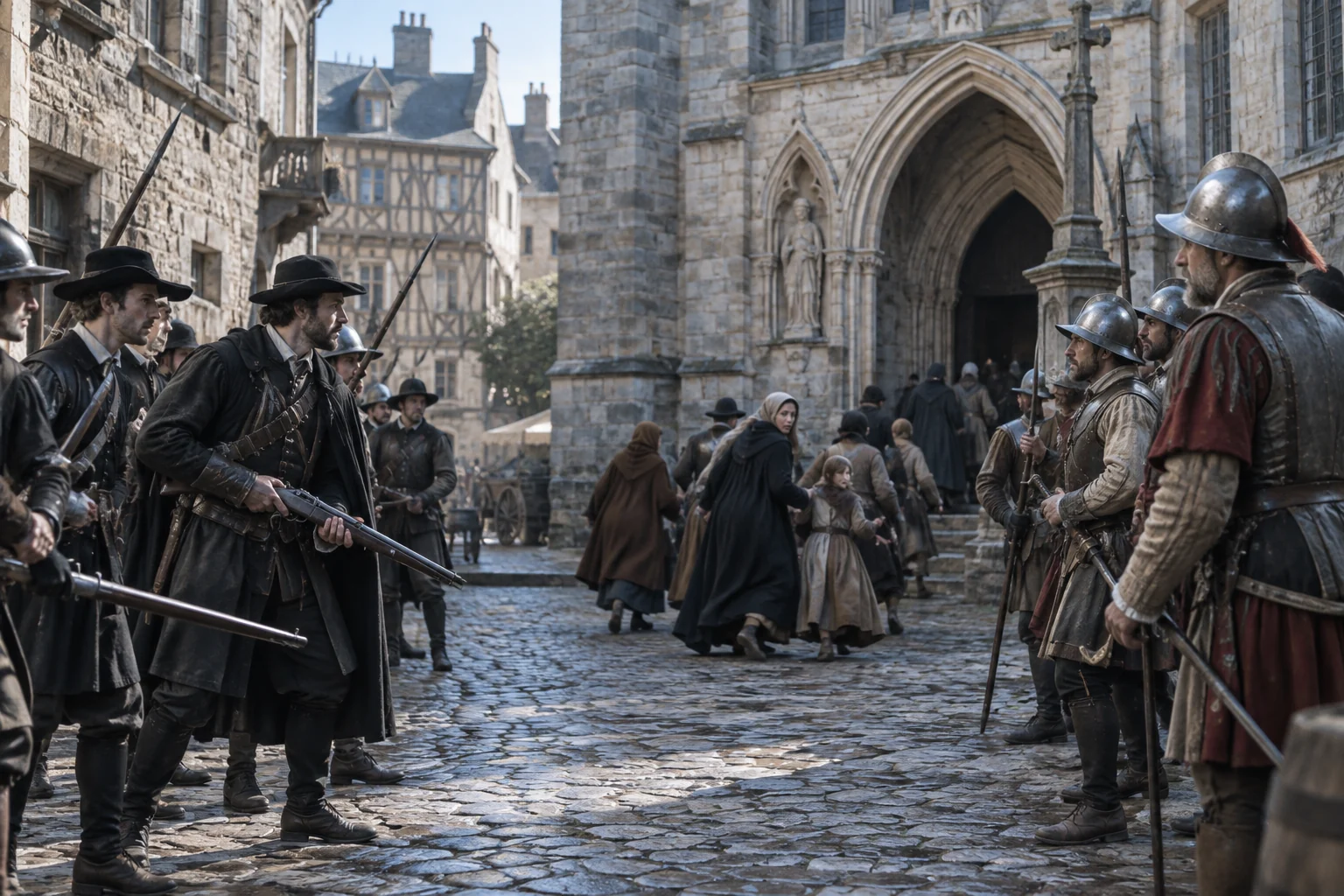
Early Modern Tier 3
Dossier 34 — French Wars of Religion (1562–1598)
Theater: The Kingdom of France (with spillover into the Spanish Netherlands and Savoy). Belligerents: The French Crown (Catholic, Valois then Bourbon-Henri IV) and Catholic League vs. Huguenot (French Protestant) forces, with foreign intervention by Spain (supporting the Catholic League), England, and the Dutch (supporting the Huguenots). Validation tier: C (low) — no reliable whole-war aggregate; major incident figures are disputed.
Overview
A series of eight (conventionally counted) civil wars between 1562 and 1598, fought between French Catholics and Huguenots (Calvinist Protestants), ending with the Edict of Nantes (1598), in which Henri IV granted the Huguenots substantial religious toleration. The wars devastated France, drew in Spain, England, and Savoy, and nearly destroyed the Valois monarchy.
Causes (attributed)
- Confessional division: the spread of Calvinism among the French nobility and urban bourgeoisie after c. 1555 collided with a Catholic monarchy committed to religious unity. The Massacre of Vassy (1562), in which the Duke of Guise's retainers killed Huguenot worshippers, is conventionally treated as the spark of the first war.
- Aristocratic factionalism: the Guise (Catholic) and Bourbon/Condé-Montmorency (Huguenot-aligned) factions used religion as the banner of a struggle for control of the regency government during the minorities of François II and Charles IX. Historians (notably J. H. M. Salmon, Denis Crouzet) attribute the wars' duration to this fusion of faith and faction.
- State weakness: a child king, a foreign regent (Catherine de' Medici), and fiscal crisis made arbitration impossible. Contested: Catherine de' Medici's personal responsibility — especially for the St. Bartholomew's Day Massacre (1572) — remains debated; older narratives cast her as the architect, while revisionist work (e.g., Crouzet) emphasizes contingency and court dynamics. Her culpability is not settled fact.
Course (brief, neutral)
The wars proceeded in eight phases punctuated by fragile edicts of pacification (Amboise 1563, Longjumeau 1568, Saint-Germain 1570, etc.). The St. Bartholomew's Day Massacre (August 1572) — the killing of thousands of Huguenots in Paris and the provinces after the attempted assassination of Admiral Coligny — eliminated the Huguenot leadership and internationalized the conflict. The death of Henri III (assassinated 1589) ended the Valois line; Henri IV, a Protestant convert to Catholicism ("Paris is worth a Mass" — attribution of the quote is disputed), fought the Catholic League and its Spanish backers until his victory and the Edict of Nantes (1598).
Casualties
- No reliable whole-war aggregate exists. This research pass's searches found no dependable total for 1562–1598; do not substitute massacre figures for war totals.
- St. Bartholomew's Day Massacre (1572): estimates range from 5,000 to 30,000 killed. The Musée Protestant (French Protestant museum) gives 7,000–21,000 (https://www.museeprotestant.org/en/notice/the-st-bartholomews-day-massacre-24-august-1572/ — URL not verified verbatim in this research pass). The wide band reflects the absence of systematic records; all figures are approximations, none fully verified.
Outcome and legacy
- The Edict of Nantes (1598) granted Huguenots freedom of conscience and limited rights of worship, plus fortified "places of safety" — the first large-scale European experiment in religious coexistence, revoked by Louis XIV in 1685.
- The wars entrenched the principle of confessional coexistence by exhaustion and strengthened the Bourbon monarchy's claim to stand above faction — a foundation of French absolutism.
- Legacy is contested: Catholic-traditionalist memory stresses Protestant rebellion; Protestant memory stresses martyrdom; republican historiography treats the wars as a cautionary tale of fanaticism.
Historiography pulse
- Consensus: the standard eight-war periodization; St. Bartholomew's as the pivotal atrocity; the Edict of Nantes as the settlement.
- Debates: the "violence" school (Crouzet) on ritual and apocalyptic dimensions of the massacres; the extent of popular vs. elite agency; Catherine de' Medici's role; casualty quantification.
- Notable scholarship: Denis Crouzet, Les guerriers de Dieu; J. H. M. Salmon; Mack P. Holt, The French Wars of Religion, 1562–1629. (Links were not verified in this research pass.)
UNVERIFIED list
- Any aggregate death total for the full 1562–1598 wars.
- Precise St. Bartholomew's death toll (5,000–30,000 is a range of estimates, not a verified count).
- Attribution of "Paris is worth a Mass" to Henri IV.
- Catherine de' Medici's personal culpability for St. Bartholomew's.
Sources
- Casualty grounding searches (the 2026-09-23 research pass): St. Bartholomew's estimates 5,000–30,000; Musée Protestant 7,000–21,000 (URL to be re-verified).
- Historiography: Crouzet, Salmon, Holt (standard works; links were not verified in this research pass).
Images
Sources
- Casualty grounding searches (the 2026-09-23 research pass): St. Bartholomew's estimates 5,000–30,000; Musée Protestant 7,000–21,000 (URL to be re-verified
- Historiography: Crouzet, Salmon, Holt (standard works; links were not verified in this research pass