Conflict dossier · #16 of 120
Gothic Wars and the Fall of Western Rome (376–476 CE)
Ancient Tier 1
Gothic Wars and the Fall of Western Rome (376–476 CE)
Overview
- Belligerents: the (Eastern and Western) Roman Empire vs. successive Gothic and other groups — the Thervingi/Greuthungi Goths under Fritigern (376–382 war), the Visigoths under Alaric I (395–410), the Ostrogoths under Theodoric the Great (489–493), alongside Vandals, Suebi, Alans, Burgundians, Franks, and Huns as co-actors in the Western collapse.
- Dates: 376 CE (the Gothic crossing of the Danube) to 476 CE (deposition of Romulus Augustulus by Odoacer) — the conventional century of the Western fall. The Gothic War of 376–382 is the core "Gothic War"; the dossier covers the full arc per the approved plan.
- Theater: the Balkans, Italy, Gaul, Iberia, North Africa.
Causes — attributed
- Ammianus Marcellinus (contemporary) attributes the 376–382 war to Roman official corruption: the generals Lupicinus and Maximus exploited the starving Gothic refugees admitted across the Danube, driving them to revolt; Valens's decision to fight at Adrianople without waiting for Gratian compounded the disaster.
- Modern scholars (e.g., Peter Heather, The Fall of the Roman Empire; Guy Halsall, Barbarian Migrations and the Roman West) debate the grand causes: Heather's influential thesis holds that the Hunnic push + Gothic migration created a military crisis the Western Empire — fiscally weaker than the East — could not survive, with the loss of Africa's tax base to the Vandals (439) as the point of no return. Halsall and others stress internal Roman political fragmentation and civil wars as equal or greater causes. The "transformation vs. catastrophe" debate (Walter Goffart and the "Vienna school") questions how violent the transition was — reported here as a live scholarly dispute, not settled.
Course
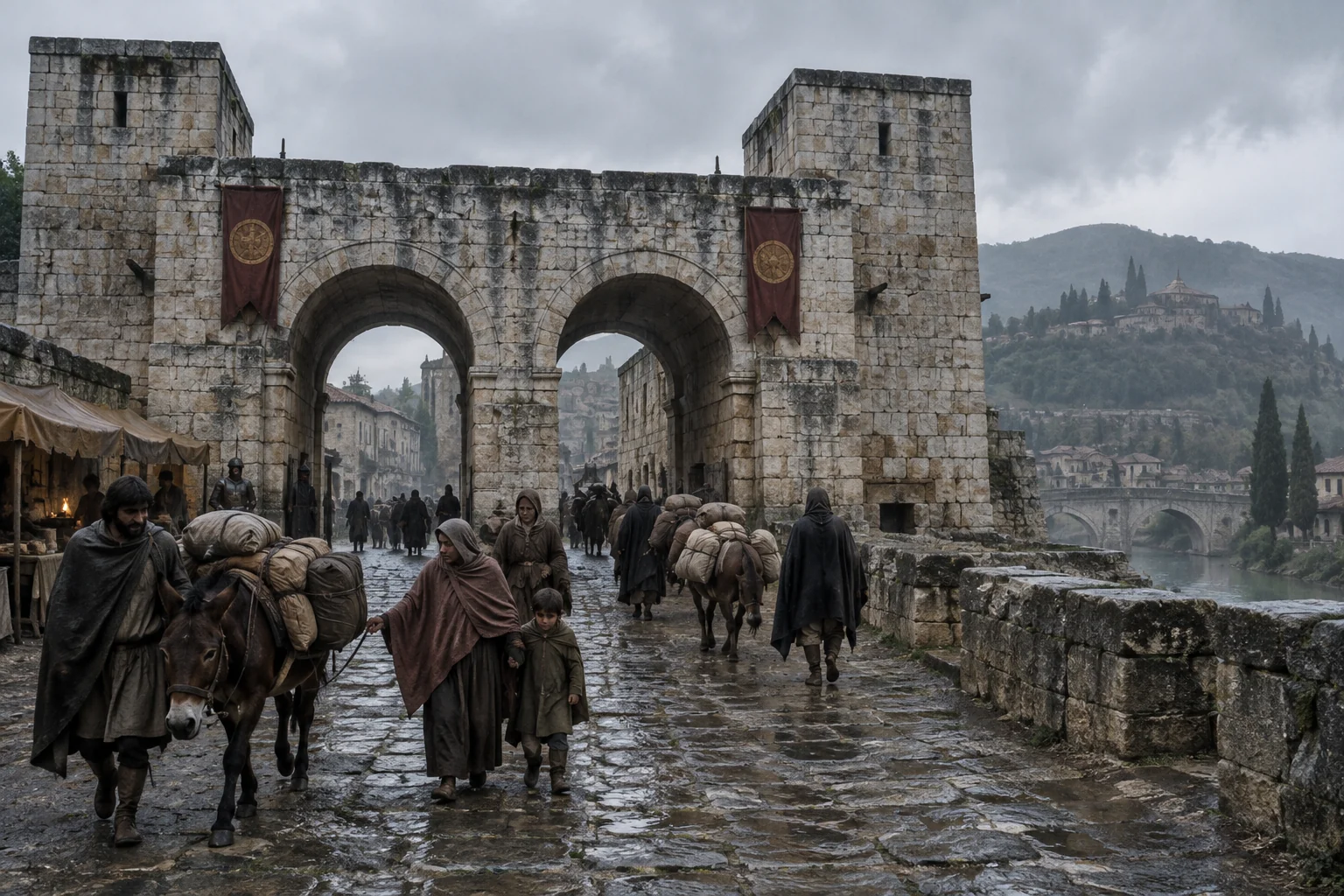
376: Goths admitted across the Danube; exploitation → revolt. 378: Adrianople — Valens and roughly two-thirds of the Eastern field army destroyed. 382: Theodosius settles the Goths as foederati. 395–410: Alaric's Visigoths, denied Roman commands, invade Italy; sack of Rome (410) — the first in 800 years. 406–407: Rhine crossing (Vandals, Alans, Suebi); Britain abandoned (410). 439: Vandals take Carthage and Africa's grain/tax base. 451: Catalaunian Plains — Romans and Visigoths check Attila. 455: Vandals sack Rome. 468: the great East–West expedition against the Vandals fails catastrophically. 476: Odoacer deposes Romulus Augustulus; the Western imperial office ends (the East continues as the Byzantine Empire).
Casualties
- Adrianople (378): Ammianus's account implies catastrophic losses; modern estimates: Peter Heather 10,000–15,000; Williams & Friell ~20,000 — "roughly two-thirds of the Roman force" (https://en.wikipedia.org/wiki/Battle_of_Adrianople). Valens himself was killed, his body never recovered.
- No aggregate death toll exists for the 376–476 century (UNVERIFIED). The demographic impact is debated: some scholars argue for severe depopulation in parts of the West (Italy, the Balkans); others emphasize continuity of population under new rulers. Heather estimates the Western Empire's population fell significantly in the 5th century, but precise figures are UNVERIFIED.
- The dossier qualifies on decisive geopolitical consequence: the end of the Western Roman Empire.
Outcome & legacy
The Western imperial office ended; successor kingdoms (Visigothic Spain, Vandal Africa, Frankish Gaul, Ostrogothic Italy) divided the West. The Eastern Empire survived another thousand years. The "fall of Rome" became history's master-narrative of civilizational collapse — invoked in political rhetoric ever since — while modern scholarship increasingly describes a transformation with catastrophic episodes rather than a single cataclysm.
Historiography pulse
- Academic consensus: the political-military sequence is well documented (Ammianus, Zosimus, Prosper, Hydatius, the Notitia Dignitatum, archaeology); the causes are the most debated question in late-antique historiography.
- Major debates: (1) Heather's external-shock thesis vs. internal-decay/transformation models; (2) how violent the 5th-century transition was (Goffart's peaceful-accommodation thesis vs. archaeological evidence of destruction layers); (3) whether 476 is a meaningful date (many scholars prefer 480, or see no sharp break).
- Notable scholarship/documentary: Peter Heather, The Fall of the Roman Empire (2005) and Empires and Barbarians (2009); Guy Halsall, Barbarian Migrations and the Roman West (2007); Bryan Ward-Perkins, The Fall of Rome and the End of Civilization (2005) — the "catastrophist" counter to Goffart.
Validation tier
Tier 1 — multi-source consensus on events; casualty aggregates Tier 3 (none exist).
UNVERIFIED points
- Any aggregate death toll for the 376–476 period.
- The scale of 5th-century demographic decline in the West.
- The precise causal weighting of external invasion vs. internal failure (the central scholarly dispute).
Sources
- Ammianus Marcellinus, Res Gestae Books 26–31 — contemporary, culminating in Adrianople.
- Zosimus, New History; Prosper of Aquitaine; Hydatius — 5th-century chroniclers.
- Peter Heather, The Fall of the Roman Empire: A New History (Macmillan, 2005).
- Guy Halsall, Barbarian Migrations and the Roman West, 376–568 (Cambridge, 2007).
- Battle of Adrianople — https://en.wikipedia.org/wiki/Battle_of_Adrianople
Images
Sources
- Ammianus Marcellinus, Res Gestae Books 26–31 — contemporary, culminating in Adrianople
- Zosimus, New History; Prosper of Aquitaine; Hydatius — 5th-century chroniclers
- Peter Heather, The Fall of the Roman Empire: A New History (Macmillan, 2005
- Guy Halsall, Barbarian Migrations and the Roman West, 376–568 (Cambridge, 2007
- Battle of Adrianople