Conflict dossier · #81 of 120
Gulf War (2 August 1990 – 28 February 1991)
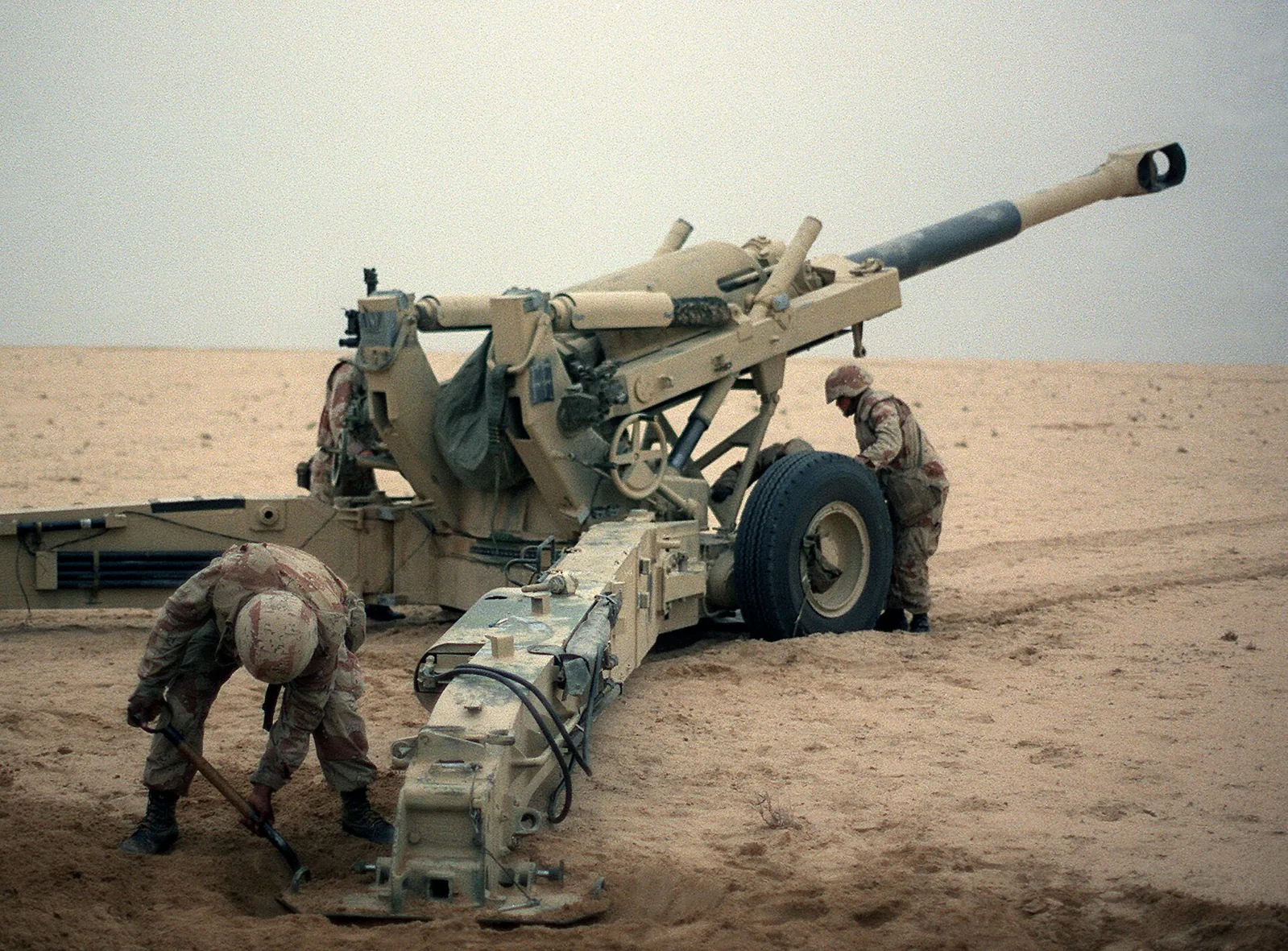
20th Century Tier 1
Gulf War (2 August 1990 – 28 February 1991)
Overview
- Belligerents: A U.S.-led coalition of 39 countries (per CNN's Gulf War Fast Facts; key contributors: United States, UK, France, Saudi Arabia, Egypt, Syria) acting under UN Security Council resolutions, vs. Iraq (Saddam Hussein).
- Theater: Kuwait, southern Iraq, northern Saudi Arabia; air campaign over Iraq.
- Outcome: Decisive coalition victory; Kuwait liberated; Iraqi forces expelled; UN ceasefire (Resolution 687) imposed sanctions, weapons inspections, and a no-fly-zone regime. Saddam remained in power.
Causes (attributed)
- Historians attribute the invasion to Iraq's debt crisis after the Iran–Iraq War, disputes over Kuwaiti oil production/OPEC quotas and the Rumaila oil field, and Saddam's claim to Kuwait as a historically Iraqi province — a claim rejected by Kuwait and the international community.
- The U.S. ambassador April Glaspie's July 1990 meeting with Saddam is endlessly debated: critics argue ambiguous American signaling emboldened him; defenders (and released transcripts) argue she warned against aggression — the "green light" thesis is contested, not settled.
- The coalition's formation is attributed to oil-security interests, international-law enforcement after the Cold War, and regional states' fear of Iraqi expansion — weighted differently across accounts.
Course (brief, neutral)
Iraq invaded and annexed Kuwait on 2 August 1990. After UN resolutions and a U.S.-led buildup (Operation Desert Shield), a 42-day air campaign (Operation Desert Storm) began 17 January 1991, followed by a 100-hour ground offensive from 24 February. Iraqi forces were routed; retreating columns were destroyed on the "Highway of Death" (Highway 80, 26–27 February 1991). A ceasefire took effect 28 February. Post-war Shia and Kurdish uprisings in Iraq were crushed by Saddam's remaining forces, producing a refugee crisis and the northern no-fly zone.
Casualties (named sources; contested)
- Iraqi military deaths: estimates range 1,500 to 100,000 (CNN Fast Facts); scholarly/journalistic reconstructions (e.g., post-war battlefield surveys cited by strategypage.com's 2003 review) suggest the lower end — "probably less than 5,000" military dead plus <1,000 civilians from the air campaign — but the true figure is UNVERIFIED.
- Highway of Death: 200–300 (low) to 800–1,000 (firsthand-account-based, ITN Archive digitization notes) to 10,000 (high, "widely considered unreliable" per ITN/YouTube documentation).
- Coalition: 382 U.S. in-theater deaths (CNN; includes non-combat); ~300+ coalition deaths overall from all causes (figures vary by definition).
- Kuwaiti civilian deaths during occupation: commonly cited in the low thousands (exact figure UNVERIFIED).
- Post-war uprisings and sanctions-era mortality are frequently conflated with war deaths in popular accounts; they are separate phenomena and must not be folded into the Gulf War toll without attribution.
- Working range for combat deaths: a few thousand to ~25,000+; no authoritative count.
Outcome & legacy
- Kuwait restored; Iraq subjected to the harshest sanctions regime of the era and UNSCOM inspections; the war established the post–Cold War "New World Order" intervention template.
- The failure to remove Saddam and the crushing of the 1991 uprisings shaped U.S. Iraq policy through 2003; Gulf War illness ("Gulf War syndrome") affected thousands of veterans (causes debated).
- The war was the first heavily televised conflict (CNN effect); precision-guided munitions entered public consciousness.
Historiography pulse
- Academic consensus: a short, coalition-dominated conventional war; Iraqi casualty figures were inflated in early reporting and remain uncertain; the war's political consequences (sanctions, uprisings, U.S. basing) outweighed its military drama.
- Major debates: the Glaspie "green light" question; proportionality of the Highway of Death attack (critics call it a "turkey shoot," defenders a legitimate interdiction — both positions documented); whether stopping short of Baghdad was wisdom or error.
- Notable works: Lawrence Freedman & Efraim Karsh, The Gulf Conflict 1990–1991 (1993); the ITN Archive's 2024 digitization of Highway of Death footage; the U.S. Army's official histories.
Validation tier
Tier 1 — multi-source consensus on dates, belligerents, course, and outcome. Iraqi death toll Tier 3 (1,500–100,000 range; the low end is better supported by post-war surveys but no count is authoritative).
UNVERIFIED points
- Iraqi military and civilian death tolls (order-of-magnitude uncertainty).
- Highway of Death precise casualties.
- The Glaspie meeting's causal role (interpretive, not factual).
Sources
- https://www.cnn.com/world/middleeast/gulf-war-fast-facts?cid=external-feeds_iluminar_meta (coalition size, casualty ranges)
- https://www.youtube.com/watch?v=hTJycwiup3Q (ITN Archive Highway of Death documentation: 200–300 low, 800–1,000 firsthand-based, 10,000 unreliable high)
- https://www.warhistoryonline.com/modern-day-conflicts/highway-of-death-gulf-war.html
- https://strategypage.com/htmw/htmurph/articles/20030220.aspx (post-war survey-based low estimates)