Conflict dossier · #41 of 120
Dossier 41 — Haitian Revolution (1791–1804)
Early Modern Tier 2
Dossier 41 — Haitian Revolution (1791–1804)
Theater: Saint-Domingue (the French colony on western Hispaniola), with spillover into neighboring colonies and naval actions in the Caribbean. Belligerents: Enslaved and free Black insurgents (led successively by figures including Toussaint Louverture, Jean-Jacques Dessalines, and Henri Christophe) vs. French colonial forces (royalist, then republican, then Napoleonic expeditionary forces under Charles Leclerc), with interventions by Spain (1793–1795) and Britain (1793–1798). Validation tier: Tier 2 (moderate) — named historians' estimates exist but conflict; no settled total.
Overview
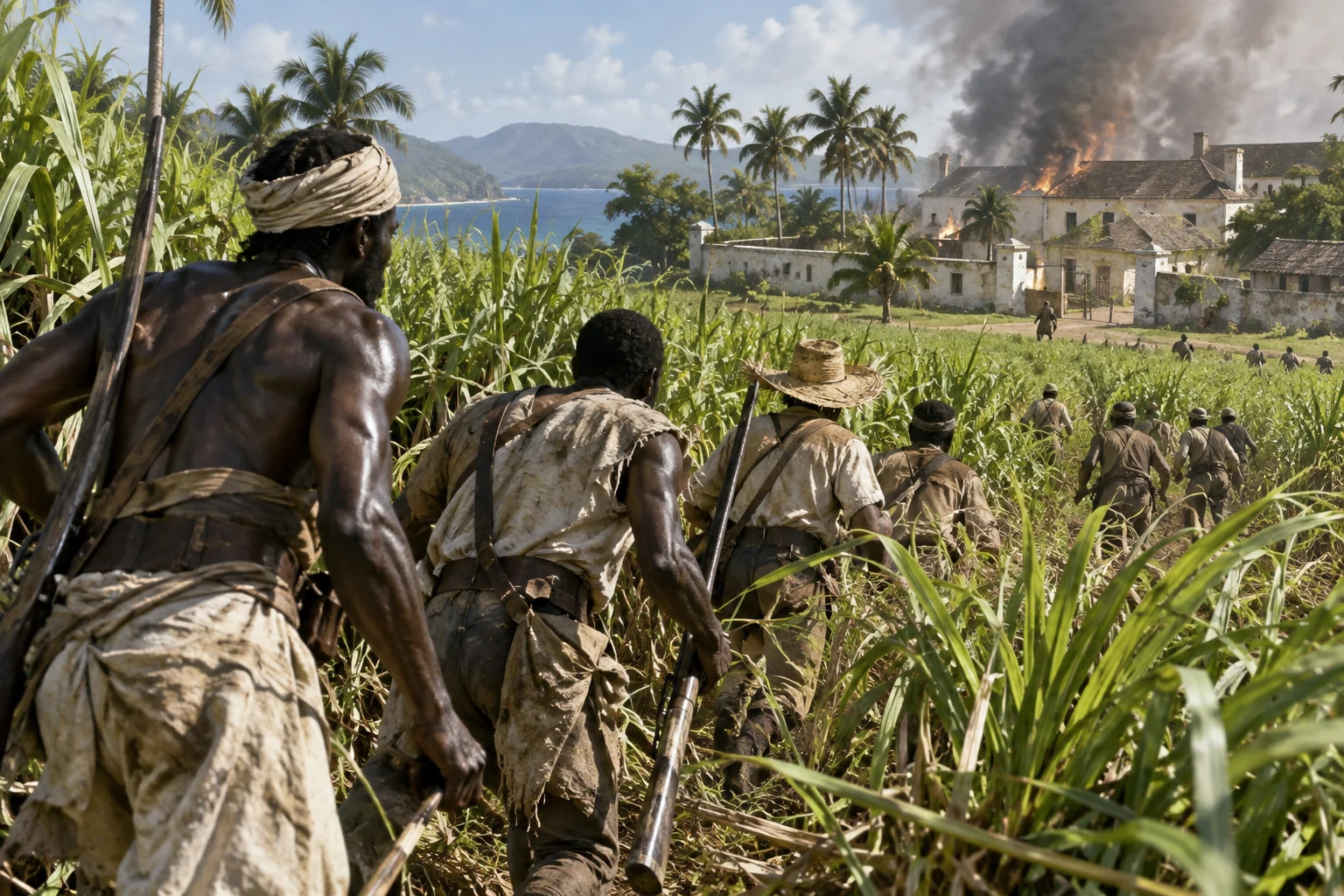
The only successful slave revolt in history, the Haitian Revolution destroyed the plantation system of France's richest colony and produced the independent state of Haiti (1 January 1804). Beginning with the Bois Caïman uprising (August 1791), it unfolded through phases: slave insurrection, Spanish and British intervention during the French Revolutionary wars, Toussaint Louverture's ascendancy, Napoleon's attempt to restore slavery (1802), and final victory under Dessalines. Disease — especially yellow fever — killed far more European soldiers than combat.
Causes (attributed)
- Slavery and plantation brutality: Saint-Domingue's sugar economy rested on enslaved African labor under exceptionally lethal conditions; historians attribute the revolt's scale to the colony's extreme exploitation and its large enslaved majority.
- Revolutionary contagion and political fracture: the French Revolution's ideals and the colony's white-planter, free-people-of-color, and enslaved divisions created openings the enslaved seized (History Extra).
- Contested: the role of the French Revolution as trigger vs. the revolt as an autonomous movement with its own logic; the degree of external (e.g., British, Spanish) instigation, which is generally treated as opportunistic rather than causal.
Course (brief, neutral)
The August 1791 uprising burned plantations across the north. France's National Convention abolished slavery (1794), and Louverture allied with the French, expelling the Spanish and then the British (1798). Louverture became the colony's effective ruler. Napoleon sent the Leclerc expedition (1802) to restore slavery; Louverture was captured and died in a French prison (1803). Under Dessalines, the insurgents defeated the French — decimated by yellow fever — at Vertières (November 1803); independence was declared on 1 January 1804.
Casualties
- Historian Robert L. Scheina: 350,000 Haitian dead and 50,000 European troops dead.
- Encyclopedia of African American Politics: nearly 200,000 Black deaths, thousands of mixed-race deaths, and up to 100,000 French and British soldiers dead.
- Historian David Geggus: at least three of every five British troops sent to Saint-Domingue in 1791–1797 died of disease.
- These estimates conflict in scope and category; present as ranges, not a settled total. Civilian deaths from famine and reprisals are embedded in these figures but not separately counted.
Outcome and legacy
- Independent Haiti (1804) — the first Black republic and the second independent state in the Americas; slavery abolished.
- France's defeat helped prompt Napoleon's sale of Louisiana to the United States (1803). Haiti paid a large indemnity to France (1825) for recognition, crippling its finances for generations.
- Legacy: the revolution became a touchstone of anti-slavery and anti-colonial movements; its leaders' reputations (Louverture, Dessalines, Christophe) remain debated — liberators vs. authoritarian rulers.
Historiography pulse
- Consensus: the revolution as the radical edge of the Age of Revolution; disease as the decisive military factor against European armies; the 1825 indemnity as a long-run economic catastrophe.
- Debates: Dessalines's 1804 massacres of remaining French colonists — scale, intent, and characterization (atrocity vs. founding violence); Louverture's constitutional authoritarianism; the revolution's place in French vs. Haitian national memory.
- Notable scholarship: David Geggus's work on the British intervention; Robert L. Scheina on Latin American military history. Links were not verified in this research pass.
UNVERIFIED list
- Any single settled death total (Scheina's 400,000 vs. the Encyclopedia's ~300,000 conflict).
- Breakdown of combat vs. disease vs. famine deaths among Haitians.
- Death toll of the 1804 massacres of French colonists (widely varying claims).
Sources
- Overview and estimates: https://www.dejavu.org/cgi-bin/get.cgi?ver=95&url=http%3A%2F%2Fweb.archive.org%2Fweb%2F20190112140734%2Fhttps%3A%2F%2Fen.wikipedia.org%2Fwiki%2FHaitian_Revolution
- Background: https://www.historyextra.com/membership/haitian-revolution-rebellion-hispaniola-what-happened-toussaint-louverture/