Conflict dossier · #26 of 120
26. Hussite Wars (1419–1434)
Medieval Tier 2
26. Hussite Wars (1419–1434)
Overview
- Belligerents: Hussite factions (Taborites, Orebites/Orphans, Praguers/Utraquists) vs. the Catholic crusading coalitions of Sigismund of Luxembourg, the papacy, and German princes.
- Dates: 1419–1434 (conventional; Hussite raiding expeditions continued into the 1430s).
- Theater: Bohemia, with the famous Spanilé jízdy ("beautiful rides") carrying Hussite armies into Germany, Austria, Poland, and Hungary.
- Outcome: Military stalemate resolved by the Compactata of Basel (1436) — Utraquist communion in both kinds accepted; radical Taborites crushed by moderate Hussites at Lipany (1434).
Causes
Jan Hus's reform preaching and his execution at Constance (1415); the indulgence controversy; Bohemian religious and political tensions; Sigismund's contested succession; the First Defenestration of Prague (1419); and a series of papally proclaimed crusades against the Hussites. Attribution: modern Czech and international scholarship treats the wars as simultaneously religious, social, and national-political.
Course
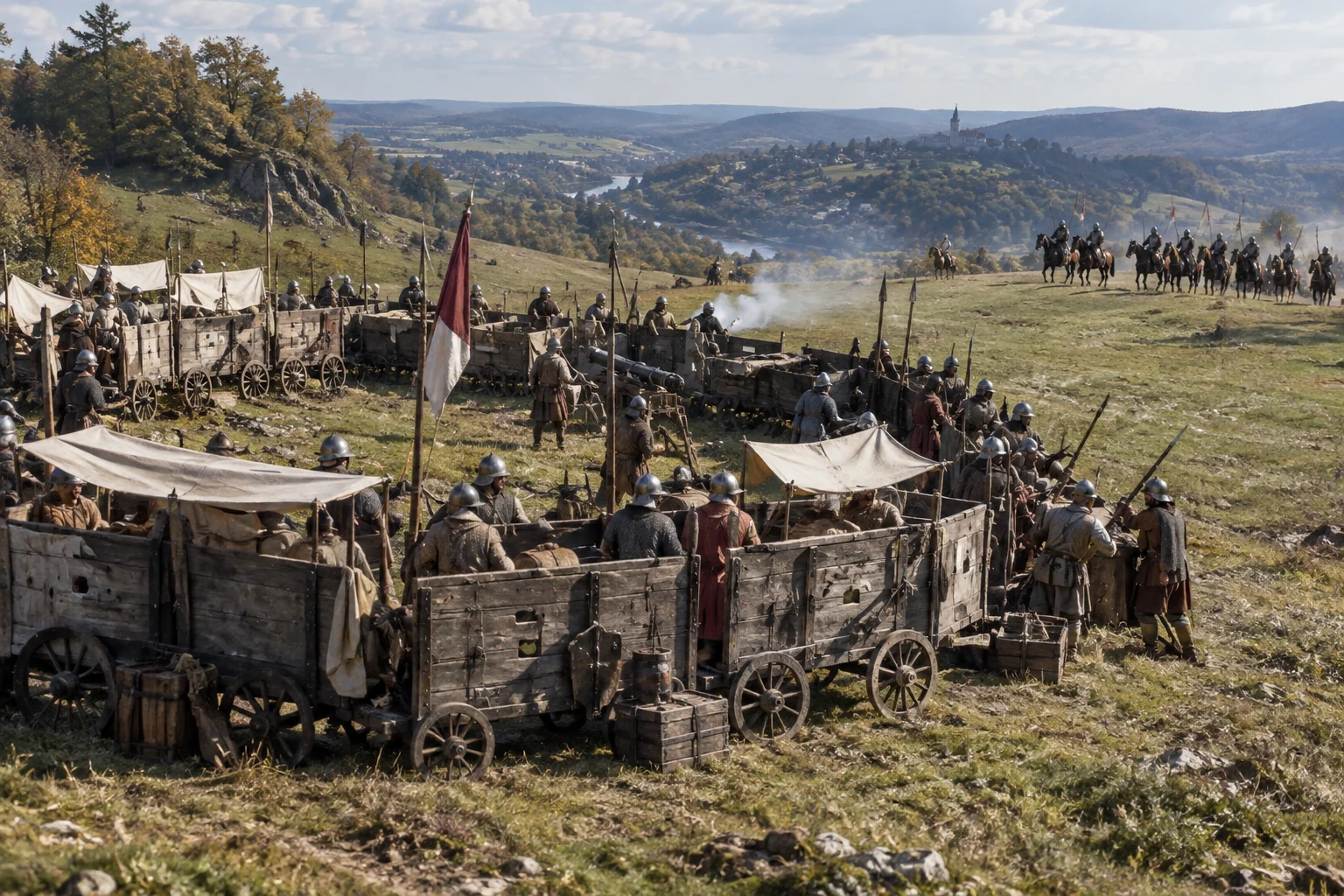
Five anti-Hussite crusades (1420–1431) were defeated, notably at Vítkov Hill (1420), Kutná Hora (1421–1422), and Domažlice (1431), through Jan Žižka's (d. 1424) and Prokop the Great's use of wagon forts (vozová hradba), field artillery, and hand firearms. Internal Hussite divisions led to Lipany (1434), where the Utraquist–Catholic coalition destroyed the Taborite field army.
Casualties
- The Kutná Hora campaign (1421–1422) carries claims of 2,000–12,000 crusader dead; Hussite losses unknown. Chronicler figures require caveat.
- No reliable total-war death toll was found; the aggregate is UNVERIFIED.
- UNVERIFIED: any total death toll for the wars.
Outcome & Legacy
The Compactata made Bohemia the first officially bi-confessional land in Latin Christendom; the wars pioneered extensive battlefield use of handguns, field artillery, and wagon forts; they stand as the great pre-Reformation religious war and a cornerstone of Czech national memory (Žižka, Hus).
Historiography Pulse
- Consensus on military innovation and the wars' pre-Reformation significance; debate on the social-revolutionary character of Taboritism and on "Czech national" framings.
- The johnhus.org documentary project reflects continued public-history interest.
- Documentaries: Czech public-history documentaries; the johnhus.org documentary noted in sources.
- Validation tier: Tier 2 — strong evidence for campaigns and outcome; casualty totals absent.
Sources
- https://en.wikipedia.org/wiki/Battle_of_Kutn%C3%A1_Hora
- https://en.wikisource.org/wiki/The_Hussite_Wars/Chapter_3
- http://en.wikipedia.org/wiki/Hussite_Wars
- https://johnhus.org/content/documentary/
Images (8 views — files in images/hussite-wars/)
| File | View |
|---|---|
| 01-hero-battle-art.jpg | Hussite wagon-fort battle (art) |
| 02-theater-map.jpg | Hussite Wars theater map |
| 03-hus.jpg | Jan Hus statue, Prague |
| 04-vitkov.jpg | Vítkov Hill / Žižka memorial |
| 05-tabor.jpg | Tábor (Hussite town) |
| 06-hand-cannon.jpg | Hussite hand cannon / early firearms (museum) |
| 07-chalice.jpg | Hussite chalice emblem/banner |
| 08-kutna-hora.jpg | Kutná Hora (St. Barbara's Church) |