Conflict dossier · #32 of 120
32. Imjin War (1592–1598)
Medieval Tier 1
32. Imjin War (1592–1598)
Overview
- Belligerents: Toyotomi Japan (invader; ~300,000 men across two invasions) vs. Joseon Korea (primary defender) aided by Ming China (43,000+ men in the first phase, 75,000+ in the second). Righteous armies (uibyeong) of Korean volunteers and Admiral Yi Sun-sin's navy were decisive Korean elements.
- Dates: May 1592 (landing at Busan) – December 1598 (Battle of Noryang; Japanese withdrawal). Two invasions: Bunroku campaign (1592–1593) and Keichō campaign (1597–1598), separated by a truce/negotiation lull.
- Theater: Korean Peninsula — land campaigns from Busan to Pyongyang, and the southern coastal waters (Hansan, Myeongnyang, Noryang).
- Outcome: Japanese defeat and complete withdrawal; status quo ante bellum restored; Korea devastated; Ming China fiscally drained; Toyotomi power in Japan fatally weakened ahead of Sekigahara (1600).
Causes
Toyotomi Hideyoshi, having unified Japan (1590), demanded Korea serve as the invasion corridor for his stated ambition to conquer Ming China — the motive universally attested in Japanese sources and accepted by scholarship (Kenneth Swope, A Dragon's Head and a Serpent's Tail). Historians debate supplementary motives: diverting and rewarding the restless daimyo armies; securing trade dominance; Hideyoshi's megalomania. Korea's Joseon court, divided by factionalism, rejected passage and refused military preparation; Ming China intervened to protect its tributary ally. Attribution: the China-conquest ambition is Hideyoshi's stated program; structural motives are historians' interpretations.
Course
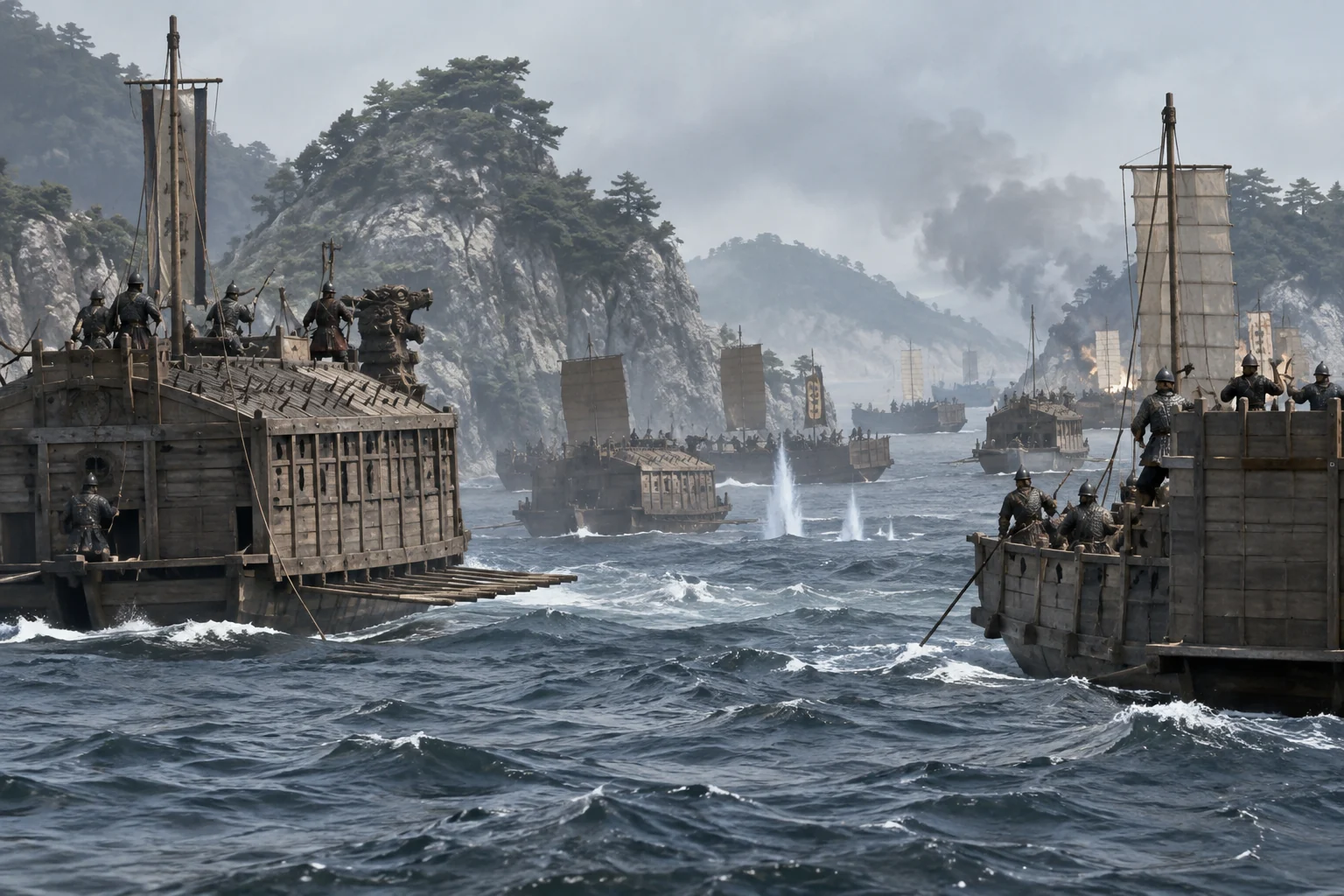
1592: 158,000 Japanese land at Busan, sweep north, take Hanseong (Seoul) and Pyongyang. At sea, Admiral Yi Sun-sin annihilates Japanese squadrons — Hansan (August 1592, the "crane-wing" formation) — severing Japanese logistics. 1593: Ming intervention under Li Rusong retakes Pyongyang; stalemate and truce negotiations (farcical, built on mutual mistranslation). 1597: second invasion (141,500 Japanese); Yi Sun-sin, briefly disgraced and reinstated, wins Myeongnyang (1597) with 13 ships against a vastly larger Japanese fleet. Hideyoshi dies (September 1598); the Council of Five Elders orders withdrawal. 16 December 1598: Noryang — Korean-Ming fleet destroys the Japanese evacuation fleet; Yi Sun-sin is killed in the battle.
Casualties
- Korean military: 185,000+ killed, 50,000–60,000 captives (Wikipedia, citing Korean sources); army + civilian total given as ~1,000,000 (Wikipedia's "Japanese invasions of Korea" article, citing source [14]); an independent overview (imjinwarhistory.com) gives 1–2 million total deaths across the war.
- Ming China: 30,000+ dead (Wikipedia).
- Japan: total casualties unknown; 460+ ships lost (Wikipedia).
- UNVERIFIED: any single aggregate death toll — the 1-million and 1–2-million figures are tertiary compilations, not scholarly consensus counts; Korean claims of 185,000 military dead are from Korean national sources and not independently corroborated; Japanese figures are unknown, not zero.
- Civilian devastation is nevertheless well documented: mass enslavement/deportation of Korean artisans to Japan, burned farmland, and famine.
Outcome & Legacy
Korea was left economically and demographically devastated; the Ming dynasty's war spending (one of Wanli's "Three Great Campaigns") contributed to its fiscal crisis and eventual fall to the Manchus (1644) — a causal link argued by scholars but debated in strength. In Japan, the war discredited the Toyotomi and enabled Tokugawa Ieyasu's rise. In Korea, Admiral Yi Sun-sin became the central national hero (statue at Gwanghwamun, Hyeonchungsa shrine). Diplomatic and trade relations were restored from 1607 and endured two centuries (World History Encyclopedia via screenrant.com summary).
Historiography Pulse
- The landmark English-language study is Kenneth Swope's A Dragon's Head and a Serpent's Tail: Ming China and the First Great East Asian War, 1592–1598 (2009), which reframes the war as a Ming-centered great-power conflict rather than a purely Korean national epic.
- Three national framings coexist: Korean Imjin Waeran (Japanese aggression narrative; North Korea's "Imjin Fatherland War"); Japanese Bunroku-Keichō no Eki (neutral era-name terminology avoiding "invasion"); Chinese Wanli Chaoxian Zhanzheng (defense of a tributary ally).
- Contested specifics: the turtle ship's (geobukseon) actual role (Korean national symbolism vs. historians who stress the panokseon fleet as a whole); casualty numbers as national-memory politics.
- Documentaries: Korean and Japanese documentary coverage exists; no single consensus flagship documentary identified in English — noted as a gap.
- Validation tier: Tier 1 — multi-source consensus on course, belligerents, and outcome; casualty aggregates contested and national-source-dependent (Tier 2–3 by figure).
Sources
- https://imjinwarhistory.com/imjin-war-complete-guide-1592-1598/
- https://ipfs.io/ipfs/QmXoypizjW3WknFiJnKLwHCnL72vedxjQkDDP1mXWo6uco/wiki/Imjin_War.html (mirror of Wikipedia's "Japanese invasions of Korea (1592–98)")
- https://en.wikipedia.org/wiki/Battle_of_Noryang
- https://en.wikipedia.org/wiki/Battle_of_Byeokjegwan
- https://en.wikipedia.org/wiki/Battle_of_Pyongyang_(1592)
- https://en.wikipedia.org/wiki/Battle_of_Jiksan
- https://screenrant.com/shogun-imjin-war-japan-korea-history-explained/
- https://en.topwar.ru/205026-imdzhinskaja-vojnafinal.html
Images (8 views — files in images/imjin-war/)
| File | View |
|---|---|
| 01-hero-turtle-ship.jpg | Turtle ship (geobukseon) replica, museum (tasteful hero) |
| 02-theater-map.jpg | Theater map of the 1592 and 1597 invasions |
| 03-yi-sun-sin-statue.jpg | Admiral Yi Sun-sin statue, Gwanghwamun, Seoul |
| 04-hansan-painting.jpg | Contemporary painting of the Battle of Hansan |
| 05-japanese-castle.jpg | Japanese fortress ruins in Korea (Suncheon/Ulsan) |
| 06-hyeonchungsa.jpg | Hyeonchungsa shrine / Admiral Yi memorial |
| 07-byobu-screen.jpg | Japanese byōbu screen depicting the invasion |
| 08-busan-landing.jpg | Busan landing site memorial |