Conflict dossier · #67 of 120
Indonesian National Revolution (1945–1949)
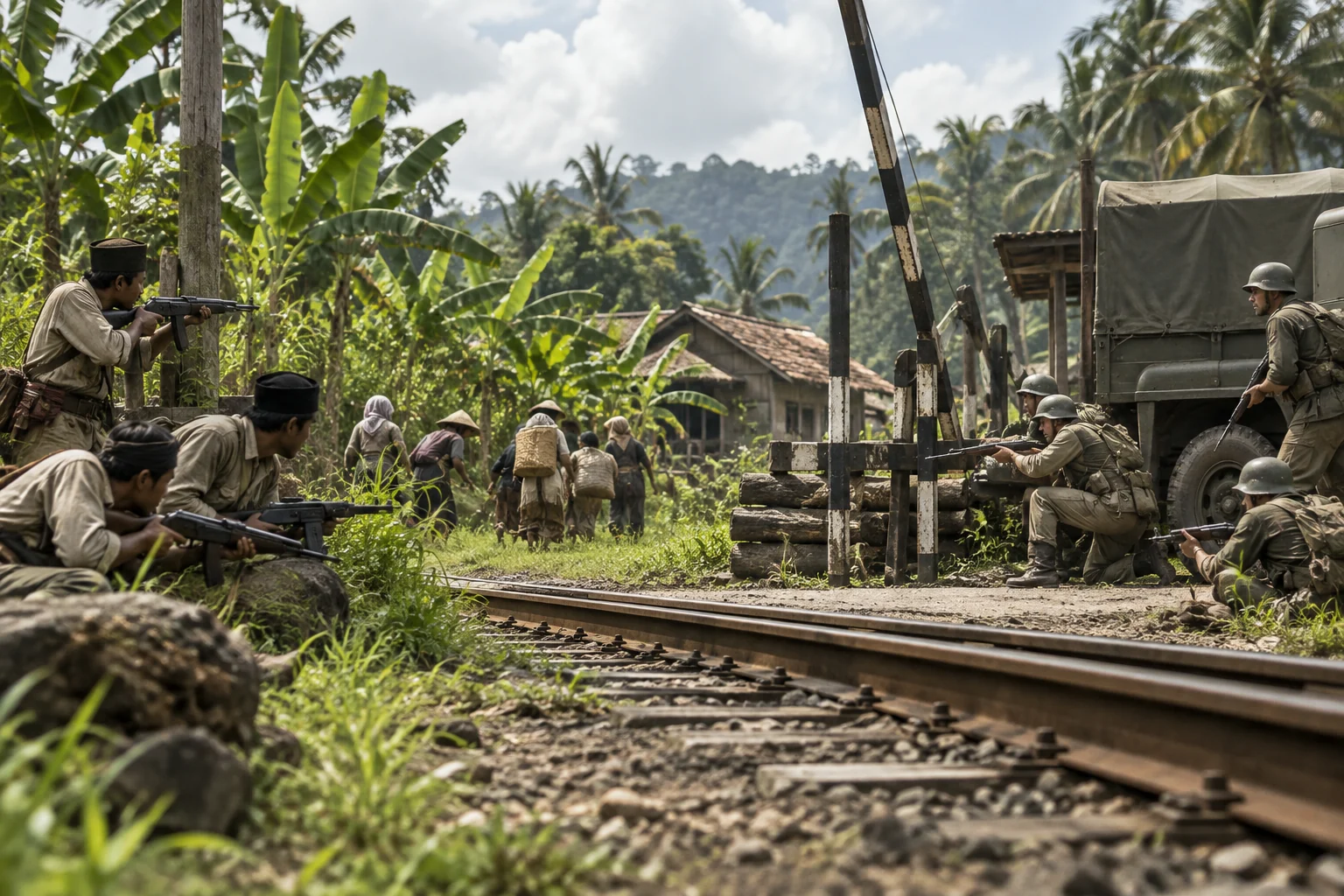
20th Century Tier 1
Indonesian National Revolution (1945–1949)
Overview
- Belligerents: Republic of Indonesia (Sukarno, Mohammad Hatta; Indonesian Army/TNI and militias) vs. the Netherlands (Dutch Army, KNIL; two "Police Actions" 1947, 1948–49); British forces (1945–46) initially as the occupying Allied authority; Japanese forces (1945) in transitional roles.
- Dates: 17 August 1945 (proclamation of independence) – 27 December 1949 (transfer of sovereignty)
- Theater: Java, Sumatra, Sulawesi, and across the Indonesian archipelago.
Causes — attributed
- General historical consensus (factsanddetails.com; talkdiplomacy.com): the Japanese occupation (1942–45) destroyed Dutch colonial authority and armed/trained Indonesian nationalists; Sukarno and Hatta proclaimed independence days after Japan's surrender; the Netherlands refused recognition and sought to restore colonial rule.
- Scholars attribute the outbreak to the power vacuum of 1945 — British forces tasked with disarming the Japanese became de facto Dutch allies (Battle of Surabaya, November 1945) — and to the Dutch "Police Actions" (Operation Product, July 1947; Operation Crow, December 1948) which internationalized the conflict.
- Academic debate: the role of the US (initially neutral, then pressuring the Dutch via Marshall Plan leverage); the Cold War framing — the Madiun Affair (1948, the Republic's suppression of a communist uprising) helped win American sympathy for the nationalists.
Course
After the 17 August 1945 proclamation, pemuda (youth) militias seized Japanese arms; the Battle of Surabaya (November 1945) against British forces became the revolution's founding battle. The British withdrew in 1946; the Dutch launched two "Police Actions" — July 1947 (Operation Product) and December 1948 (Operation Crow, capturing Yogyakarta and the Republican leadership) — but guerrilla resistance under General Sudirman continued, and international condemnation (UN Security Council resolutions, US threats to cut Marshall aid) forced the Round Table Conference at The Hague; sovereignty transferred 27 December 1949.
Casualties — ranges with named sources
- Indonesian deaths: Wikipedia: 97,421–100,000 (fighting and civilians); factsanddetails.com (citing Reuters, 2022): "around 6,000 Dutch soldiers died in the war and at least 150,000 Indonesians were killed. Around 100,000 Indonesians died as a direct result of the war, and the total human cost has been estimated at about 250,000 lives."
- politikon.iapss.org (citing KITLV's Harinck, Van Horn, and Luttikhuis, 2017): ~100,000 Indonesians died vs. ~5,000 Dutch soldiers.
- Dutch: more than 4,000 Dutch soldiers (Wikipedia); historica.fandom.com: 6,228 Dutch troops died; British: 980 killed or missing in Java and Sumatra 1945–46, mostly Indian soldiers (Wikipedia).
- Demographic: historian Pierre van der Eng estimated a demographic gap of ~2.4 million people in Indonesia across the 1940s (including Japanese occupation); a UN study estimated at least 4 million Indonesians died 1942–1949 from war, famine, and colonial-order collapse (cited on medium.com — attributed).
- Contested: the Westerling/South Celebes affair (1946–47): Indonesian official figures claim up to 40,000 killed; Dutch official reports (IJzereef, Commission Enthoven) put Westerling's direct responsibility at 388–1,055; Geersing argues ~256–388 (scripties.uba.uva.nl) — Tier 3, politically charged.
Outcome & legacy
- Dutch recognition of Indonesian sovereignty (27 December 1949); end of the Dutch East Indies; Sukarno's Republic of Indonesia (unitary state proclaimed 17 August 1950).
- The revolution is Indonesia's founding national narrative; the Netherlands only fully acknowledged the 1945–49 period as a war of independence in the 2020s — the 2022 Dutch government-commissioned study concluded Dutch forces committed "extreme violence" on a structural basis (factsanddetails.com, Reuters 2022).
- ~7 million displaced on Java and Sumatra (Wikipedia).
Historiography pulse
- Academic consensus: a decolonization war won through a combination of military resistance and international (especially US/UN) pressure.
- Major debates: (a) casualty figures — Indonesian vs. Dutch counts differ substantially (Tier 2–3); (b) the "Police Actions" terminology vs. "war" framing; (c) the scale of Dutch atrocities — the 2022 Dutch government study marked a historiographic turning point; (d) the Cold War reading (Madiun) vs. nationalist reading.
- Notable scholarship: the 2022 multi-volume Dutch government study Over de grens / "Beyond the Pale" (KITLV-NIOD-NIMH); David Anderson's work on the revolution; Benedict Anderson, Java in a Time of Revolution (1972), a classic.
Validation tier
Tier 1 on causes, course, outcome; Tier 2 on aggregate casualty bands (~100,000 Indonesian / ~4,000–6,000 Dutch — convergent ranges); Tier 3 on the South Celebes/Westerling figures (flagged).
UNVERIFIED points
- Exact Indonesian deaths: 97,421–100,000 (fighting/civilian) vs. 250,000 total human cost — different definitions, no single settled figure.
- Westerling affair deaths: 256 to 40,000 across sources — heavily contested.
- UN "4 million Indonesians 1942–1949" figure includes Japanese occupation famine and is an attributed estimate.
Sources
- Wikipedia, "Indonesian National Revolution" — https://en.wikipedia.org/wiki/Indonesian_National_Revolution
- Facts and Details, "Indonesian War of Independence (1945-1949)" — https://factsanddetails.com/indonesia/History_and_Religion/sub6_1c/entry-9663.html
- TalkDiplomacy, "The Indonesian National Revolution" — https://www.talkdiplomacy.com/post/theindonesiannationalrevolution
- Politikon/IAPSS (KITLV casualty citation) — http://politikon.iapss.org/index.php/politikon/article/download/517/472/1038
- Medium / Nusantara & The Netherlands, "Free of Everything" (2025) — https://medium.com/nusantara-the-netherlands/free-of-everything-5a3a4f010573
- University of Amsterdam thesis on the Westerling affair — https://scripties.uba.uva.nl/download?fid=c4075308
Images
Sources
- Wikipedia, "Indonesian National Revolution"
- Facts and Details, "Indonesian War of Independence (1945-1949)"
- TalkDiplomacy, "The Indonesian National Revolution"
- Politikon/IAPSS (KITLV casualty citation
- Medium / Nusantara & The Netherlands, "Free of Everything" (2025
- University of Amsterdam thesis on the Westerling affair