Conflict dossier · #23 of 120
23. Mongol Conquests (1206–1368)
Medieval Tier 2
23. Mongol Conquests (1206–1368)
Overview
- Belligerents: The Mongol Empire under Genghis Khan and his successors (later the Yuan, Ilkhanate, Chagatai, and Golden Horde khanates) vs. the Jin and Song dynasties, the Khwarezmian Empire, Kievan Rus' principalities, Persia, the Abbasid Caliphate, and others.
- Dates: 1206 (Genghis Khan's proclamation) to 1368 (fall of the Yuan) per the plan bracket; Timur's campaigns are excluded from this dossier even where popular totals fold them in.
- Theater: East Asia, Central Asia, Persia, the Middle East, Russia, and eastern Europe.
- Outcome: The largest contiguous land empire in history; destruction of numerous states; long-term demographic and political transformation of Eurasia.
Causes
Genghis Khan's unification of the steppe tribes created a formidable military machine; expansion was driven by the logic of steppe empire-building, the pursuit of pasture, tribute, and security, and the momentum of successive campaigns. Attribution: modern historians debate the relative weight of deliberate strategy vs. the self-reinforcing dynamics of conquest; claims of purely defensive expansion are not consensus.
Course
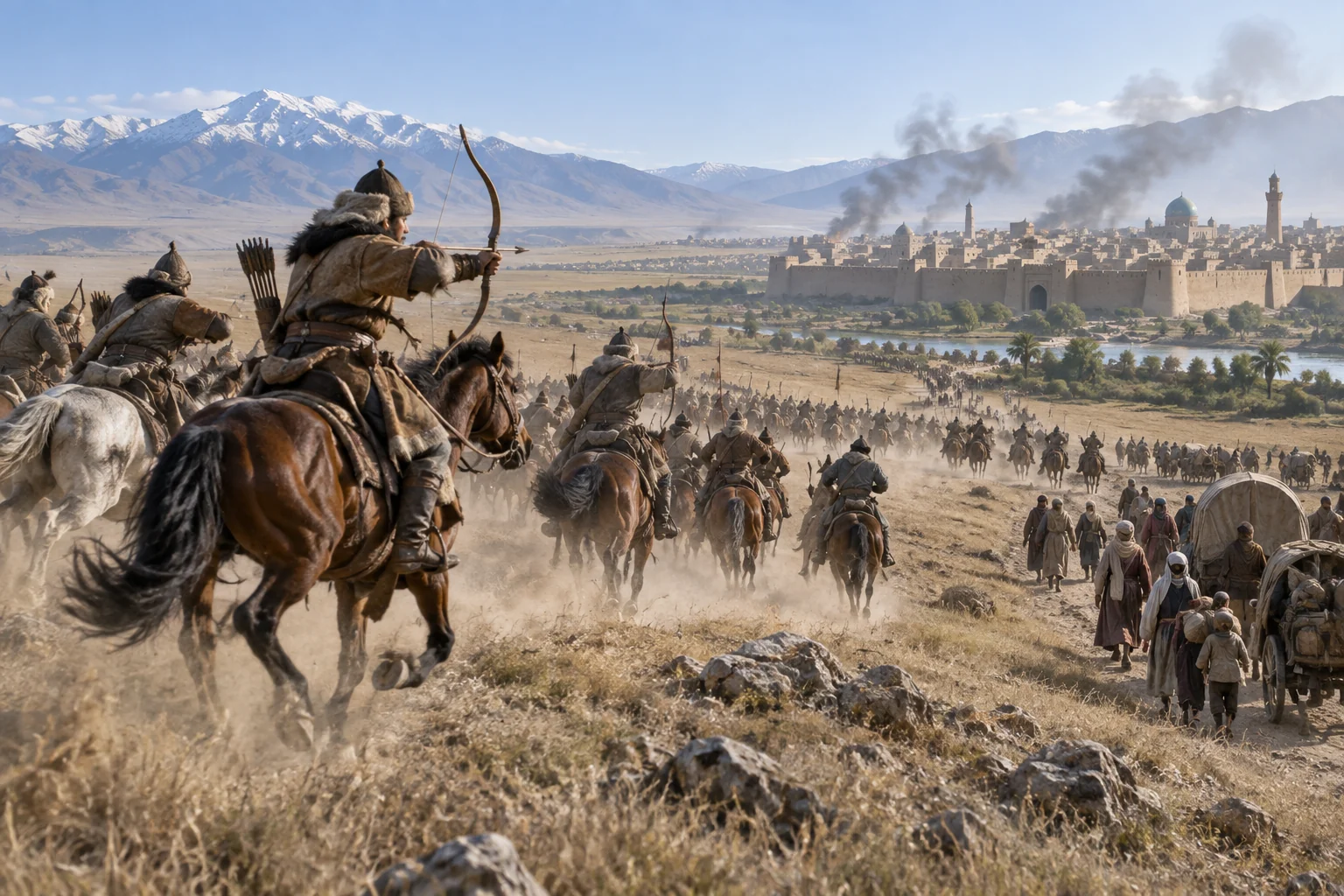
The Jin dynasty was progressively reduced (1211–1234); the Khwarezmian Empire was annihilated (1219–1221); Rus' principalities fell (1237–1242); Persia was conquered; Baghdad fell to Hülegü in 1258, ending the Abbasid Caliphate; the Southern Song fell in 1279, completing the Yuan conquest of China. Western Europe was spared full invasion after the 1241–1242 withdrawal.
Casualties
- The popular aggregate of 20–60 million deaths is widely repeated but methodologically criticized; the underlying censuses and extrapolations are disputed. The entire range is UNVERIFIED.
- Medieval city-level claims — 1.2 million at Urgench, 1.7 million at Nishapur, 700,000 at Merv — are logistically disputed by modern historians.
- UNVERIFIED: the 20–60 million aggregate; medieval city massacre totals taken literally; any figure that folds Timur's campaigns into the Mongol total for this bracket.
Outcome & Legacy
Pax Mongolica enabled unprecedented Eurasian connectivity, trade, and technology transfer; the Black Death's westward movement is associated with Mongol-era networks (attribution: debated in detail, consensus on association). The conquests devastated agrarian regions of Persia, Mesopotamia, and northern China. The empire fragmented into competing khanates.
Historiography Pulse
- Traditional emphasis on conquest, massacre, and demographic destruction vs. Jack Weatherford's revisionist stress on administration, trade, and religious pluralism (Genghis Khan and the Making of the Modern World); critics argue Weatherford minimizes coercion and devastation. Timothy May and David Morgan provide scholarly counterweights.
- Active debate on demographic methodology and on the Mongols' administrative legacy.
- Documentaries: heavily covered in popular documentary; Weatherford's thesis widely popularized.
- Validation tier: Tier 2 — strong evidence for the conquest narrative; casualty aggregates heavily contested.
Sources
- https://en.wikipedia.org/wiki/Mongol_invasions
- https://www.zmescience.com/science/news-science/genghis-khan-environment-26052014/
- https://en.wikipedia.org/wiki/Genghis_Khan_and_the_Making_of_the_Modern_World
- https://www.youtube.com/watch?v=nIXEwnCD5WI
Images (8 views — files in images/mongol-conquests/)
| File | View |
|---|---|
| 01-hero-battle-art.jpg | Mongol siege/battle art |
| 02-empire-map.jpg | Mongol Empire at greatest extent (map) |
| 03-genghis.jpg | Genghis Khan monument/statue |
| 04-baghdad.jpg | Siege of Baghdad 1258 (miniature) |
| 05-warrior.jpg | Mongol warrior arms and armor (museum) |
| 06-persian-miniature.jpg | Ilkhanid Persian miniature (battle) |
| 07-ain-jalut.jpg | Battle of Ain Jalut 1260 (art) |
| 08-karakorum.jpg | Karakorum ruins / Erdene Zuu |