Conflict dossier · #21 of 120
21. Norman Conquest (1066)
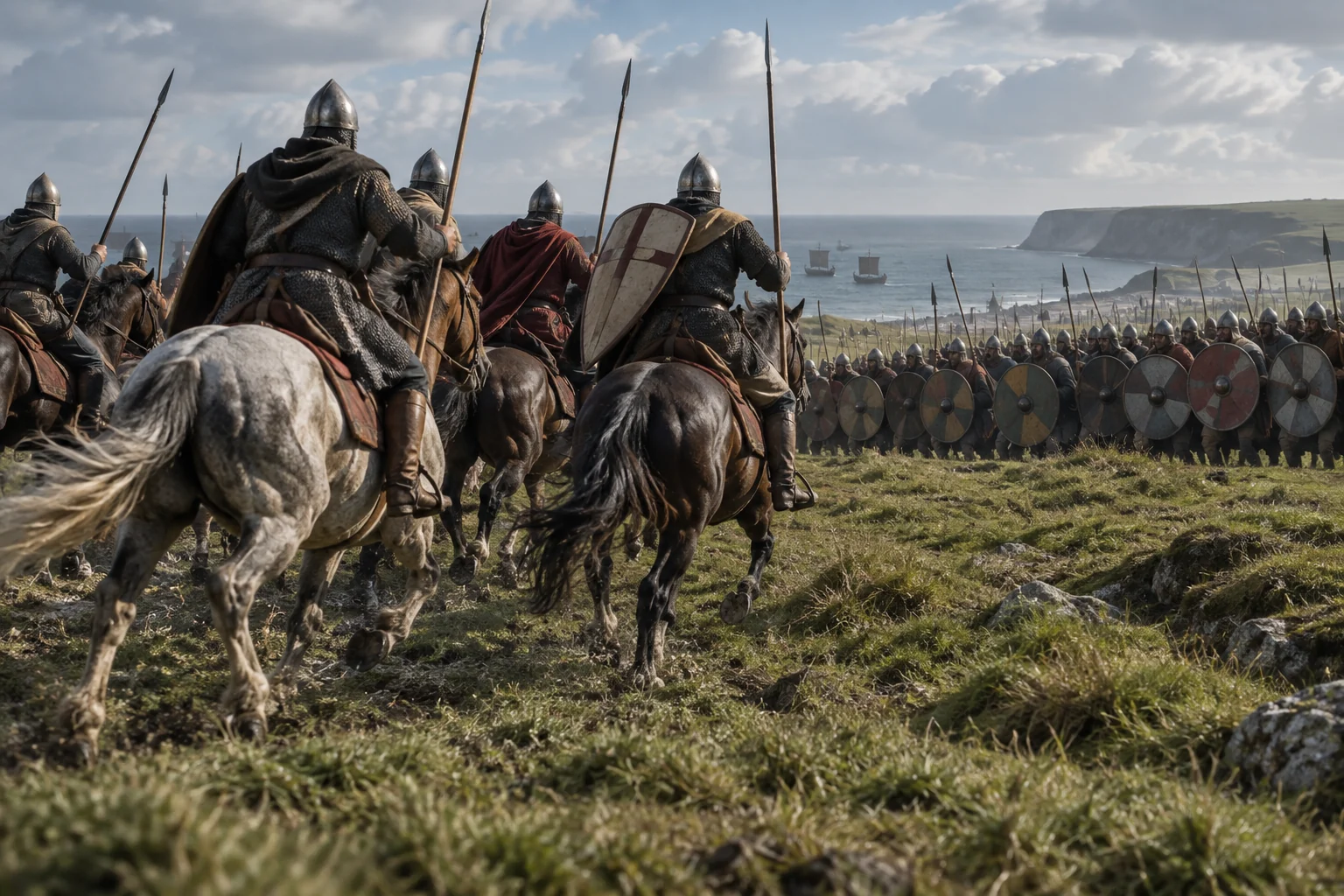
Medieval Tier 2
21. Norman Conquest (1066)
Overview
- Belligerents: William, Duke of Normandy (with Norman, Breton, Flemish, and French contingents, plus papal backing) vs. Harold Godwinson's England, with Harald Hardrada's Norway as a third force at Stamford Bridge.
- Dates: 1066 (with consolidation campaigns and revolts continuing into the 1070s, notably the Harrying of the North, 1069–1070).
- Theater: Southern and northern England.
- Outcome: Decisive Norman victory; William crowned at Westminster on Christmas Day 1066; the Anglo-Saxon aristocracy was replaced by a Norman-French elite.
Causes
The succession crisis after Edward the Confessor's childless death: Harold Godwinson's coronation was contested by William, who claimed a prior promise of the throne (a claim transmitted through Norman sources and the Bayeux Tapestry), and by Harald Hardrada. Attribution: the legitimacy of William's claim is a Norman-narrative construct; English sources present Harold as the lawful successor. Papal support for William added a religious sanction to the invasion.
Course
Hardrada's invasion was destroyed at Stamford Bridge (25 September 1066). Three days later William landed at Pevensey; Harold force-marched south and was killed at Hastings (14 October 1066), traditionally depicted as struck by an arrow in the eye in the Bayeux Tapestry. William's coronation followed, but resistance continued — revolts in the southwest, the Fenlands (Hereward the Wake), and the North, culminating in the Harrying of the North (1069–1070), a scorched-earth campaign in Yorkshire and the northern counties.
Casualties
- Hastings: estimates cluster around 2,000–3,000 Norman and 4,000–5,000 English dead; exact figures remain uncertain.
- Harrying of the North: Orderic Vitalis claims 100,000 dead — a chronicler estimate requiring caveat. Modern treatments often speak of tens of thousands dead from violence and consequent famine, but this also needs careful sourcing.
- The modern label "genocide" applied to the Harrying is a contested classification and must be attributed, not asserted.
- UNVERIFIED: total deaths in the Harrying of the North; any aggregate conquest death toll; literal readings of Orderic Vitalis.
Outcome & Legacy
The Conquest reoriented England toward continental Europe, replaced the ruling class and much of the episcopate, introduced Norman-French into law and administration, and produced Domesday Book (1086) — one of medieval Europe's great administrative surveys. The Bayeux Tapestry is the iconic near-contemporary visual record.
Historiography Pulse
- Debate continues on the Harrying's scale and on whether "genocide" is an applicable category.
- The Bayeux Tapestry is read both as Norman propaganda and as a richly detailed source.
- Documentaries: well-served by popular documentaries on Hastings and the Tapestry.
- Validation tier: Tier 2 — strong multi-source evidence for the campaign narrative; casualty figures for the Harrying contested.
Sources
- http://rachel.education.gov.ck/wikip/wp/b/Battle_of_Hastings.htm
- https://www.calendarz.com/on-this-day/october/14/norman-conquest
- https://www.youtube.com/watch?v=WUoctu2x35k
- https://www.youtube.com/watch?v=Asad9EUTXPg
Images (8 views — files in images/norman-conquest/)
| File | View |
|---|---|
| 01-hero-tapestry.jpg | Bayeux Tapestry — Battle of Hastings scene |
| 02-invasion-map.jpg | 1066 invasion routes map |
| 03-harold.jpg | Bayeux Tapestry — Harold Godwinson |
| 04-battle-abbey.jpg | Battle Abbey / Hastings battlefield |
| 05-william.jpg | William the Conqueror statue, Falaise |
| 06-white-tower.jpg | White Tower, Tower of London |
| 07-domesday.jpg | Domesday Book manuscript |
| 08-norman-knight.jpg | Norman knightly arms and armor |