Conflict dossier · #57 of 120
Russo-Japanese War (1904–1905)
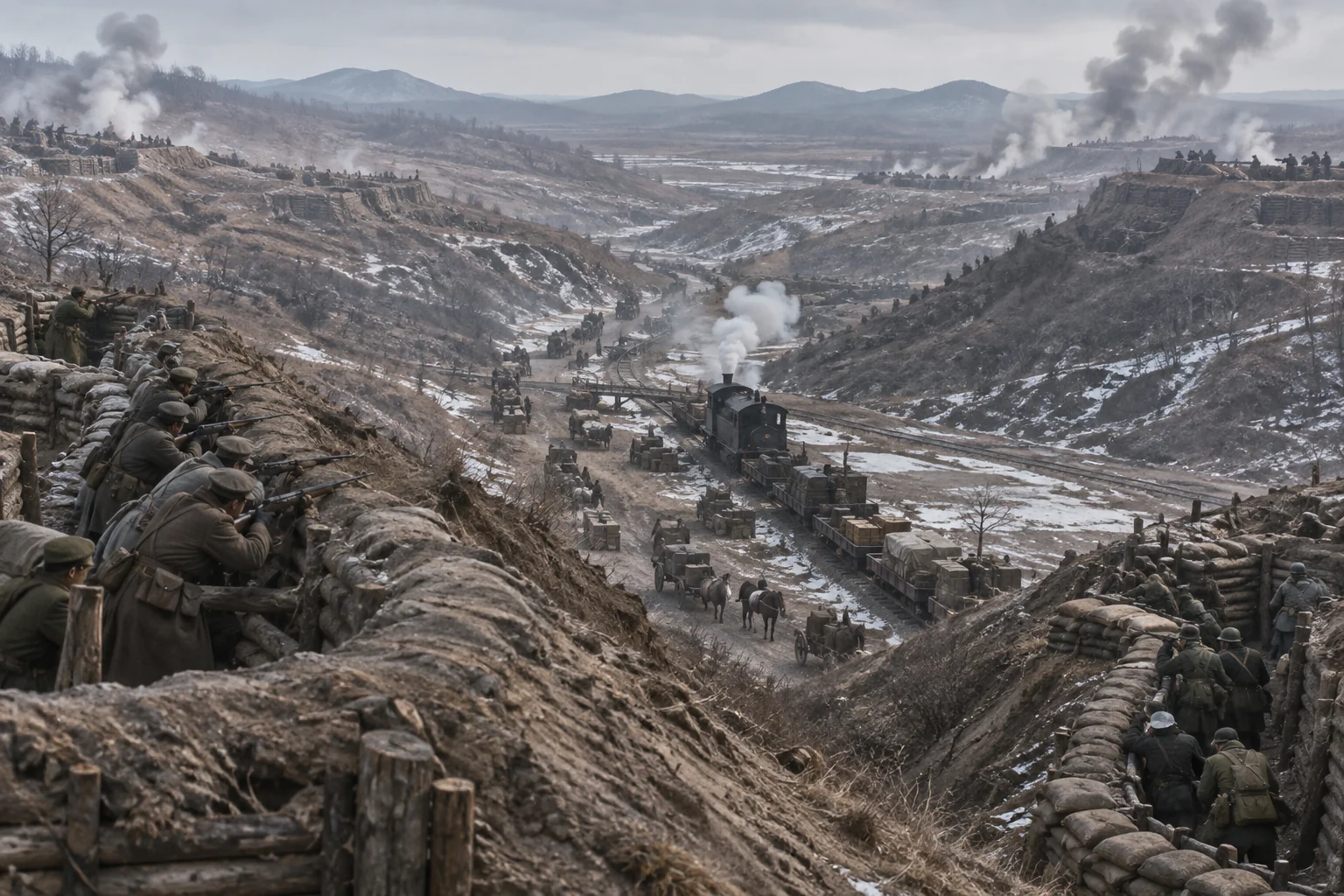
20th Century Tier 1
Russo-Japanese War (1904–1905)
Overview
- Belligerents: Empire of Japan vs. Russian Empire (Montenegro declared war on Japan in solidarity with Russia but played no military role)
- Dates: 8 February 1904 – 5 September 1905
- Theater: Manchuria (Northeast China), Korea, the Yellow Sea, the Sea of Japan
Causes — attributed
- Siobhan Peeling (International Encyclopedia of the First World War, 1914-1918-online.net) attributes the war to "Russian and Japanese expansionism in the Far East": clashes over military, political, and commercial interests in East Asia, rooted in the Triple Intervention of 1895 (Russia, France, Germany forcing Japan to return the Liaotung Peninsula won in the First Sino-Japanese War), Russia's subsequent 25-year lease of the Liaotung Peninsula and Port Arthur, troop movements into Manchuria during the Boxer Uprising, and railway-building on Chinese territory from 1897.
- Philip Streich and Jack S. Levy (Oxford Journals / International Studies Association, 2016) argue via a bargaining model of war that the primary causes were a commitment problem and preventive logic (Russia's growing relative power), plus informational asymmetries: Russian political and military leaders underestimated Japanese capabilities and resolve — misperceptions they trace to racial/cultural stereotypes, psychological biases, and bureaucratic faction competition distorting decision-making.
- David Schimmelpenninck van der Oye (Toward the Rising Sun, 2001) emphasizes ideological causes: Russian imperialist ideologies (including Finance Minister Sergei Witte's "pénétration pacifique" via the Trans-Siberian Railway) and Tsar Nicholas II's own orientalist thinking legitimizing Russian designs in Asia.
- Consensus view (Peeling; classace.io summary of scholarship): both powers rejected compromise — Japan severed diplomatic relations 6 February 1904 after Russia rejected Japanese proposals for negotiations over Korea; Japan attacked Port Arthur 8 February and declared war 10 February.
Course
Japan struck first with a surprise naval attack on Port Arthur (8 February 1904), then won a series of land victories: Yalu River (April–May 1904), the siege of Port Arthur (July 1904–January 1905, after an eight-month siege), Yellow Sea (August 1904), Sandepu (January 1905), Mukden (February–March 1905). At sea, Admiral Tōgō Heihachirō destroyed Russia's Baltic Fleet at Tsushima (27–28 May 1905) after its eight-month voyage. With Russia shaken by the 1905 Revolution at home and Japan nearing financial exhaustion (war cost ~1.7 billion yen, per japanesewiki.com), both accepted US mediation; the Treaty of Portsmouth was signed 5 September 1905: both sides evacuated Manchuria, Russia ceded the southern half of Sakhalin to Japan, Korea became a Japanese protectorate, and Russia transferred the Liaodong lease to Japan.
Casualties — ranges with named sources
- Wikipedia (citing official published sources): Russia: 43,300–71,453 dead (34,000–52,623 killed/died of wounds; 9,300–18,830 died of disease); Japan: 80,378–99,000 dead (47,152–47,400 killed; 11,424–11,500 died of wounds; 21,802–27,200 died of disease).
- Patrick W. Kelley (Military Preventive Medicine, 2004, via thoughtco.com): Russia ~38,000 battle dead + 18,830 disease deaths; Japan 58,257 battle dead + 21,802 disease deaths.
- Combined military dead generally stated at 130,000–170,000 (ipfs Wikipedia mirror; bootcampmilitaryfitnessinstitute.com).
- China suffered ~20,000 civilian deaths plus financial losses of over 69 million taels of silver (Wikipedia mirror via ipfs.io).
Outcome & legacy
- First decisive defeat of a European great power by an Asian nation in the modern era; Japan emerged as a great power, annexed Korea in 1910 (Japan–Korea Treaty).
- Russia's defeat accelerated the 1905 Revolution and forced concessions to the Duma; historians (e.g., classace.io summary) link the humiliation to the eventual overthrow of the Romanovs in 1917.
- The war's battles (notably Port Arthur's siege warfare) held lessons for WWI that contemporaries largely dismissed, according to encyc.org.
- George E. Mowry (quoted on Wikipedia) concludes Roosevelt "did an excellent job of balancing Russian and Japanese power in the Orient"; Roosevelt earned the 1906 Nobel Peace Prize for mediating. The Japanese public, expecting an indemnity and Russian cessions, rioted in Tokyo (Hibiya incendiary incident, September 1905).
- Led to the 1906 Second Geneva Convention on protection of shipwrecked soldiers (Wikipedia mirror via ipfs.io).
Historiography pulse
- Academic consensus (Peeling, 1914-1918-online.net; Schimmelpenninck van der Oye; Streich & Levy): causes debated across geostrategic, ideological, and decision-making schools; no single-factor account dominates.
- Major debate: the "bureaucratic rivalry" school (Witte vs. Bezobrazov/Alekseyev) vs. structural-geostrategic accounts of Manchuria/Korea rivalry.
- Notable scholarship: Schimmelpenninck van der Oye, Toward the Rising Sun (2001); Streich & Levy, "Information, Commitment, and the Russo-Japanese War of 1904–1905" (International Studies Quarterly, 2016).
Validation tier
Tier 1 — multi-source academic consensus on causes, course, and outcome; casualty figures presented as ranges across named sources.
UNVERIFIED points
- Exact casualty totals: sources disagree; no single agreed figure. The 130,000–170,000 combined military-dead range is a commonly cited band, not a settled count.
Sources
- Siobhan Peeling, "Russo-Japanese War," 1914-1918-online.net — https://encyclopedia.1914-1918-online.net/article/russo-japanese-war-2-0/?format=pdf
- Philip Streich & Jack S. Levy, "Information, Commitment, and the Russo-Japanese War of 1904–1905" (2016) — https://static1.squarespace.com/static/693db56638b73579024695de/t/69596e94459ac80c50961810/1767468692405/2016+Information%2C+Commitment%2C+%26+Russo-Japanese+War.pdf
- Wikipedia timeline/casualty summary (official-source citations) — https://en.wikipedia.org/wiki/Timeline_of_the_Russo-Japanese_War
- ThoughtCo, "Facts on the Russo-Japanese War" (Kelley casualty figures) — https://www.thoughtco.com/facts-on-the-russo-japanese-war-195812
- Japanese Wiki Corpus casualty detail — https://www.japanesewiki.com/history/Russo-Japanese%20War.html
Images
Sources
- Siobhan Peeling, "Russo-Japanese War," 1914-1918-online.net
- Philip Streich & Jack S. Levy, "Information, Commitment, and the Russo-Japanese War of 1904–1905" (2016
- Wikipedia timeline/casualty summary (official-source citations
- ThoughtCo, "Facts on the Russo-Japanese War" (Kelley casualty figures
- Japanese Wiki Corpus casualty detail