Conflict dossier · #82 of 120
Rwandan Civil War and Genocide (1 October 1990 – 18 July 1994)
20th Century Tier 1
Rwandan Civil War and Genocide (1 October 1990 – 18 July 1994)
Overview
- Belligerents: The Hutu-led Rwandan government and armed forces (FAR), the Interahamwe and Impuzamugambi militias, and much of the civilian Hutu population mobilized for killing, vs. the Tutsi-led Rwandan Patriotic Front (RPF, under Paul Kagame), which invaded from Uganda in 1990.
- Theater: Rwanda; massive refugee outflows to Zaire/DRC and Tanzania.
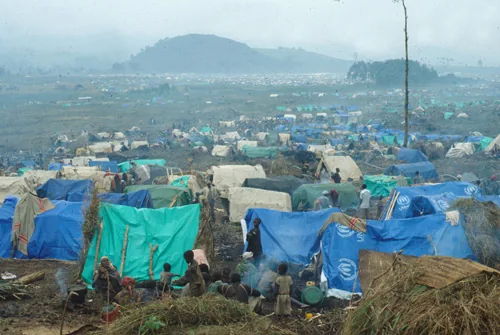
- Outcome: The RPF defeated the government forces and stopped the genocide, taking Kigali in July 1994; ~2 million Hutus fled to Zaire fearing retribution; the genocide's organizers regrouped in eastern Zaire, seeding the Congo wars.
Causes (attributed)
- Scholars (Gérard Prunier, Alison Des Forges of Human Rights Watch, Mahmood Mamdani, Scott Straus) trace the genocide to: colonial-era racialized Hutu/Tutsi categories hardened by Belgian identity cards; the 1959–62 Hutu revolution and cycles of anti-Tutsi violence; economic crisis and political liberalization pressures in the early 1990s; and a small Hutu-power elite's deliberate planning — Des Forges' Leave None to Tell the Story documents the planning evidence.
- The RPF invasion (1990) and the Arusha Accords (1993) power-sharing deal are cited as the context in which hardliners chose extermination; the 6 April 1994 shooting down of President Habyarimana's plane is the consensus trigger, but who shot it down is UNVERIFIED and fiercely contested (attributions exist on multiple sides; French judicial investigations have shifted over time).
- Straus and others emphasize mass civilian participation driven by authority structures, fear, and material incentives — not only top-down orders; Mamdani stresses the political (not "tribal") logic. The "ancient tribal hatreds" framing is rejected by mainstream scholarship.
Course (brief, neutral)
The RPF invaded in October 1990, beginning a civil war punctuated by ceasefires and the 1993 Arusha Accords. After the presidents' plane was shot down on 6 April 1994, Hutu-power leaders and militias began systematically murdering Tutsi and moderate Hutu — roadblocks, church massacres, and house-to-house killing at a rate of roughly 8,000–10,000 per day at the peak. UNAMIR, the UN mission, was drastically reduced after ten Belgian peacekeepers were murdered. The RPF resumed its offensive and took Kigali on 4 July 1994; by mid-July the genocidal government had fled to Zaire with ~2 million refugees. France's Operation Turquoise (June–August 1994) created a "safe zone" in the southwest — its role (humanitarian vs. facilitating génocidaires' escape) is contested.
Casualties (named sources; contested in parts)
- Genocide deaths: the long-standard figure is ~800,000 (commonly cited; UCSD lecture materials, LSE's McDoom research summary: "between 500,000 and 800,000"; ERLC: 800,000 in ~100 days, ~70% of Tutsi then living in Rwanda).
- Recent scholarship has revised downward the Tutsi-specific toll: demographer Marijke Verpoorten's work suggests ~600,000 Tutsi deaths (debated); total deaths including moderate Hutu and war deaths are sometimes put above 1,000,000 (UNVERIFIED as precise).
- Civil-war (1990–94) battle deaths beyond the genocide: tens of thousands (no systematic count; UNVERIFIED).
- Refugees: ~2 million fled to Zaire; hundreds of thousands more internally displaced.
- Working figure: ~800,000 genocide dead (1994), majority Tutsi, plus ~50,000 Hutu moderates (Echoes & Reflections figure); exact totals contested.
Outcome & legacy
- The RPF has governed Rwanda since 1994; Paul Kagame's government combined rapid development with authoritarian control and suppression of dissent — a duality widely noted by scholars and journalists.
- International justice: the ICTR (Arusha) convicted senior organizers, establishing genocide jurisprudence; Rwanda's gacaca community courts processed ~2 million cases.
- The refugee camps in Zaire became militarized, leading directly to the First and Second Congo Wars.
- The genocide is the paradigmatic case of international failure to prevent mass killing ("never again" discourse), heavily memorialized (Kigali Genocide Memorial, annual Kwibuka).
Historiography pulse
- Academic consensus: a planned, state-organized genocide of Tutsi (and moderate Hutu) executed with mass civilian participation; the international community, especially the UN Security Council, failed to act.
- Major debates: the exact death toll (800k standard vs. lower demographic revisions); who downed Habyarimana's plane; RPF crimes during and after 1994 (attributed by critics, minimized by Kigali — defamation discipline applies); France's role (Mitterrand-era support for the Habyarimana regime; Operation Turquoise).
- Notable works: Alison Des Forges, Leave None to Tell the Story (HRW, 1999); Gérard Prunier, The Rwanda Crisis; Mahmood Mamdani, When Victims Become Killers; Scott Straus, The Order of Genocide; Jean Hatzfeld, Machete Season; films Hotel Rwanda (2004), Sometimes in April (2005); Philip Gourevitch, We Wish to Inform You….
Validation tier
Tier 1 — multi-source consensus on the genocide's occurrence, planning, scale order, and the RPF's military victory. Exact death toll Tier 2 (800,000 standard; demographic revisions contested). Plane-downing responsibility Tier 3 (UNVERIFIED).
UNVERIFIED points
- Precise genocide death toll (500,000–1,000,000+ range across sources).
- Who shot down the presidential plane on 6 April 1994.
- RPF-attributed killings in 1994 (claims exist; scale contested).
- Exact civil-war battle deaths distinct from genocide murders.
Sources
- LSE research summary (Omar McDoom): https://www.lse.ac.uk/asset-library/rftw/rwanda-genocide.pdf
- UCSD lecture materials: http://pscourses.ucsd.edu/poli120n/Lecture Slides/Lecture9.pdf
- https://erlc.com/policy-content/5-facts-about-the-rwandan-genocide/
- https://echoesandreflections.org/wp-content/uploads/2023/04/12-01-05-05_Student-Handout_RW_Genocide_Overview_FINAL_x.pdf
- https://libguides.unomaha.edu/c.php?g=100469&p=7908020 (Hatzfeld reference)
Images
Sources
- LSE research summary (Omar McDoom
- UCSD lecture materials: Slides/Lecture9.pdf
- Hatzfeld reference