Conflict dossier · #56 of 120
Dossier 56 — Second Boer War (1899–1902)
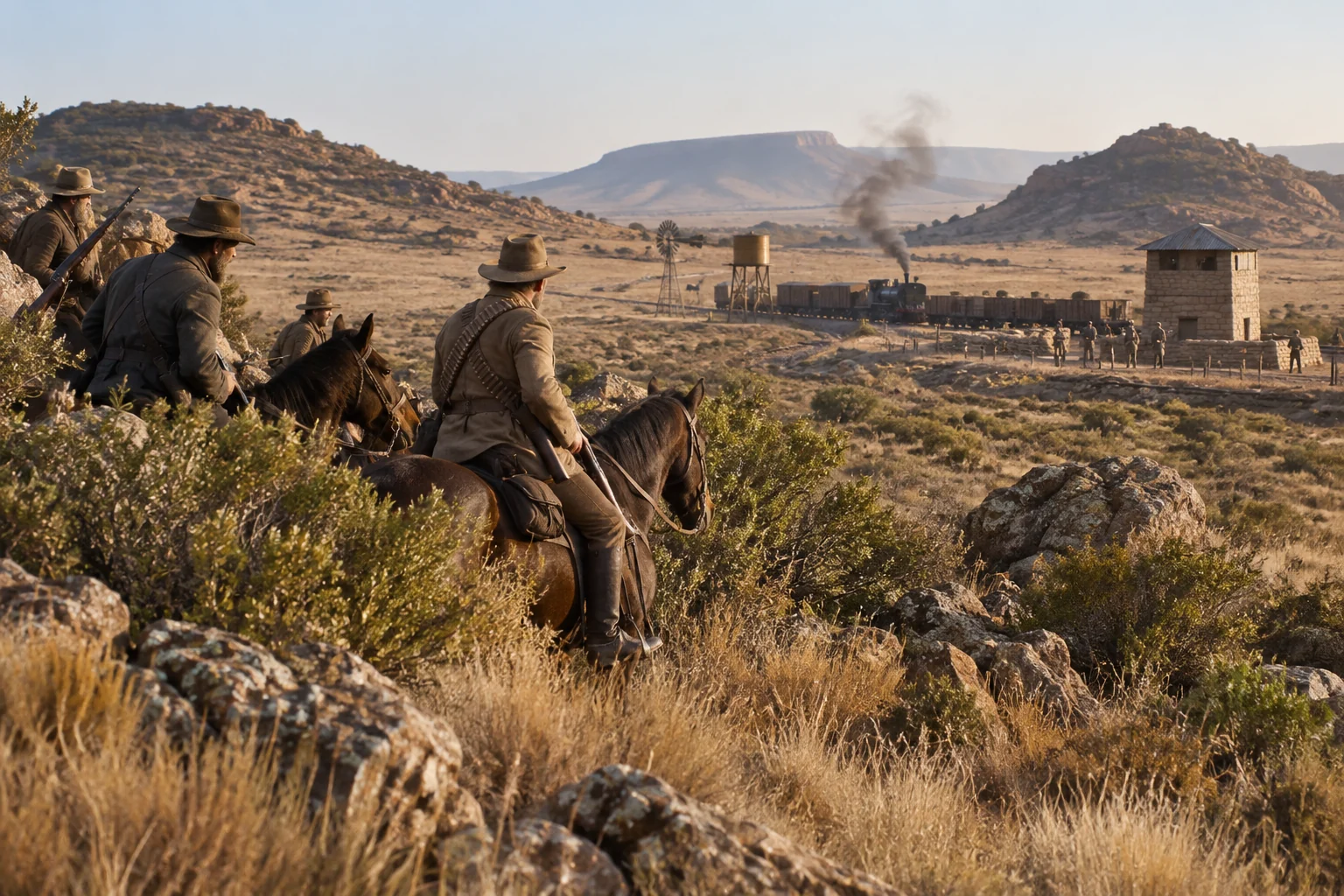
Early Modern Tier 1
Dossier 56 — Second Boer War (1899–1902)
Theater: South Africa — the Boer republics (South African Republic/Transvaal, Orange Free State), Natal, and the Cape Colony; guerrilla phase across the veld. Belligerents: The British Empire (British regulars plus colonial contingents from Canada, Australia, New Zealand, India, and the Cape/Natal) vs. the South African Republic and Orange Free State (Boer commandos, with foreign volunteers). Validation tier: Tier 1 (strong) — Britannica gives a full casualty accounting with ranges; British figures officially recorded.
Overview
The war for control of South Africa's gold- and diamond-rich interior. The Boer republics, confident after early victories and German sympathy, invaded Natal and besieged Ladysmith, Mafeking, and Kimberley (the "Black Week" disasters for Britain, December 1899). Britain poured in over 400,000 troops under Roberts and Kitchener, relieved the sieges, occupied the capitals — then faced two years of Boer guerrilla war, answered with blockhouses, scorched earth, and concentration camps. The Treaty of Vereeniging (31 May 1902) annexed the republics.
Causes (attributed)
- Mineral wealth and the Uitlander question: gold (Witwatersrand, 1886) brought British immigrants (Uitlanders) whose political exclusion by Kruger's Transvaal, plus British capitalist pressure (the "Randlords"), created the crisis (bookofworldhistory.com; J. A. Hobson's contemporary critique).
- Imperial rivalry: Kruger's republics sought German support; Britain's Cape-to-Cairo ambitions and Milner's forward policy pushed toward confrontation.
- Contested: Hobson's argument that mining capital drove the war vs. strategic and prestige motives; Boer vs. British narratives of aggression (the Boer ultimatum of October 1899 vs. British provocation).
Course (brief, neutral)
The Boers' conventional offensives (sieges of Ladysmith, Mafeking, Kimberley) initially succeeded; British defeats in Black Week (Stormberg, Magersfontein, Colenso) shocked London. Roberts's 1900 offensive relieved Kimberley and Ladysmith, took Bloemfontein, Johannesburg, and Pretoria; Kruger fled to Europe. The war then became a guerrilla conflict (1900–1902): Boer commandos under Botha, de Wet, and de la Rey raided across the veld while Kitchener built 8,000 blockhouses, swept the countryside with scorched-earth farm-burning, and interned Boer civilians (and Black Africans) in concentration camps. Peace of Vereeniging (31 May 1902): the republics became British colonies, with £3 million for reconstruction and promises of eventual self-government.
Casualties
- Britannica's accounting: nearly 100,000 lives lost overall — more than 20,000 British troops dead, about 14,000 Boer troops dead; more than 26,000 Boer women and children dead in the concentration camps (disease and malnutrition); African deaths in the camps estimated at 13,000–20,000 (not officially recorded).
- British: over 20,000 dead (combat and disease), over 20,000 wounded (compilation).
- Cost: over £200 million to the British Treasury.
- Distinguish: the camps were not extermination camps, but overcrowding, poor sanitation, and inadequate food produced catastrophic mortality — about 80% of Boer camp deaths were children (bookofworldhistory.com).
Outcome and legacy
- The South African Republic and Orange Free State were annexed; in 1910 they joined Natal and the Cape in the Union of South Africa, a self-governing dominion.
- Legacy: the camps became the founding trauma of Afrikaner nationalism and a lasting indictment of British methods (Emily Hobhouse's reports; the Fawcett Commission); the war prompted British military reform and fed the naval race with Germany; the Boer-Afrikander political ascendancy paved the road to apartheid.
Historiography pulse
- Consensus: the camps' mortality as the war's central moral fact; British victory through attrition and counter-insurgency rather than battlefield decision; the war's cost as a shock to British imperial confidence.
- Debates: the camps' intent (military necessity vs. deliberate cruelty); the war's causes (capital vs. strategy); the marginalization of Black African suffering and agency in both British and Afrikaner narratives, now being recovered.
- Notable scholarship: J. A. Hobson (contemporary critique); Emily Hobhouse's reports. Links were not verified in this research pass.
UNVERIFIED list
- Precise African camp death toll (13,000–20,000 is an estimate range; records were not kept).
- Boer civilian deaths outside the camps.
- Exact British disease vs. combat death split.
Sources
- Full accounting: https://www.britannica.com/event/South-African-War/Peace
- Consequences and camps: https://warwingsdaily.com/wars/the-second-boer-war-1899-1902/
- Camps and costs: https://bookofworldhistory.com/blog/second-boer-war-1899-1902-south-africa-causes-concentration-camps
- British study material: http://resource.download.wjec.co.uk.s3.amazonaws.com/vtc/2015-16/15-16_40/ERW%201890-1918.pdf
Images
Sources
- Full accounting
- Consequences and camps
- Camps and costs
- British study material