Conflict dossier · #28 of 120
28. Sengoku Period (1467–1615)
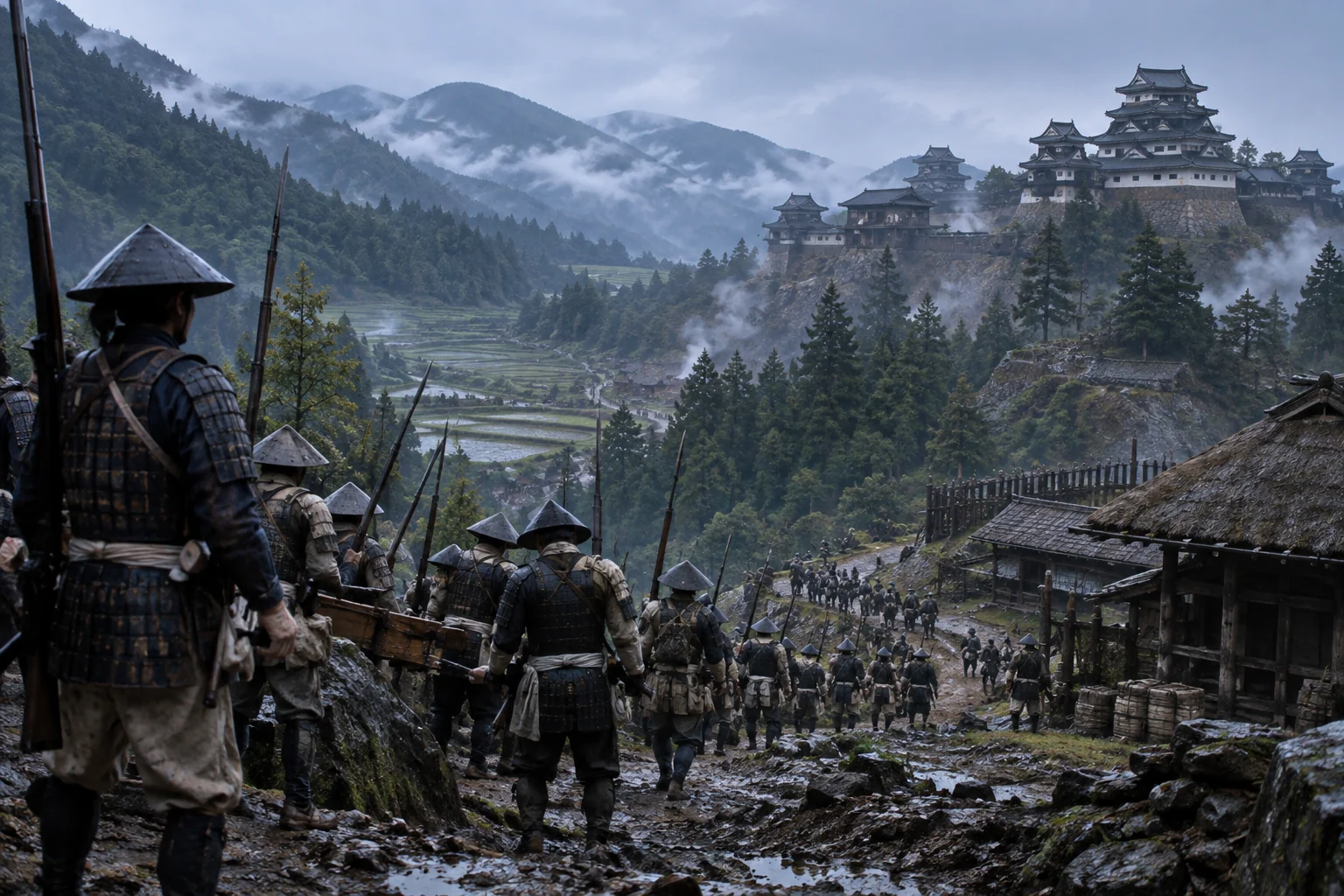
Medieval Tier 2
28. Sengoku Period (1467–1615)
Overview
- Belligerents: Competing daimyo (regional warlords) and their samurai armies — including the great unifiers Oda Nobunaga, Toyotomi Hideyoshi, and Tokugawa Ieyasu — plus the Ashikaga shogunate, Buddhist militant orders (Ikkō-ikki), and later Korean/Ming forces in the Imjin War spillover (treated separately as conflict 32).
- Dates: Conventionally 1467 (Ōnin War) to 1615 (Osaka campaigns); the beginning date is debated — alternatives include the 1454 Kyōtoku Incident and the 1493 Meiō Incident.
- Theater: The Japanese archipelago.
- Outcome: Tokugawa consolidation; the 1600 Battle of Sekigahara established Tokugawa hegemony, and the 1614–1615 Osaka campaigns destroyed the Toyotomi house, opening the Edo period.
Causes
Attribution: multiple Ashikaga and daimyo succession struggles, the weakening of shogunal authority, growing provincial autonomy, local upheaval (gekokujō — the low overthrowing the high), and competition over land and resources. No single cause; the period's name ("Warring States") is itself a later historiographical label.
Course
The Ōnin War (1467–1477) devastated Kyoto and shattered central authority; a century of daimyo warfare followed, punctuated by Nobunaga's rise (1560s–1582), Hideyoshi's unification (1580s–1590s, including the Korean invasions), Sekigahara (1600), and the Osaka sieges (1614–1615). Portuguese contact introduced firearms (1543), transforming tactics.
Casualties
- Sekigahara (1600): traditions give Western losses 8,000–35,270 and Eastern losses 4,000–10,000; a popular combined estimate is 30,000–40,000. All remain contested.
- No credible period-wide death toll exists; do not extrapolate from Sekigahara.
- UNVERIFIED: any aggregate toll for the Sengoku period; precise Sekigahara figures without ranges.
Outcome & Legacy
Two and a half centuries of Tokugawa peace; the samurai class transformed into administrators; castle towns, the bakuhan system, and the cultural forms (tea, Noh patronage, screen painting) that defined early modern Japan. The period dominates Japanese popular historical memory.
Historiography Pulse
- Debate on periodization (1467 vs. 1454 vs. 1493 start dates) and on the "unification" narrative's teleology.
- Active scholarship on the Ikkō-ikki, on firearms' tactical impact, and on Hideyoshi's domestic policies (sword hunt, land surveys).
- Documentaries: heavily covered in Japanese and international documentary (Sekigahara, Nobunaga, Hideyoshi, Ieyasu).
- Validation tier: Tier 2 — strong evidence for the political narrative; casualty figures contested; periodization debated.
Sources
- https://podscripts.co/podcasts/dan-snows-history-hit/civil-war-in-feudal-japan-the-sengoku-period
- https://en.wikipedia.org/wiki/Ōnin_War
- http://en.wikipedia.org/wiki/Sengoku_period
- https://www.japanpolicyforum.jp/pdf/2018/no48/DJweb_48_pol_01.pdf
- https://en.wikipedia.org/wiki/Battle_of_Sekigahara
- https://www.torrossa.com/it/resources/an/5084544
Images (8 views — files in images/sengoku-period/)
| File | View |
|---|---|
| 01-hero-battle-art.jpg | Battle of Sekigahara 1600 (art) |
| 02-daimyo-map.jpg | Daimyo domains map |
| 03-sekigahara-site.jpg | Sekigahara battlefield |
| 04-samurai.jpg | Samurai armor and katana (museum) |
| 05-osaka-castle.jpg | Osaka Castle |
| 06-screen.jpg | Folding-screen battle painting |
| 07-himeji.jpg | Himeji Castle |
| 08-nobunaga.jpg | Oda Nobunaga memorial/statue |