Conflict dossier · #84 of 120
Sierra Leone Civil War (23 March 1991 – 18 January 2002)
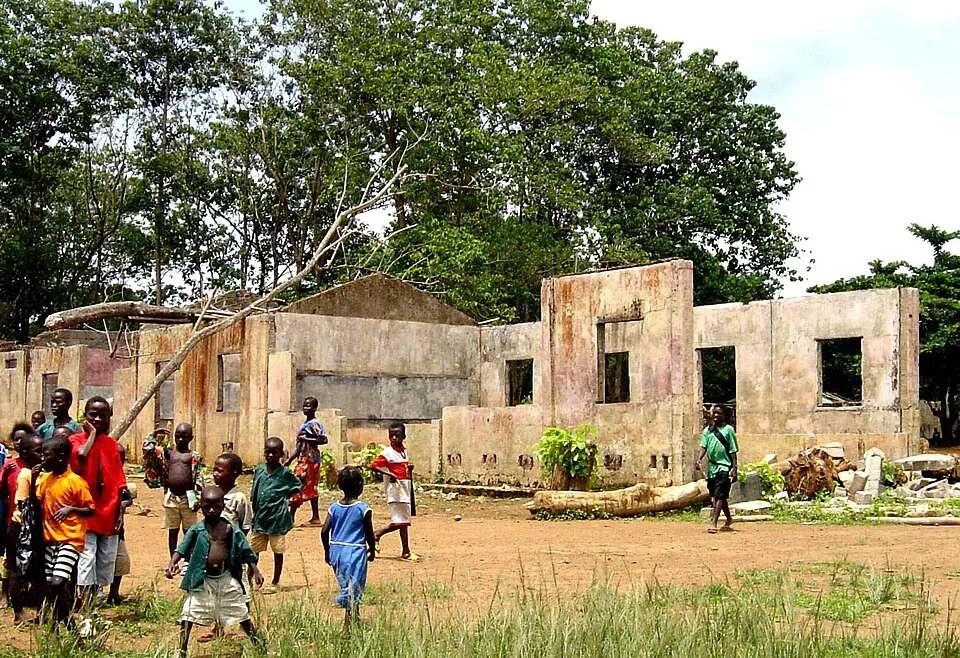
20th Century Tier 1
Sierra Leone Civil War (23 March 1991 – 18 January 2002)
Overview
- Belligerents: The Revolutionary United Front (RUF, Foday Sankoh), later allied with the Armed Forces Revolutionary Council (AFRC) junta and backed by Charles Taylor's Liberia (and, per the Special Court's findings, with Libyan and Burkinabe support), vs. successive Sierra Leone governments (SLA), the Kamajor civil defense militias (CDF), ECOMOG (Nigerian-led West African force), the private military company Executive Outcomes (1995–96), and the UK (2000–02 intervention) plus UNAMSIL peacekeepers.
- Theater: Sierra Leone; spillover from/into Liberia.
- Outcome: Commonwealth/government victory; RUF defeated after British intervention and UNAMSIL pressure; Lomé (1999) then Abuja (2000–01) agreements; war declared over January 2002; RUF became a political party.
Causes (attributed)
- Scholars (e.g., Paul Richards, Fighting for the Rain Forest; David Keen) attribute the war to the collapse of the APC one-party state under Siaka Stevens and Joseph Momoh — corruption, economic decay, and youth marginalization — which the RUF's early rhetoric exploited; Richards argues many early RUF fighters were genuinely motivated by grievance, not just greed.
- The "blood diamonds" thesis (diamonds financed and prolonged the war) is consensus as a sustaining factor; Keen and others debate whether greed or grievance better explains origins — the literature now treats them as intertwined.
- Liberian sponsorship: the Special Court for Sierra Leone found Charles Taylor aided the RUF (convicted 2012 of war crimes/crimes against humanity); Taylor's defenders disputed the extent — the court's findings are the authoritative attribution.
Course (brief, neutral)
The RUF invaded from Liberia in March 1991 with NPFL support, seizing diamond areas. The war ground on through coups (1992 Strasser, 1996 Bio, 1997 AFRC junta inviting RUF into Freetown). Executive Outcomes pushed the RUF back in 1995–96; the Abidjan Accord (1996) failed. After the 1997 coup, ECOMOG retook Freetown (1998). The RUF's January 1999 "Operation No Living Thing" assault on Freetown killed thousands and featured systematic amputations. Lomé (1999) gave Sankoh a government role but collapsed; British intervention (Operation Palliser, May 2000) and UNAMSIL broke the RUF; disarmament completed January 2002.
Casualties (named sources; contested)
- Deaths: 50,000–70,000 (Wikipedia); Amnesty International: ~75,000 civilians killed, with conflict-related estimates ranging 50,000–200,000; ICSR (2024): "an estimated 75,000 casualties"; Campbell (2002, cited in applied-anthropology paper): 50,000–70,000 dead.
- Amputations/mutilations: tens of thousands (CMAJ 2000: "thousands of civilians have lost limbs since 1992"; commonly cited ~20,000+ maimed — exact figure UNVERIFIED).
- Child soldiers: 5,000+ forcibly recruited (Amnesty).
- Displaced: ~2.5 million internally and externally — over half the population (Wikipedia; Amnesty: over one-third).
- Working range: 50,000–100,000 dead; the 200,000 upper bound is an outlier.
Outcome & legacy
- The Special Court for Sierra Leone (hybrid tribunal) convicted Taylor, RUF leaders (Sesay, Kallon, Gbao), and CDF leaders — a landmark in international justice, though the CDF convictions were controversial domestically.
- The Truth and Reconciliation Commission documented causes; diamond-trade reforms (Kimberley Process, 2003) were a direct response.
- Sierra Leone has remained at peace; amputee and war-wounded communities remain a visible legacy.
Historiography pulse
- Academic consensus: a war of state collapse financed by diamonds and Liberian sponsorship, infamous for amputations and child soldiers; ended by robust external military intervention (UK/ECOMOG/UN).
- Major debates: greed vs. grievance (Keen vs. Collier-style economism); whether Lomé's power-sharing with Sankoh was necessary or a mistake; the legitimacy of convicting CDF/Kamajor leaders who fought the RUF.
- Notable works: Paul Richards, Fighting for the Rain Forest (1996); David Keen, Conflict and Collusion in Sierra Leone; Ishmael Beah, A Long Way Gone (memoir, debated details); film Blood Diamond (2006); Amnesty's Charles Taylor briefing.
Validation tier
Tier 1 — multi-source consensus on dates, belligerents, diamond financing, Taylor's conviction, and outcome. Death toll Tier 2 (50,000–75,000 best-supported; 200,000 outlier).
UNVERIFIED points
- Precise death toll and amputation counts (no systematic count).
- Exact scale of Liberian state direction vs. facilitation (court-attributed; debated by Taylor's defenders).
Sources
- http://en.wikipedia.org/wiki/Sierra_Leone_Civil_War (infobox: 50,000–70,000; accessed 2026-09-23)
- https://amnesty.org/en/wp-content/uploads/2021/07/afr510062010en.pdf (Amnesty: ~75,000 civilians, 50,000–200,000 range, 5,000+ child soldiers)
- https://www.cmaj.ca/content/162/13/1797.full?ck=nck (CMAJ on amputations)
- https://icsr.info/2024/12/03/blood-diamonds-and-bloodshed-the-psychological-drivers-of-violence-in-sierra-leones-civil-war/ (ICSR, 2024)
Images
Sources
- infobox: 50,000–70,000; accessed 2026-09-23
- Amnesty: ~75,000 civilians, 50,000–200,000 range, 5,000+ child soldiers
- CMAJ on amputations
- ICSR, 2024