Conflict dossier · #55 of 120
Dossier 55 — Spanish–American War (1898)
Early Modern Tier 2
Dossier 55 — Spanish–American War (1898)
Theater: Cuba and Puerto Rico (Caribbean), the Philippines and Guam (Pacific); naval battles at Manila Bay and Santiago de Cuba. Belligerents: The United States (with Cuban and Filipino insurgents as co-belligerents, later adversaries in the Philippines) vs. Spain. Validation tier: Tier 2 (moderate) — U.S. figures well documented; Spanish disease deaths estimated; Cuban/Filipino civilian losses poorly quantified.
Overview
A short war (April–August 1898) arising from Cuba's independence struggle, the sinking of the USS Maine in Havana harbor (15 February 1898), and American expansionist pressure. U.S. victories at Manila Bay (1 May 1898) and Santiago de Cuba (July 1898) destroyed Spanish naval power; the Treaty of Paris (10 December 1898) ended Spanish colonial rule in the Americas and Asia — Cuba became independent under U.S. tutelage; Puerto Rico, Guam, and the Philippines were ceded to the United States. The U.S. decision to keep the Philippines triggered the Philippine–American War (1899–1902).
Causes (attributed)
- Cuban independence war: Cuba's 1895 revolt and Spain's brutal reconcentration policy generated American sympathy and press outrage ("yellow journalism" of the Hearst and Pulitzer papers) (factmonster.com; eyewitnesstohistory.com).
- The Maine: the battleship's explosion (266 dead) was blamed on Spain by the U.S. press and a U.S. naval inquiry (which attributed it to an external mine); a Spanish inquiry found an internal explosion, and later investigations (including a 1999 National Geographic computer simulation) suggested an internal fire. Responsibility remains unproven.
- Contested: whether the war was a humanitarian intervention, an imperialist land-grab, or both; McKinley's reluctance vs. congressional and press pressure for war (constitutingamerica.org).
Course (brief, neutral)
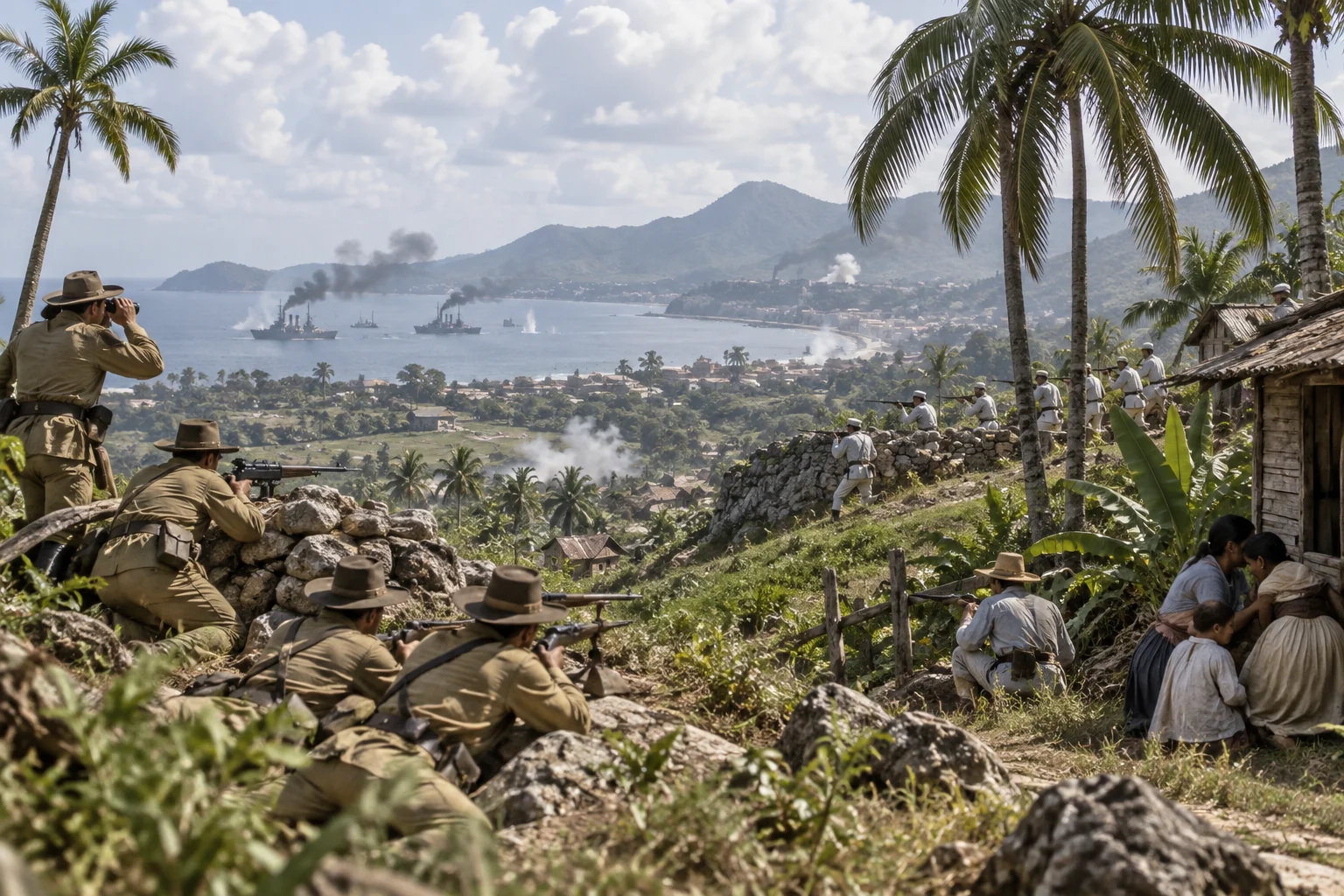
Congress declared war (25 April 1898). Commodore Dewey destroyed the Spanish Pacific squadron at Manila Bay (May 1898). In Cuba, U.S. forces landed near Santiago, won the land battles of El Caney and San Juan Hill (July 1898), and Admiral Cervera's Atlantic squadron was destroyed trying to break the blockade (3 July 1898). Spain sued for peace; the armistice (12 August 1898) and Treaty of Paris (December 1898) followed. Puerto Rico and Guam were occupied without major resistance.
Casualties
- American: 385 killed in action, 1,662 wounded (compilation); 2,061 dead of disease — disease killed over five times as many as combat. (The Maine's 266 dead are counted within the war's toll.)
- Spanish: 700–800 killed, 700–800 wounded (compilation); about 15,000 dead of disease; 40,000+ taken prisoner.
- Cuban and Filipino losses: Cuban reconcentration-camp deaths (from the pre-1898 Cuban war, often cited in the hundreds of thousands but weakly sourced) and Filipino casualties are not reliably separated from the subsequent Philippine–American War — UNVERIFIED as war-specific figures.
Outcome and legacy
- Treaty of Paris (1898): Spain relinquished Cuba (independent, under the U.S. Platt Amendment from 1901) and ceded Puerto Rico, Guam, and the Philippines (for $20 million) to the United States.
- Legacy: the United States became a colonial power, sparking the American anti-imperialist debate; the Philippine–American War followed immediately; in Spain the "Disaster of 1898" ended the Restoration's complacency and fueled the Generation of '98.
Historiography pulse
- Consensus: the war as the birth of the American overseas empire; disease as the main killer of American troops; the Maine's cause as unproven.
- Debates: humanitarian vs. imperialist motives; the erasure of Cuban and Filipino agency in U.S. narratives; the war's connection to the subsequent Philippine–American War's far greater violence.
- Notable scholarship: links were not verified in this research pass.
UNVERIFIED list
- Cuban civilian deaths from reconcentration (pre-war and wartime figures conflated in popular accounts).
- Filipino casualties attributable to the 1898 war vs. the 1899–1902 war.
- The Maine's cause (external mine vs. internal fire — unproven either way).
Sources
- Overview and figures: https://www.factmonster.com/history/us/spanish-american-war
- Strength/losses: https://simple.wikipedia.org/wiki/Spanish–American_War
- The Maine: https://socialstudiesforkids.com/articles/ushistory/sinkingofthemaine.htm
- Road to war: https://constitutingamerica.org/february-15-1898-battleship-maine-blows-up-leads-to-spanish-american-war-america-enters-world-stage-guest-essayist-joerg-knipprath/
- U.S. Navy history: https://usnhistory.navylive.dodlive.mil/Recent/Article-View/Article/2686377/presencematters-the-path-to-conflict-and-victory-in-the-spanish-american-war/