Conflict dossier · #63 of 120
Spanish Civil War (1936–1939)
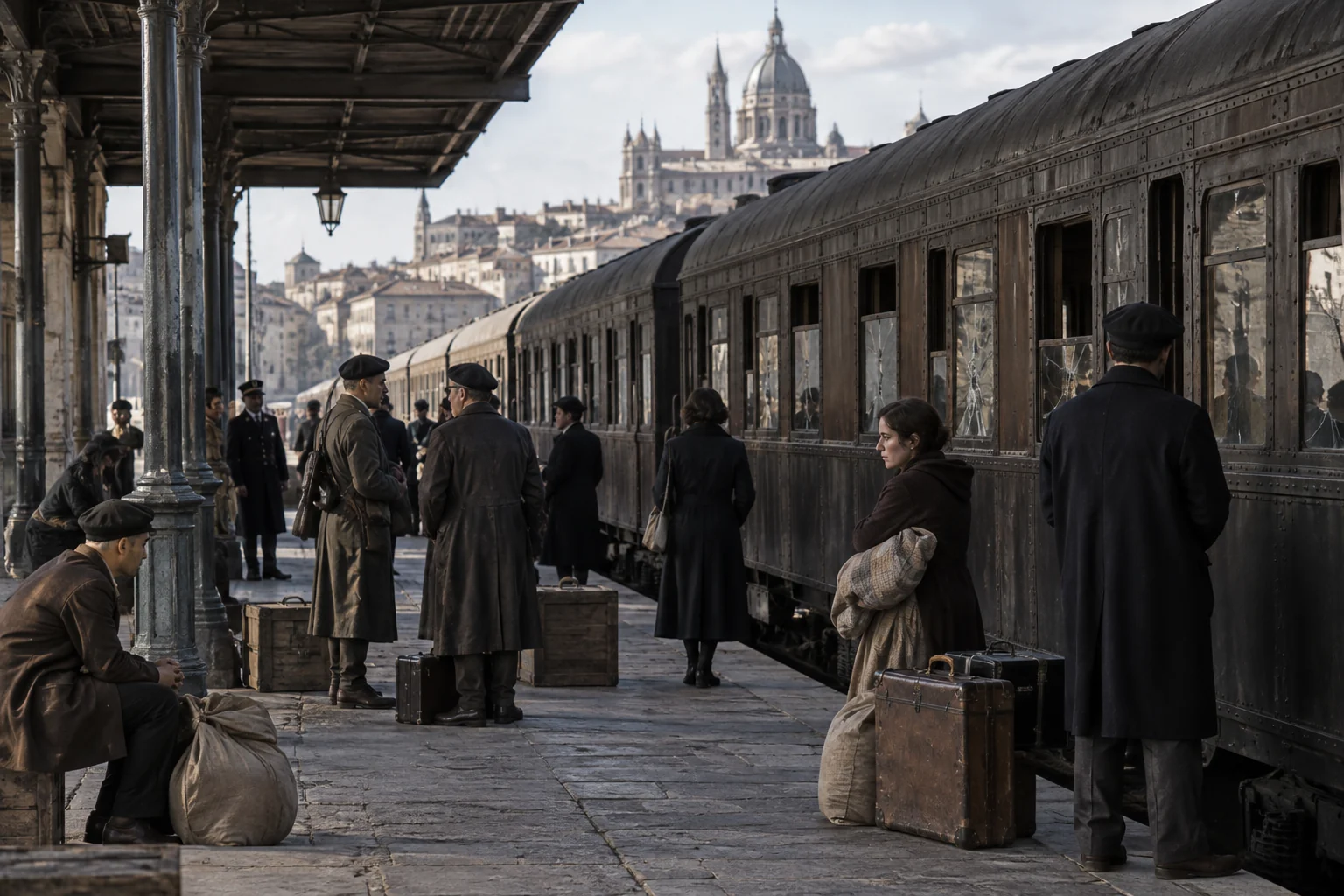
20th Century Tier 1
Spanish Civil War (1936–1939)
Overview
- Belligerents: Second Spanish Republic (Republicans: socialists, communists, anarchists, Catalan/Basque nationalists; supported by the USSR and the International Brigades) vs. Nationalist rebels (military uprising led by General Francisco Franco; supported by Nazi Germany's Condor Legion and Fascist Italy).
- Dates: 17 July 1936 – 1 April 1939 (Franco declared victory 1 April 1939; Madrid fell late March 1939)
- Theater: Spain — the peninsula, the Balearics (Mallorca), and Spanish Morocco; major battle sites: Madrid, the Ebro, Guernica, Teruel, the Jarama, Brunete.
Causes — attributed
- General historical consensus (war-memorial.net; tracesofwar.com): decades of political instability — swings between monarchy, republic, and dictatorship — culminating in the Second Spanish Republic (1931), whose reform agenda (land, church, military, Catalan autonomy) polarized a divided society.
- Historians identify proximate triggers: the contested 1936 elections, escalating political violence in spring 1936 (Gil Robles' June 1936 Cortes speech catalogued hundreds of incidents — attributed figures, outono.net), and the assassination of monarchist deputy José Calvo Sotelo (13 July 1936) — described by many historians as the event that triggered the uprising (outono.net).
- Scholarly debate: the weight of long-term structural causes (agrarian crisis, church-state conflict, regional nationalism) vs. the contingent July Crisis; whether the Republic could have survived without foreign intervention; the comparative roles of German/Italian and Soviet aid. Antony Beevor's The Battle for Spain (2006) is a leading English account; Paul Preston and Hugh Thomas are other touchstones.
- Defamation discipline: atrocities on both sides are attributed — the "White Terror" (Nationalist) and "Red Terror" (Republican) — with figures from named historians only.
Course
The military uprising of 17–18 July 1936 failed in Madrid, Barcelona, and the industrial north, creating a divided Spain. Franco, transported from Morocco with German/Italian airlift and sealift, advanced north (the Army of Africa's "column of death"). The Republic, aided by Soviet arms and the International Brigades, held Madrid (November 1936). The war's turning points: the bombing of Guernica (26 April 1937) by the Condor Legion; the fall of the northern front (1937); Teruel (winter 1937–38); the Battle of the Ebro (July–November 1938), the Republic's last major offensive, which failed; Catalonia's fall (early 1939); Madrid's surrender (28 March 1939).
Casualties — ranges with named sources
- General band: 500,000–1,000,000 killed (war-memorial.net); war-memorial.net gives 466,300 battle deaths; Scientific American cites ~500,000 total with ~150,000 civilians killed by summary execution.
- Combat deaths: ~200,000 in action — ~110,000 Republicans, ~90,000 Nationalists (tracesofwar.com; educationforum.ipbhost.com).
- Repression ("White" vs. "Red" Terror) — contested: Antony Beevor: Franco's "white terror" ~200,000 deaths, "red terror" ~38,000 (Wikipedia, citing Beevor); Julius Ruiz: minimum 37,843 executions in the Republican zone, maximum 150,000 executions in Nationalist Spain including 50,000 after the war (Wikipedia); Michael Seidman: Nationalists ~130,000, Republicans ~50,000 (Wikipedia).
- Postwar: ~100,000 Republicans executed after the war; ~35,000 died in Franco's concentration camps (tracesofwar.com). A 2008 investigation by judge Baltasar Garzón covered 114,266 executions/disappearances (1936–1951) (Wikipedia).
- Other: ~10,000 civilians killed in bombardments (mostly Condor Legion); ~25,000 died from the blockade-induced malnutrition; International Brigades lost ~4,900 (2,000 Germans, 1,000 French, 900 Americans, 500 British, 500 others); Nationalist foreign volunteers lost ~5,300 (4,000 Italians, 300 Germans, 1,000 others) (tracesofwar.com; educationforum.ipbhost.com).
- Wikipedia (citing demographic studies): 346,000 deaths 1936–1939; 540,000 for 1936–1942 including postwar terror and war suffering.
Outcome & legacy
- Nationalist victory; Franco's dictatorship (1939–1975) — repression, the "Valley of the Fallen," and the exile of hundreds of thousands of Republicans.
- The war became the symbolic rehearsal for WWII — Guernica as the icon of aerial terror against civilians (Picasso's painting).
- Spain's economy took decades to recover ("Spanish miracle" of the 1960s).
- Memory remains contested: Spain's Historical Memory Law (2007) and ongoing mass-grave exhumations (Scientific American, 2024) show the war still divides Spanish public life.
Historiography pulse
- Academic consensus: a structurally rooted conflict triggered by the July 1936 crisis; foreign intervention decisively favored the Nationalists.
- Major debates: (a) the scale of the two terrors — estimates differ by multiples (Tier 3); (b) the Republic's internal divisions (communists vs. anarchists/POUM, the May Days 1937); (c) whether Franco's regime was "fascist" in the full sense — debated; (d) the Republic's responsibility for Red Terror vs. Nationalist systematic repression.
- Notable scholarship/documentaries: Hugh Thomas, The Spanish Civil War (1961, revised 1977); Antony Beevor, The Battle for Spain (2006); Paul Preston, The Spanish Holocaust (2012) — a major work on the repression, its figures debated by other scholars; Orwell's Homage to Catalonia (1938) as primary-source classic.
Validation tier
Tier 1 on causes framework, course, outcome; Tier 3 on terror/repression death figures (flagged — widely divergent named estimates).
UNVERIFIED points
- Total deaths: 500,000–1,000,000 band only; no agreed figure.
- White Terror vs. Red Terror: Beevor (200,000 / 38,000), Ruiz (min 37,843 Rep. / max 150,000 Nat.), Seidman (130,000 / 50,000) — no consensus.
- Postwar executions and camp deaths: ranges only.
Sources
- Wikipedia, "Spanish Civil War" — http://en.wikipedia.org/wiki/Spanish_Civil_War
- TracesOfWar.com, "The Spanish Civil War" — https://www.tracesofwar.com/articles/8149/The-Spanish-Civil-War.htm
- war-memorial.net, "Spanish Civil War (Guerra Civil)" — https://war-memorial.net/Spanish-Civil-War--3.78
- Scientific American, "Gathering the Genetic Testimony of Spain's Civil War Dead" — https://www.ScientificAmerican.com/article/gathering-the-genetic-testimony-of-spain-s-civil-war-dead/
- The Education Forum, "Spanish Civil War" — https://educationforum.ipbhost.com/topic/19821-spanish-civil-war/