Conflict dossier · #47 of 120
Dossier 47 — Taiping Rebellion (1850–1864)
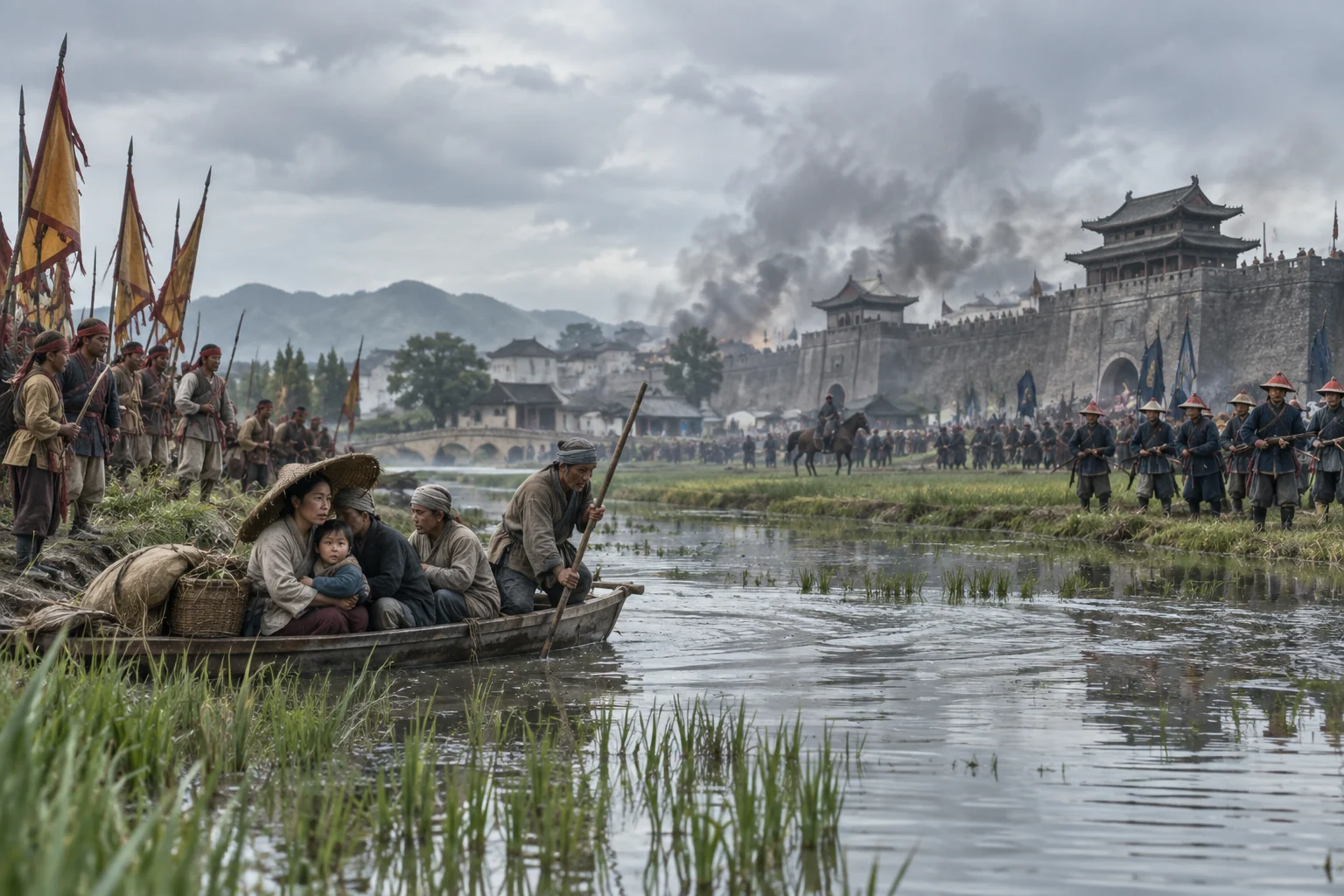
Early Modern Tier 2
Dossier 47 — Taiping Rebellion (1850–1864)
Theater: Southern and central China — Guangxi, Hunan, Hubei, Jiangsu, Zhejiang; the rebel capital at Nanjing (Tianjing); the Yangtze valley as the main axis. Belligerents: The Taiping Heavenly Kingdom (Hong Xiuquan's movement, with generals including Yang Xiuqing, Shi Dakai, and Li Xiucheng) vs. the Qing Empire (provincial armies, notably Zeng Guofan's Xiang Army and Li Hongzhang's Huai Army, with the "Ever Victorious Army" under foreign officers including Charles Gordon). Validation tier: Tier 2 (moderate) — the 20–30 million band is widely cited but rests on census limitations; mark as speculative.
Overview
The deadliest civil war of the nineteenth century and one of the deadliest conflicts in human history. Hong Xiuquan, a failed examination candidate influenced by Protestant Christianity, proclaimed the Taiping Heavenly Kingdom and raised a rebellion that at its height controlled much of southern China with Nanjing as its capital. Qing forces, reorganized under scholar-officials like Zeng Guofan, reconquered the territory over a decade; Nanjing fell in 1864. Most deaths came from famine and disease rather than battle.
Causes (attributed)
- Qing dynastic crisis: population pressure, fiscal breakdown, corruption, and the aftermath of the First Opium War delegitimized Qing rule in the south (Britannica).
- Religious-ideological mobilization: Hong Xiuquan's syncretic Christian theology gave the movement a program (land reform, equality of the sexes in theory, iconoclasm) that attracted the Hakka and other marginalized groups.
- Contested: whether the rebellion was primarily anti-Manchu nationalism, Christian millenarianism, or peasant revolt; the Taiping's social program as genuine reform vs. theocratic authoritarianism.
Course (brief, neutral)
The rebellion began in Guangxi (Jintian uprising, 1851); Taiping armies marched north, capturing Nanjing (1853) and making it their capital. A northern expedition toward Beijing failed. Internal purges (the Tianjing incident, 1856) decimated Taiping leadership. Zeng Guofan's Xiang Army, funded by likin taxes and built on Confucian discipline, ground down the rebellion; with the Ever Victorious Army's help in the lower Yangtze, Qing forces retook the major cities; Nanjing fell in July 1864 and Hong Xiuquan died shortly before.
Casualties
- Widely cited estimate: 20–30 million deaths, the great majority from famine and disease rather than combat (Britannica gives approximately 20 million).
- Caveat: the figure rests on Qing census comparisons with severe limitations — war-disrupted registration, migration, and collapsed reporting — and is speculative rather than counted. Some popular claims reach 100 million; those are UNVERIFIED and not credible.
- No reliable breakdown by battle, famine, disease, or massacre exists.
Outcome and legacy
- The Qing survived but at the cost of devolving military power to Han provincial leaders (Zeng Guofan, Li Hongzhang), permanently weakening central Manchu control and enabling the warlord era's preconditions.
- Legacy: the rebellion devastated the Yangtze delta's economy for a generation; in PRC historiography it is treated as a peasant revolution; in Western historiography as a warning about the limits of the "20–30 million" figure.
Historiography pulse
- Consensus: the rebellion as the nineteenth century's deadliest conflict; famine/disease as the main killers; the Qing's survival through Han-led regional armies.
- Debates: the reliability of the 20–30 million band (demographers vs. popularizers); Hong Xiuquan's Christianity as sincere vs. instrumental; the Taiping program's modernity.
- Notable scholarship: links were not verified in this research pass.
UNVERIFIED list
- Any precise total (20–30M is a speculative census-based band).
- The 100-million claims found in weak sources.
- Battle vs. famine vs. disease breakdowns.
Sources
- Overview: https://www.britannica.com/event/Taiping-Rebellion
- Background: http://www.modernchinesehistory.com/pages/p7.html
- Overview: https://en.wikipedia.org/wiki/Taiping_Rebellion