Conflict dossier · #36 of 120
Dossier 36 — Thirty Years' War (1618–1648)
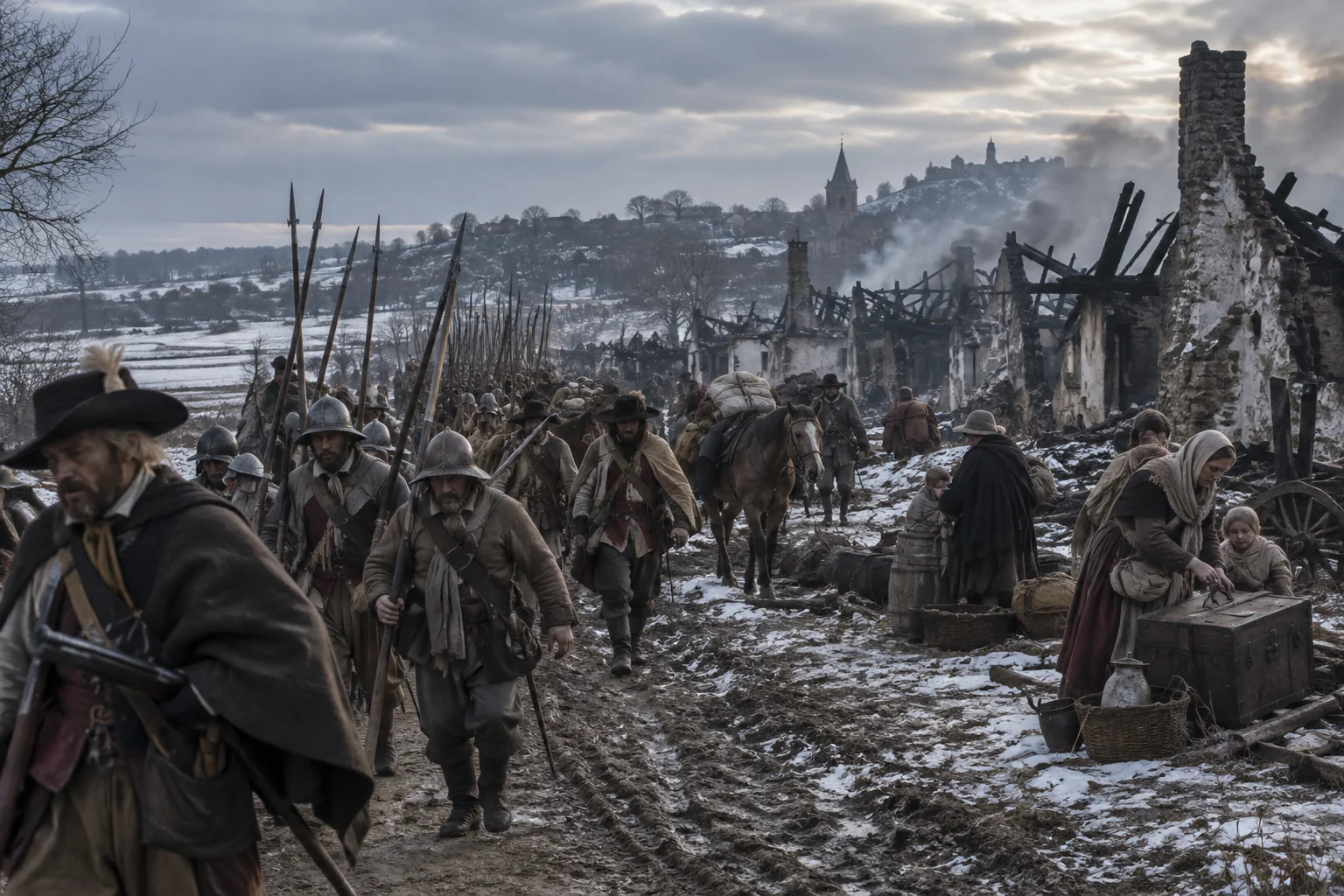
Early Modern Tier 2
Dossier 36 — Thirty Years' War (1618–1648)
Theater: The Holy Roman Empire (above all the German lands and Bohemia), with campaigns in the Spanish Netherlands, northern Italy, Denmark, and the Baltic; naval dimension minor. Belligerents: Habsburg bloc — the Austrian and Spanish Habsburgs, the Catholic League (Bavaria), and allied German Catholic princes — vs. the Protestant Union and, successively, Denmark-Norway (1625–1629), Sweden (1630–1635/1648), and Catholic France with its allies (1635–1648). Saxony and Brandenburg changed sides or hedged. Validation tier: B (moderate) — modern scholarly consensus exists on the death band, but all figures are estimates; older numbers are discredited.
Overview
The most destructive European war before the twentieth century, fought across four conventional phases (Bohemian 1618–1625, Danish 1625–1629, Swedish 1630–1635, French/Swedish 1635–1648). It began as a Bohemian revolt against Habsburg Catholic rule (the Defenestration of Prague, 1618) and became a general European war over the balance of power. It ended with the Peace of Westphalia (1648). Civilian deaths — from famine, plague, and the passage of armies — dwarfed battlefield deaths.
Causes (attributed)
- Religious-constitutional conflict: the Bohemian estates' revolt against Ferdinand II's revocation of Protestant rights (the Letter of Majesty) fused confessional grievance with defense of estate liberties. Historians treat the Defenestration of Prague (23 May 1618) as the conventional trigger.
- Habsburg power and the balance of power: France (under Richelieu, then Mazarin), Sweden (Gustavus Adolphus), and Denmark intervened to prevent Habsburg hegemony in the Empire. Modern scholarship (notably Peter H. Wilson) attributes the war's prolongation primarily to great-power rivalry rather than religion alone.
- Contested: whether the war was "really" a war of religion. Older confessional historiography said yes; Wilson (The Thirty Years War: Europe's Tragedy, 2009) and others argue religion was the idiom of a constitutional and hegemonic struggle. This dossier does not present either as settled fact.
Course (brief, neutral)
The Bohemian phase ended with the Catholic victory at White Mountain (1620) and the execution of 27 rebel leaders in Prague. Denmark's intervention failed (Lutter, 1626); the Edict of Restitution (1629) attempted a maximal Catholic settlement. Sweden landed in 1630, won at Breitenfeld (1631) and Lützen (1632, where Gustavus Adolphus was killed), then was checked at Nördlingen (1634). France's open entry (1635) turned the war into a Franco-Habsburg struggle fought on German soil. Exhaustion produced the twin treaties of Münster and Osnabrück (1648).
Casualties
- Modern estimates: roughly 4.5–8 million deaths, the great majority civilians (disease, famine, exposure). This band reflects current scholarly estimates surfaced in this research pass's searches; it is an estimate range, not a verified count.
- Older claims of up to 12 million are no longer generally accepted by modern historians.
- Distinguish: deaths from population decline — regional population losses (in some German regions cited at 30–50%) include migration, flight, and collapsed birth rates, not only deaths. Do not equate population-decline figures with death tolls.
Outcome and legacy
- The Peace of Westphalia (1648) confirmed the sovereignty of the German princes, recognized the independence of the Dutch Republic and (effectively) Switzerland, and established the principle of cuius regio, eius religio in an extended, more tolerant form.
- Legacy: the war became the archetype of early-modern catastrophe in German memory ("the" war of German history before 1914); the "Westphalian system" of sovereign states is conventionally dated from 1648 — a framing international-relations scholars have increasingly qualified (the treaties did not invent sovereignty, and the Empire persisted until 1806).
Historiography pulse
- Consensus: the four-phase periodization; civilian catastrophe as the war's defining demographic fact; Westphalia as a settlement of exhaustion.
- Debates: religion vs. state-building as the war's "true" character (Wilson vs. older confessional accounts; C. V. Wedgwood's classic narrative history remains widely read); the scale of the demographic catastrophe (regional studies have revised both maximalist and minimalist claims); whether the war was one war or a cluster of overlapping wars.
- Notable scholarship: Peter H. Wilson, The Thirty Years War: Europe's Tragedy (2009); C. V. Wedgwood, The Thirty Years War (1938); Ronald Asch's and Johannes Burkhardt's German-language work. (Links were not verified in this research pass.)
UNVERIFIED list
- Any precise death total (4.5–8 million is a modern estimate band).
- Regional population-loss percentages as death counts (they conflate death, flight, and fertility collapse).
- Battle-level casualty figures from contemporary chronicles (systematically inflated).
Sources
- Casualty grounding searches (the 2026-09-23 research pass): modern band 4.5–8M; 12M discarded.
- Overview reference: https://en.wikipedia.org/wiki/Thirty_Years%27_War
- Historiography: Wilson (2009), Wedgwood (1938) — standard works; links were not verified in this research pass.
Images
Sources
- Casualty grounding searches (the 2026-09-23 research pass): modern band 4.5–8M; 12M discarded
- Overview reference
- Historiography: Wilson (2009), Wedgwood (1938) — standard works; links were not verified in this research pass