Conflict dossier · #30 of 120
30. Timur's Conquests (1370–1405)
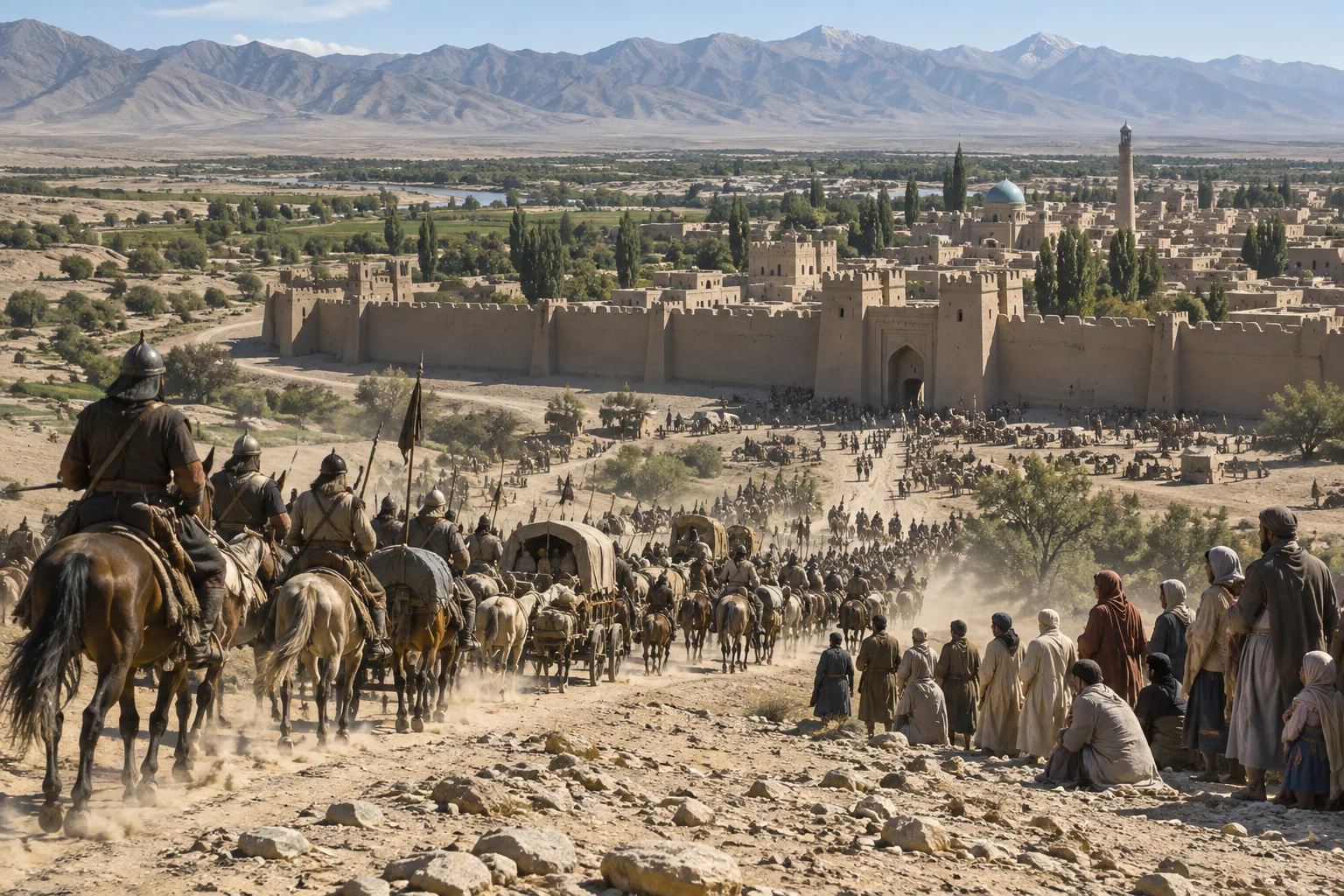
Medieval Tier 1
30. Timur's Conquests (1370–1405)
Overview
- Belligerents: The armies of Timur (Tamerlane, "Timur the Lame"), Turco-Mongol emir of Transoxiana, vs. successively: the Chagatai Khanate, the Kartids and Muzaffarids of Persia, the Golden Horde under Tokhtamysh, the Delhi Sultanate (Tughlaqs), the Mamluk Sultanate of Egypt-Syria, the Jalayirids of Baghdad, the Christian kingdoms of Georgia and Armenia, the Knights Hospitaller (Smyrna), and the Ottoman Empire under Bayezid I (Bayezid the Thunderbolt).
- Dates: 1370 (consolidation of Transoxiana) – 1405 (death at Otrar en route to invade Ming China).
- Theater: Central Asia, Persia, the Caucasus, the Kipchak steppe, northern India, Syria, Iraq, Anatolia.
- Outcome: Timur died undefeated on campaign; his empire stretched from the Mediterranean to the edge of China but fragmented within decades among his descendants (Timurids; Babur founded the Mughal Empire in 1526).
Causes
Timur claimed legitimacy as restorer of the Mongol (Chinggisid) order — he installed a Chinggisid puppet khan, took Chinggisid wives, and took the title guregen (royal son-in-law), as Beatrice Forbes Manz documents — while ruling as a Muslim sovereign (ghazi). Historians distinguish his stated legitimations (Chinggisid restoration, jihad, protection of co-religionists) from structural drivers identified in scholarship: control of the Silk Road trade revenues, tribute extraction, and the nomadic political economy in which booty rewarded his followers (Manz: "based on charismatic authority"). Against the Mamluks and Ottomans he framed campaigns as punishment of rulers who harbored his enemies or encroached on Turkmen clients; against the Golden Horde as elimination of a rival khan. Attribution discipline: legitimations are Timur's own court claims (Zafarnama tradition); motives are historians' interpretations.
Course
1370: Timur takes power in Transoxiana. 1380s: conquest of Khorasan, Persia — Isfahan taken 1387; after its revolt, massacre and the famous towers of skulls (reported 70,000 dead, per contemporary accounts). 1391–1395: campaigns against Tokhtamysh's Golden Horde (Kundurcha 1391, Terek 1395), crippling the Horde. 1398–1399: invasion of the Delhi Sultanate; capture and sack of Delhi, artisans deported to Samarkand. 1400–1401: Aleppo and Damascus taken from the Mamluks; Baghdad destroyed 1401. 20 July 1402: Battle of Ankara — Bayezid I captured, triggering the Ottoman Interregnum (1402–1413). 1402–1404: ravaging of western Anatolia, capture of Smyrna; Samarkand beautified with Bibi-Khanym Mosque and Gur-e-Amir. February 1405: death at Otrar while mobilizing against Ming China.
Casualties
- The widely repeated figure of 17 million dead (about 5% of the then-world population) appears in tertiary sources (e.g., Wikipedia's Timurid Empire article, ThoughtCo) but is explicitly described as "impossible to verify" — it traces to inflated contemporary chronicle claims. ThoughtCo cites "about 19 million" from "contemporary sources," noting it is "probably exaggerated."
- Specific massacre figures (Isfahan 70,000; Baghdad 20,000; towers of skulls at Isfahan) come from Timurid-era or hostile chroniclers; modern historians treat the orders of magnitude as indicative but the precision as rhetorical.
- UNVERIFIED: any aggregate death toll for Timur's conquests; the 17-million figure taken literally; per-city figures taken literally.
- UNVERIFIED: the popular claim that Delhi "never recovered" for a century — an interpretive claim, not a measured demographic fact.
Outcome & Legacy
The Timurid Empire did not long survive its founder as a unified state (shattered by succession wars after 1405), but the Timurid Renaissance — Samarkand and Herat as centers of science, astronomy (Ulugh Beg), and miniature painting — and the Mughal Empire of Timur's descendant Babur are its durable legacies. In modern Uzbekistan Timur is the national hero (Amir Timur); in Iran, the Arab world, and India he is remembered chiefly for destruction.
Historiography Pulse
- Beatrice Forbes Manz ("Tamerlane's Career and Its Uses," Journal of World History 13.1, 2002; "Tamerlane and the Symbolism of Sovereignty") is the landmark modern scholar: Timur was a master of legitimation who fused Chinggisid, Islamic, and Turco-Mongol symbols; his career was systematically used after his death — including by modern Uzbekistan as founding father.
- Active debate on identity/ethnicity: Timur was a Turkified Barlas (Turco-Mongol), not an "Uzbek" in the modern sense — a point of scholarly contention against Uzbek nationalist historiography.
- Polarized memory: national hero in Uzbekistan vs. archetype of pointless destructiveness in Iranian, Arab, and Indian historiography; Western literature (Marlowe's Tamburlaine, Poe's "Tamerlane") romanticized him.
- Documentaries: general Central Asian / conqueror documentary coverage; no single flagship documentary identified — noted as a gap.
- Validation tier: Tier 1 — multi-source consensus on campaign sequence and political outcome; casualty figures UNVERIFIED; motives debated between legitimation-theorists and structuralists.
Sources
- https://en.wikipedia.org/wiki/Timurid_Empire
- https://www.thoughtco.com/timur-or-tamerlane-195675
- https://factsanddetails.com/asian/cat65/sub424/item2681.html
- https://www.slideserve.com/oberon/reflections-tamerlane (summary of Beatrice Forbes Manz, "Tamerlane's Career and Its Uses," Journal of World History 13.1, 2002)
- https://mughal-library.s3.me-central-1.amazonaws.com/Images/research_papers/pdfs/research_paper_tamerlane_and_the_symbolism_of.pdf (Manz, "Tamerlane and the Symbolism of Sovereignty")
- https://www.iias.Asia/sites/iias/files/nwl_article/2019-05/IIAS_NL74_4041.pdf (IIAS Newsletter on Timur in modern Uzbekistan)
- https://en.dharmapedia.net/wiki/Timur
Images (8 views — files in images/timurs-conquests/)
| File | View |
|---|---|
| 01-hero-timur-portrait.jpg | Earliest-known Timur portrait miniature, TSMK H2152 (tasteful hero) |
| 02-empire-map.jpg | Timurid Empire extent map c. 1405 |
| 03-gur-e-amir.jpg | Gur-e-Amir mausoleum, Samarkand |
| 04-bibi-khanym.jpg | Bibi-Khanym Mosque, Samarkand |
| 05-ankara-battlefield.jpg | Battle of Ankara (1402) battlefield site |
| 06-amir-timur-statue.jpg | Amir Timur statue (Tashkent/Samarkand) |
| 07-shah-i-zinda.jpg | Shah-i-Zinda necropolis, Samarkand |
| 08-zafarnama-miniature.jpg | Zafarnama manuscript battle miniature |