Conflict dossier · #1 of 120
Trojan War (c. 12th century BCE)
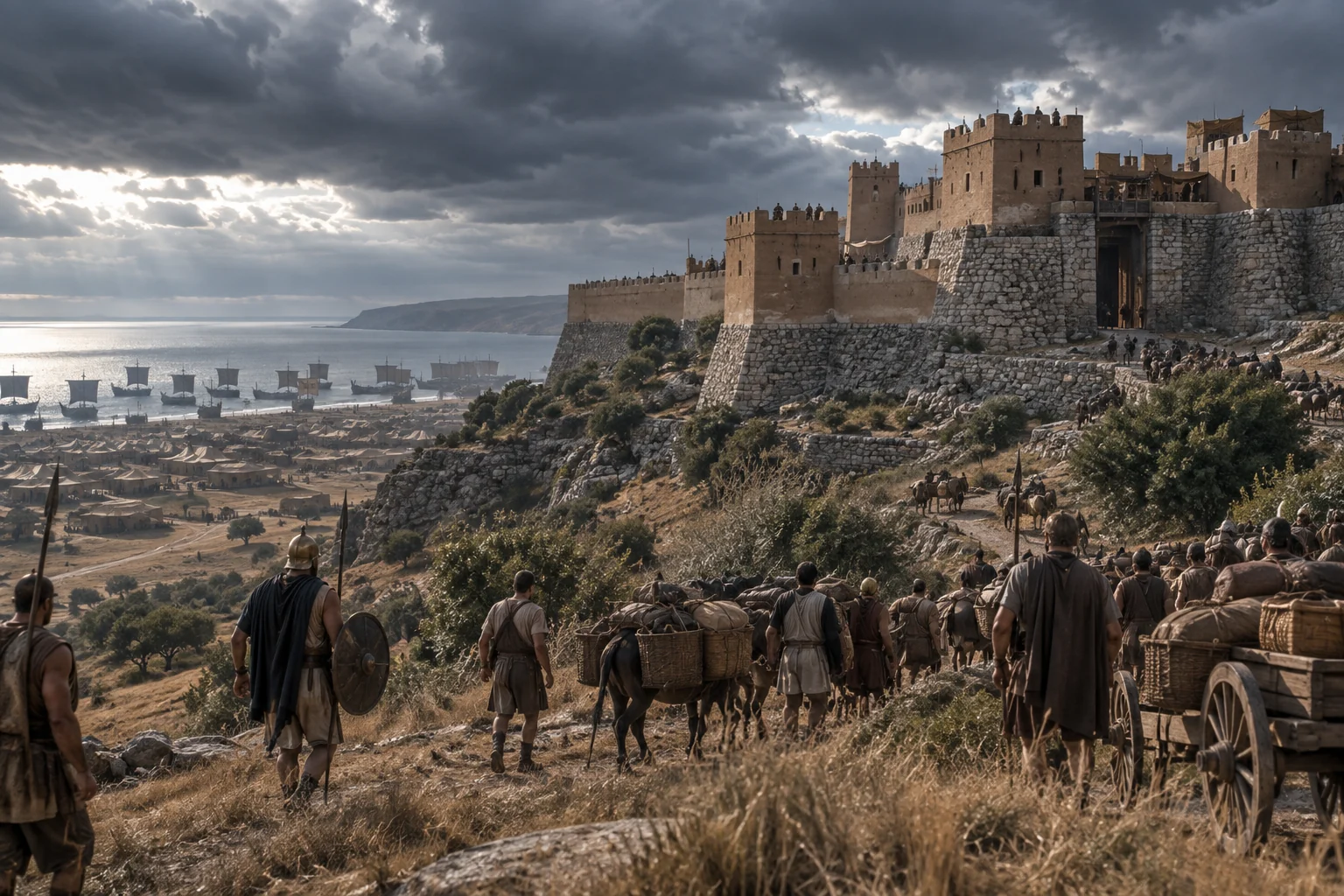
Ancient Tier 3
Trojan War (c. 12th century BCE)
Overview
- Belligerents: a coalition of Mycenaean Greek states (the "Achaeans") vs. the city of Troy (Wilusa/Ilios) and its Anatolian allies — per the Homeric epics Iliad and Odyssey.
- Dates: traditional ancient chronology (Eratosthenes) placed the fall of Troy in 1184 BCE; modern scholarship associates the relevant destruction layer (Troia VIIa) with roughly 1180 BCE.
- Theater: northwestern Anatolia — the city at Hisarlik (modern Tevfikiye, Çanakkale Province, Türkiye) and the surrounding Troad.
- Nature: legendary/semi-legendary. Whether any historical conflict underlies the epic is one of the longest-running debates in classical scholarship.
Causes — attributed, not stated as fact
- The mythic tradition (Homer, the Epic Cycle) attributes the war to the abduction of Helen by the Trojan prince Paris and the oath binding the Achaean kings to defend Menelaus.
- Joachim Latacz and other "Bronze Age" proponents argue for an economic-political motive: Troy (Wilusa) controlled trade through the Dardanelles, and Mycenaean raiding or a genuine siege reflected Late Bronze Age geopolitical rivalry, with Hittite correspondence (the Tawagalawa letter, Alaksandu treaty) showing Ahhiyawa (Achaean) interest in western Anatolia.
- Skeptics (e.g., Frank Kolb, Dieter Hertel) argue the destruction layers at Hisarlik can be explained by natural disaster and that no archaeological evidence supports a decade-long siege; they read the epic as an 8th-century BCE poetic composition drawing on generic Bronze Age memories.
- No ancient source outside the epic tradition records a "Trojan War" as a discrete historical event.
Course
Per the Iliad: after Paris takes Helen to Troy, Agamemnon leads a thousand-ship expedition; a ten-year siege follows, with set-piece duels and divine interventions, ending in the sack of the city via the wooden horse (a story told not in the Iliad itself but in the Odyssey and the lost Iliou Persis). The archaeological record at Hisarlik shows Troia VIIa was destroyed by violence around 1180 BCE — but the archaeology cannot confirm a ten-year siege, a wooden horse, or the named heroes.
Casualties
- UNVERIFIED — no credible figures exist. The epics give no totals; the Catalogue of Ships implies a large force, but all numbers are poetic.
- Modern estimates of the actual Late Bronze Age population of Troy (Wilusa) run to roughly 7,000–10,000 (Korfmann's lower-town estimate) — the scale of any real conflict would have been orders of magnitude smaller than the epic's thousands of ships.
- No dossier casualty range can be responsibly given.
Outcome & legacy
Historically: the Late Bronze Age collapse (c. 1200–1150 BCE) swept away Mycenaean palace civilization and the Hittite Empire alike; Troia VIIa's destruction is one data point within that wider collapse. Culturally: the Trojan War cycle became the foundational narrative of Greek identity and of Western literature, art, and political rhetoric for three millennia.
Historiography pulse
- Academic consensus: the "historicity of the Iliad" is not settled; the dominant position is agnostic — a historical kernel (a real Late Bronze Age conflict around Wilusa) is plausible, amplified and reshaped by four centuries of oral tradition. Hardly any scholar defends the epic narrative as literal history.
- Major debate: the "Troy debate" (Troia-Streit) of the 1990s–2000s — Manfred Korfmann's excavations (1988–2005) showed a large fortified lower town and evidence of violent destruction, supporting a "kernel of truth" reading; critics (Kolb, Hertel, Hänsel) disputed the interpretation of the lower town and the trade-route thesis.
- Notable scholarship/documentary: Latacz, Troy and Homer: Towards a Solution of an Old Mystery (Oxford, 2004); Trevor Bryce, The Trojans and their Neighbours (2006); the British Museum's "Troy: Myth and Reality" exhibition (2019–2020).
Validation tier
Tier 3 — legendary subject; the historical event (if any) is heavily contested and single-tradition. Flagged. Included per the approved plan because of its foundational cultural significance, with the debate covered honestly.
UNVERIFIED points
- Whether a "Trojan War" occurred as a discrete historical event.
- The ten-year siege, the wooden horse, and the named heroes (Achilles, Hector, Agamemnon, Helen, Paris) — no independent attestation.
- Trojan War casualty figures of any kind.
- The abduction-of-Helen motive as history.
Sources
- Homer, Iliad and Odyssey (8th century BCE tradition) — primary literary source, not history.
- Hittite texts: Tawagalawa letter, Alaksandu treaty, Manapa-Tarhunda letter — attest Wilusa and Ahhiyawa activity in western Anatolia.
- Korfmann excavations at Troia (1988–2005); Troia VIIa destruction layer c. 1180 BCE.
- Joachim Latacz, Troy and Homer (Oxford University Press, 2004) — https://generales.uprrp.edu/humanidades/wp-content/uploads/sites/5/2018/09/Troy-and-Homer.pdf (review)
- Historicity of the Iliad — https://en.wikipedia.org/wiki/Historicity_of_the_Iliad
- "Troy and the Trojan War: Archaeology, History and the Epic Traditions" — https://ecampusontario.pressbooks.pub/mycenaeangreeceandhomerictradition/chapter/troy-and-the-trojan-war-archaeology-history-and-the-epic-traditions/
Images
Sources
- Homer, Iliad and Odyssey (8th century BCE tradition) — primary literary source, not history
- Hittite texts: Tawagalawa letter, Alaksandu treaty, Manapa-Tarhunda letter — attest Wilusa and Ahhiyawa activity in western Anatolia
- Korfmann excavations at Troia (1988–2005); Troia VIIa destruction layer c. 1180 BCE
- Joachim Latacz, Troy and Homer (Oxford University Press, 2004) — (review
- Historicity of the Iliad
- "Troy and the Trojan War: Archaeology, History and the Epic Traditions"