Conflict dossier · #20 of 120
20. Viking Age Wars (793–1066)
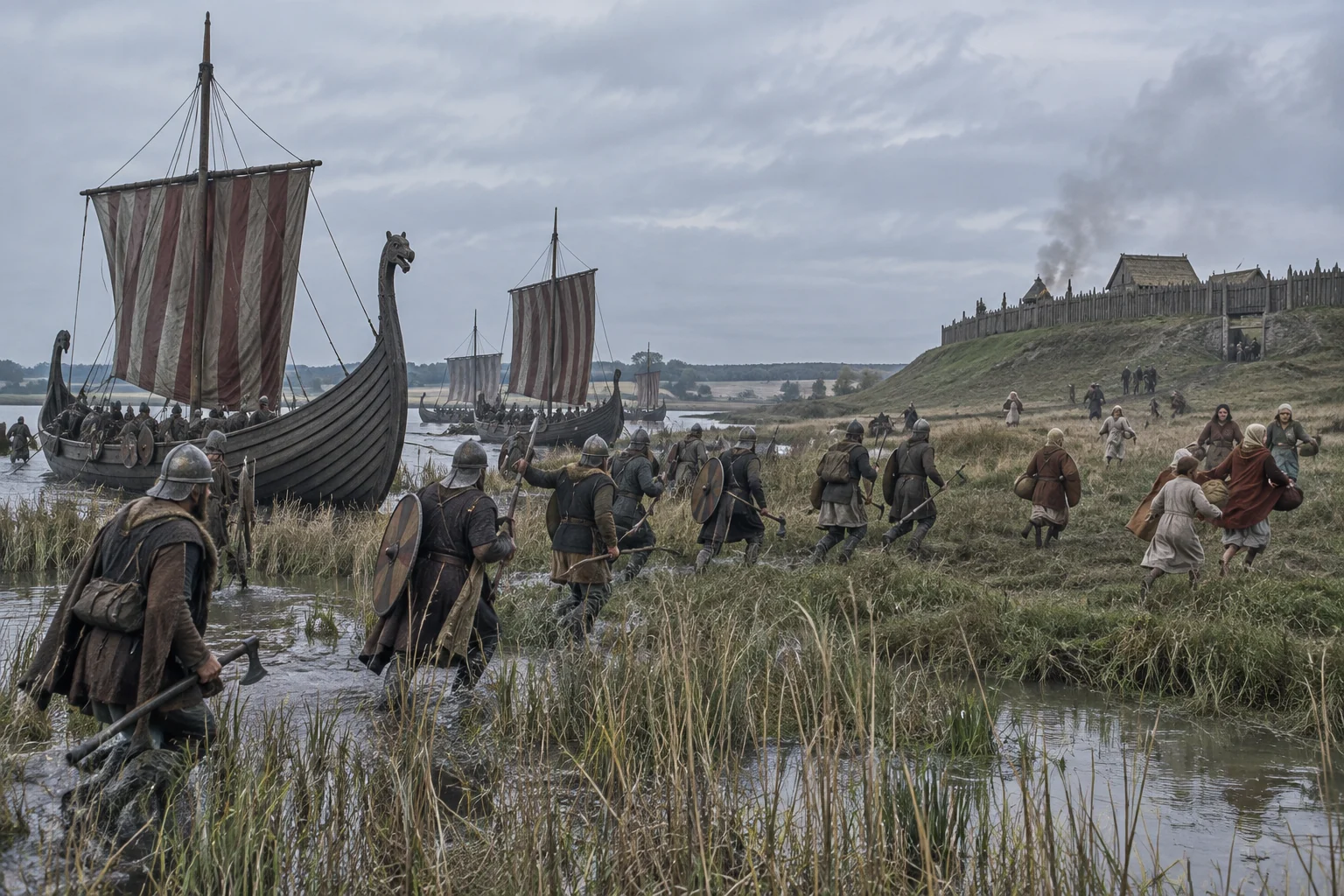
Medieval Tier 2
20. Viking Age Wars (793–1066)
Overview
- Belligerents: Scandinavian raiders, settlers, and later Norse/Danish kingdoms vs. Anglo-Saxon England, Frankish/Carolingian realms, Ireland, Scotland, Rus' principalities, and others.
- Dates: Conventionally 793 (Lindisfarne) to 1066 (Stamford Bridge/Hastings).
- Theater: The British Isles, northern France, the Low Countries, Iberia, the Mediterranean, the North Atlantic, and western Russia.
- Outcome: Not a single war but a centuries-long family of raids, invasions, settlements, and state-building conflicts; outcomes include the Danelaw, Normandy, the Norse Atlantic world, and the eventual Christianization and absorption of Scandinavia into Latin Christendom.
Causes
Scholarship rejects single-cause explanations. Cited factors include competitive chieftaincies, the pursuit of wealth (including slavery), trade networks, limited arable land, political fragmentation in target regions, maritime technology (the longship), and settlement opportunities. Documentary and popular claims making climate the dominant driver are weak and should not be adopted without academic corroboration. This dossier does not adopt a "Viking fury" monocause.
Course
Early raiding (Lindisfarne 793) escalated to overwintering armies, the Great Heathen Army's conquest of much of Anglo-Saxon England (865+), settlement in Normandy (911), campaigns in Ireland and Scotland, eastern ventures to Byzantium and the Abbasid world, and the 11th-century Danish conquest of England under Cnut. The conventional close is Harald Hardrada's defeat at Stamford Bridge (1066).
Casualties
- No credible aggregate death toll exists for the Viking Age as a whole.
- Battle-level estimates are reconstructed: Stamford Bridge Norwegian losses are often put around 10,000, but this is a modern reconstruction and should be caveated.
- Bioarchaeology: one study found lethal trauma in 11 of 30 sampled Norwegian skeletons vs. 6 of 82 Danish specimens — this cannot be extrapolated to total war deaths.
- UNVERIFIED: any aggregate death toll for the Viking Age; precise battle figures presented without caveat.
Outcome & Legacy
Norse settlement reshaped England, Ireland, Normandy, and the North Atlantic; the Varangian Guard served Byzantium; Scandinavian kingdoms consolidated and Christianized. The Viking Age is central to the national histories of Britain, Ireland, France, and Scandinavia.
Historiography Pulse
- Modern scholarship emphasizes the Vikings as traders, settlers, and state-builders alongside raiding; the older "purely destructive" image is dated.
- Active debate on the relative weight of push/pull factors in expansion.
- Documentaries: extensive popular documentary coverage (e.g., general Viking documentaries); academic treatments distinguish settlement archaeology from saga literature.
- Validation tier: Tier 2 — scope and casualty accounting are inherently diffuse; the broad pattern rests on strong archaeological and textual evidence.
Sources
- https://www.livescience.com/archaeology/vikings/vikings-in-norway-were-much-more-likely-to-die-violent-deaths-than-those-in-denmark
- https://www.snexplores.org/article/big-viking-families-got-away-murder
- https://www.youtube.com/watch?v=hh3pZ2CgRbo
Images (8 views — files in images/viking-age-wars/)
| File | View |
|---|---|
| 01-hero-battle-art.jpg | Battle art (Stamford Bridge 1066) |
| 02-raid-map.jpg | Viking raid/settlement map |
| 03-longship.jpg | Gokstad ship (museum) |
| 04-weapons.jpg | Viking weapons (museum artifacts) |
| 05-lindisfarne.jpg | Lindisfarne priory ruins |
| 06-tapestry.jpg | Bayeux Tapestry (Norse/Norman context) |
| 07-jelling.jpg | Jelling runestones |
| 08-arbo.jpg | 19th-century Viking battle painting |