Conflict dossier · #6 of 120
Wars of the Diadochi (322–281 BCE)
Ancient Tier 1
Wars of the Diadochi (322–281 BCE)
Overview
- Belligerents: the Successors (Diadochi) — Alexander's generals and their heirs — fighting in shifting coalitions: Antigonus I Monophthalmus and Demetrius Poliorcetes; Ptolemy I (Egypt); Seleucus I (Babylon/East); Cassander (Macedon); Lysimachus (Thrace/Asia Minor); plus Eumenes, Polyperchon, Pyrrhus, and others.
- Dates: 322 BCE (First War of the Successors, after the Babylon settlement of 323) to 281 BCE (Battle of Corupedium — the last Diadoch battle).
- Theater: the entire former Alexandrian empire — Macedon, Greece, Thrace, Asia Minor, Syria, Egypt, Mesopotamia, Persia.
Causes — attributed
- Ancient sources (Diodorus Siculus, drawing on the contemporary Hieronymus of Cardia; Plutarch's Lives) attribute the wars to Alexander's failure to name an heir (the alleged "to the strongest" deathbed remark is itself doubted) and the personal ambitions of the marshals, who used the infant Alexander IV and the figurehead Philip III Arrhidaeus as legitimizing tokens until both were murdered (317, 310/309).
- Modern scholars (e.g., Richard Billows, Antigonos the One-Eyed; Robin Waterfield, Dividing the Spoils) frame the wars structurally: no institutional mechanism existed for succession in a personal-conquest empire; each marshal controlled a territorial army, so the empire fragmented along the lines of military command.
Course
First War (322–320): Perdiccas (regent) vs. coalition; Perdiccas assassinated by his own officers invading Egypt (320). Second War (319–315): Polyperchon vs. Cassander; Eumenes defeated and executed by Antigonus (316). Third War (314–311): great coalition vs. Antigonus — ends with the Peace of the Dynasts (311), each a "strategos" of his territory. Fourth War (308–301): Antigonus and Demetrius claim kingship (306), others follow; Ipsus (301) — Antigonus killed, his realm partitioned. Fifth–Sixth Wars (298–281): Demetrius seizes Macedon (294), expelled (288); Lysimachus vs. Seleucus — Corupedium (281): Lysimachus killed. Seleucus, last of the great Diadochi, is assassinated weeks later by Ptolemy Ceraunus.
Casualties
- No aggregate death toll exists for the forty-year wars (UNVERIFIED). The sources (Diodorus via Hieronymus) give army strengths but rarely credible casualty totals.
- Ipsus (301 BCE): Plutarch (via Hieronymus) gives Antigonus 70,000 infantry, 10,000 cavalry, 75 elephants vs. the coalition's 64,000 infantry, 10,500–15,000 cavalry, 400+ elephants; Antigonid losses are reported at roughly 48,000–50,000 with only ~9,000 escaping (https://en.wikipedia.org/wiki/Battle_of_Ipsus) — ancient figures, treated as indicative rather than verified.
- Corupedium (281 BCE): "almost nothing is known about the battle itself save that Seleucus won" and Lysimachus died in the fighting (per Memnon of Heraclea, via https://en.wikipedia.org/wiki/Battle_of_Corupedium).
Outcome & legacy
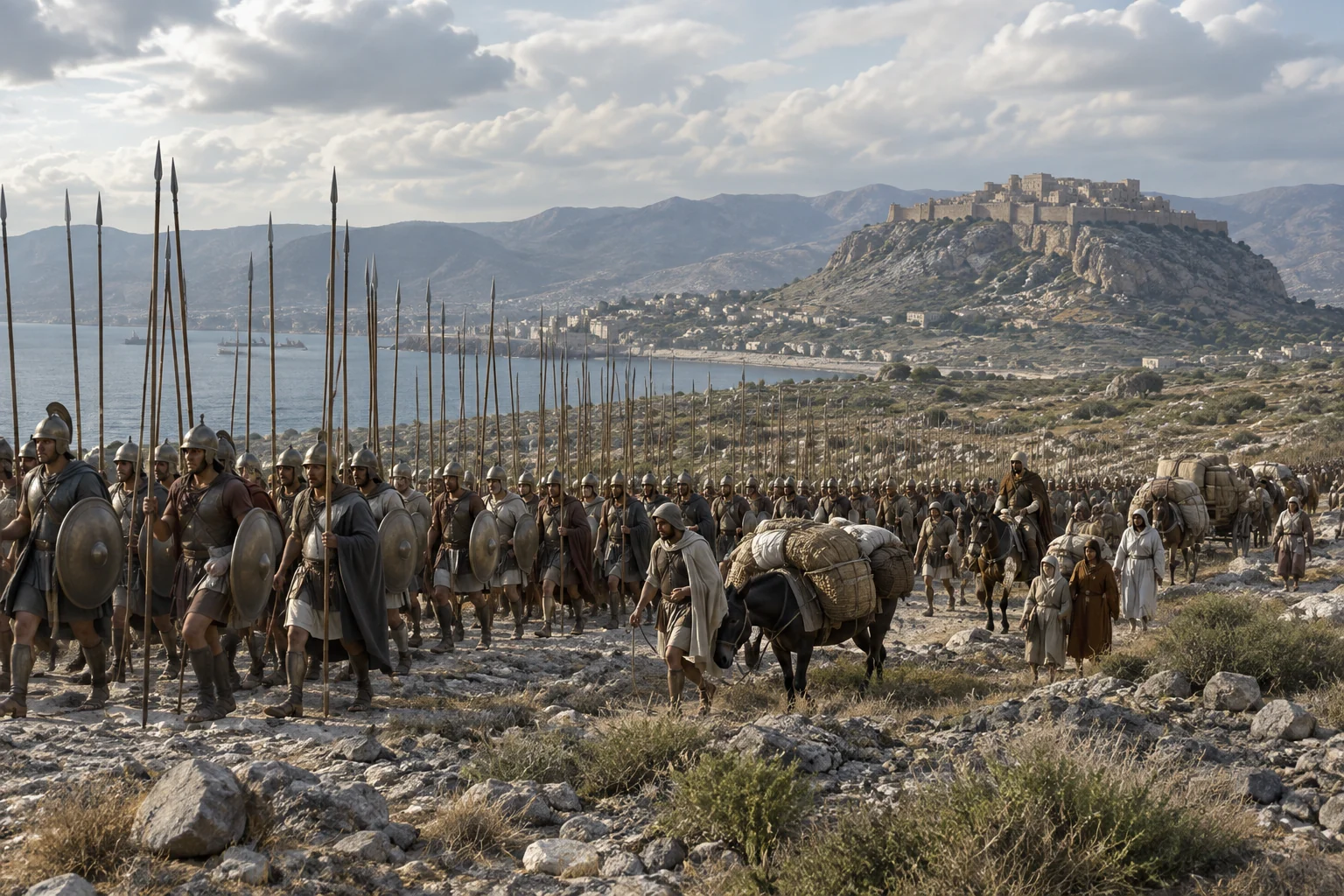
The unitary empire was permanently replaced by the Hellenistic kingdoms — Ptolemaic Egypt, Seleucid Asia, Antigonid Macedon, Attalid Pergamon. These kingdoms carried Greek culture deep into Asia for two more centuries until Rome absorbed them. The wars pioneered the large-scale Hellenistic way of war: professional phalanxes, war elephants, siege engineering (Demetrius "the Besieger").
Historiography pulse
- Academic consensus: the political narrative is unusually well sourced for antiquity, resting on Hieronymus of Cardia, an eyewitness participant whose history survives via Diodorus.
- Major debates: (1) whether any Diadoch genuinely aimed to reunite the empire or all were partitionists from the start (Billows argues Antigonus was a genuine unifier); (2) the reliability of Hieronymus given his service to Antigonus and Eumenes.
- Notable scholarship: Richard Billows, Antigonos the One-Eyed and the Creation of the Hellenistic State (1990); Robin Waterfield, Dividing the Spoils (2011); Edwyn Bevan's classic on the Seleucids.
Validation tier
Tier 1 — strong contemporary-source base (Hieronymus via Diodorus); figures indicative.
UNVERIFIED points
- Any aggregate death toll for the wars.
- Precise army strengths and casualty figures (Plutarch's numbers via Hieronymus are the best available).
- Details of Corupedium beyond the outcome and Lysimachus's death.
Sources
- Diodorus Siculus, Books 18–21 (via Hieronymus of Cardia) — primary narrative.
- Plutarch, Lives of Demetrius, Eumenes, Pyrrhus.
- Memnon of Heraclea (via Photius) — Corupedium.
- Richard Billows, Antigonos the One-Eyed and the Creation of the Hellenistic State (California, 1990).
- Battle of Ipsus — https://en.wikipedia.org/wiki/Battle_of_Ipsus
- Battle of Corupedium — https://en.wikipedia.org/wiki/Battle_of_Corupedium
Images
Sources
- Diodorus Siculus, Books 18–21 (via Hieronymus of Cardia) — primary narrative
- Plutarch, Lives of Demetrius, Eumenes, Pyrrhus
- Memnon of Heraclea (via Photius) — Corupedium
- Richard Billows, Antigonos the One-Eyed and the Creation of the Hellenistic State (California, 1990
- Battle of Ipsus
- Battle of Corupedium