Conflict dossier · #27 of 120
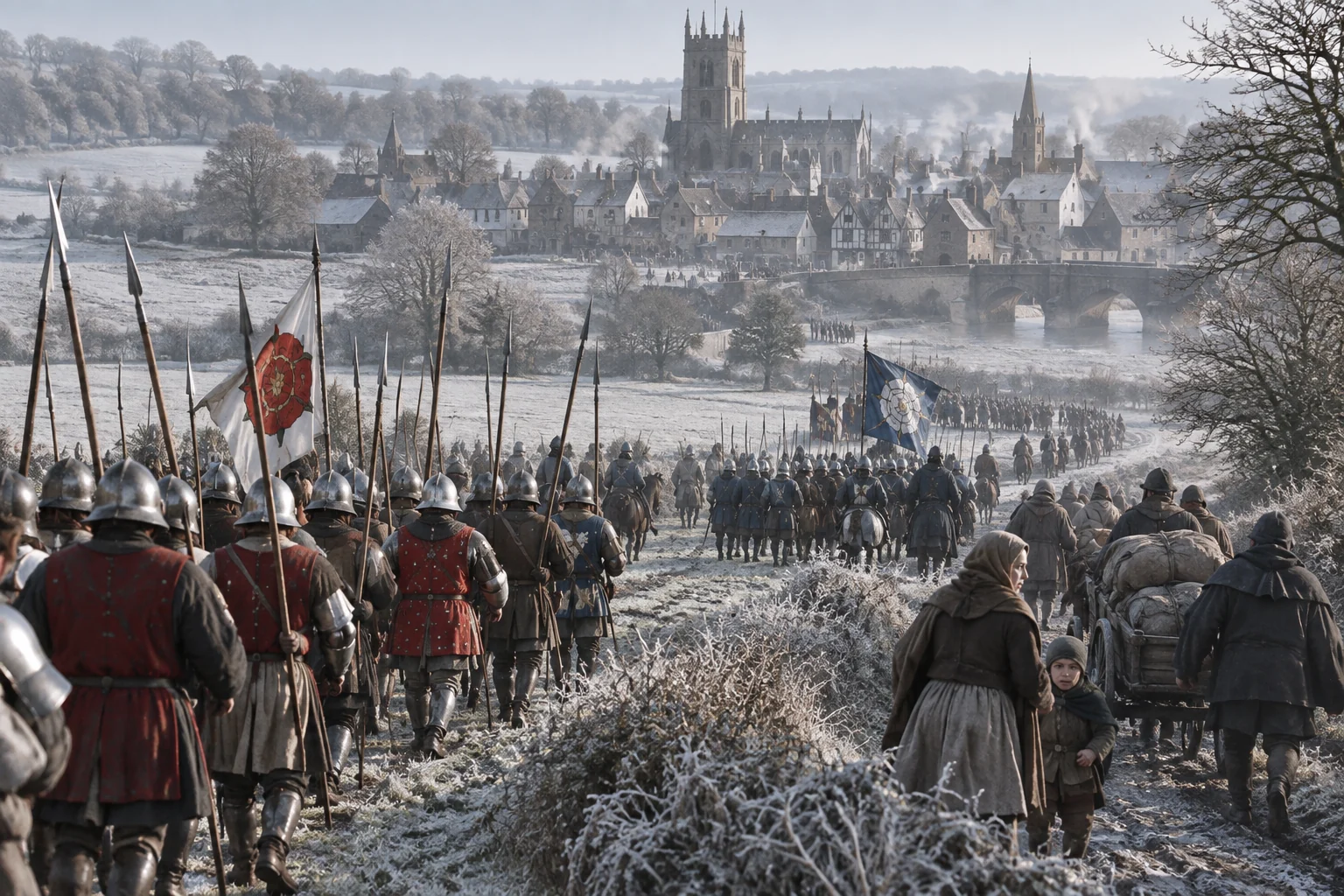
27. Wars of the Roses (1455–1487)
Medieval Tier 2
27. Wars of the Roses (1455–1487)
Overview
- Belligerents: Rival branches of the Plantagenet dynasty — the House of Lancaster (red rose) and the House of York (white rose) — and their noble retinues; the wars ended with the Tudor victory at Bosworth.
- Dates: 1455 (First St Albans) to 1487 (Stoke Field); the plan bracket extends through Henry VII's consolidation.
- Theater: England and Wales, with exile and mercenary dimensions in France, Burgundy, and Ireland.
- Outcome: Henry Tudor's victory at Bosworth Field (1485) and the defeat of the last Yorkist challenge at Stoke Field (1487); the Tudor dynasty founded.
Causes
Attribution — multifactorial, per modern scholarship: competing dynastic claims, Henry VI's incapacity and the breakdown of government, factional court politics, aristocratic feuds, royal financial weakness, economic disruption, and the loss of France. A.J. Pollard emphasizes disputes over the wars' origins and rejects the popular image of uninterrupted nationwide anarchy — much of England experienced the wars through localized noble conflict rather than constant battle.
Course
Yorkist victory at Towton (1461, the bloodiest battle) put Edward IV on the throne; the wars seesawed through Warwick's rebellion, Barnet and Tewkesbury (1471), Edward IV's restored rule, Richard III's usurpation (1483), and Henry Tudor's invasion ending at Bosworth (1485), where Richard III was killed. Lambert Simnel's Yorkist rising ended at Stoke Field (1487).
Casualties
- Towton (29 March 1461): contemporary claims range 9,000–38,000 dead; modern estimates often cluster around 10,000–13,000 (one breakdown: 3,000–4,500 Yorkist, 6,000–8,500 Lancastrian). Figures of 28,000–40,000 are contested, not settled.
- No credible aggregate total for all the wars was found.
- UNVERIFIED: any aggregate death toll; the higher Towton figures taken literally.
Outcome & Legacy
Tudor centralization; the decline of the great magnate affinities; the battlefields (especially Bosworth and Towton) became major heritage sites; Richard III's 2012 rediscovery and 2015 reburial renewed public engagement.
Historiography Pulse
- Pollard and others have dismantled the "anarchy" caricature; debate continues on the wars' structural causes and on Richard III's reputation.
- Towton's mass graves provide rare bioarchaeological evidence for medieval battle trauma.
- Documentaries: extensively covered (Towton, Bosworth, Richard III).
- Validation tier: Tier 2 — strong narrative evidence; Towton archaeology grounds casualty discussion; aggregates absent.
Sources
- https://www.bloomsbury.com/au/wars-of-the-roses-9781137121660/
- https://richardiii.net/richard-iii-his-world/the-war-of-the-roses/political-history/
- https://thewarsoftheroses.co.uk/battle-of-towton/
- https://en.wikipedia.org/wiki/Battle_of_Towton
- http://historytheinterestingbits.com/2021/03/29/guest-post-7-things-you-may-not-know-about-the-battle-of-towton-by-dan-moorhouse/
Images (8 views — files in images/wars-of-the-roses/)
| File | View |
|---|---|
| 01-hero-battle-art.jpg | Battle of Bosworth Field 1485 (art) |
| 02-theater-map.jpg | Wars of the Roses battle map |
| 03-towton.jpg | Battle of Towton 1461 (art) |
| 04-richard.jpg | Richard III statue/memorial, Leicester |
| 05-towton-site.jpg | Towton battlefield memorial |
| 06-armor.jpg | 15th-century English plate armor (museum) |
| 07-tower.jpg | Tower of London (medieval) |
| 08-rose-emblem.jpg | Red/white rose emblem (manuscript/heraldry) |