Conflict dossier · #65 of 120
Winter War (1939–1940)
20th Century Tier 1
Winter War (1939–1940)
Overview
- Belligerents: Finland (commander-in-chief Marshal Carl Gustaf Emil Mannerheim) vs. Soviet Union (Joseph Stalin)
- Dates: 30 November 1939 – 13 March 1940 (105 days; Moscow Peace Treaty signed 12 March 1940, effective 13 March)
- Theater: Finnish–Soviet border — Karelian Isthmus (Mannerheim Line), Ladoga Karelia, northern Finland (Suomussalmi), the Arctic coast.
Causes — attributed
- General historical consensus (globalsecurity.org; Wikipedia): the Molotov-Ribbentrop Pact's secret protocol (August 1939) placed Finland in the Soviet sphere of influence; the USSR demanded Finnish territory near Leningrad and a lease on Hanko for naval bases; negotiations failed; the USSR staged the Mainila incident (26 November 1939, shelling attributed by Finland to the Soviets, cited by Moscow as a pretext) and invaded 30 November 1939.
- Historians attribute Soviet motives to securing Leningrad's approaches and testing German tolerance of Soviet expansion — not to a declared annexation aim (Molotov stated the goal was "purely to secure Leningrad," per Wikipedia).
- Academic debate: whether the Mainila incident was a Soviet false-flag operation — most Western historians treat it as staged by the USSR (attributed); the war's place in the broader narrative of Soviet aggression vs. defensive security policy.
Course
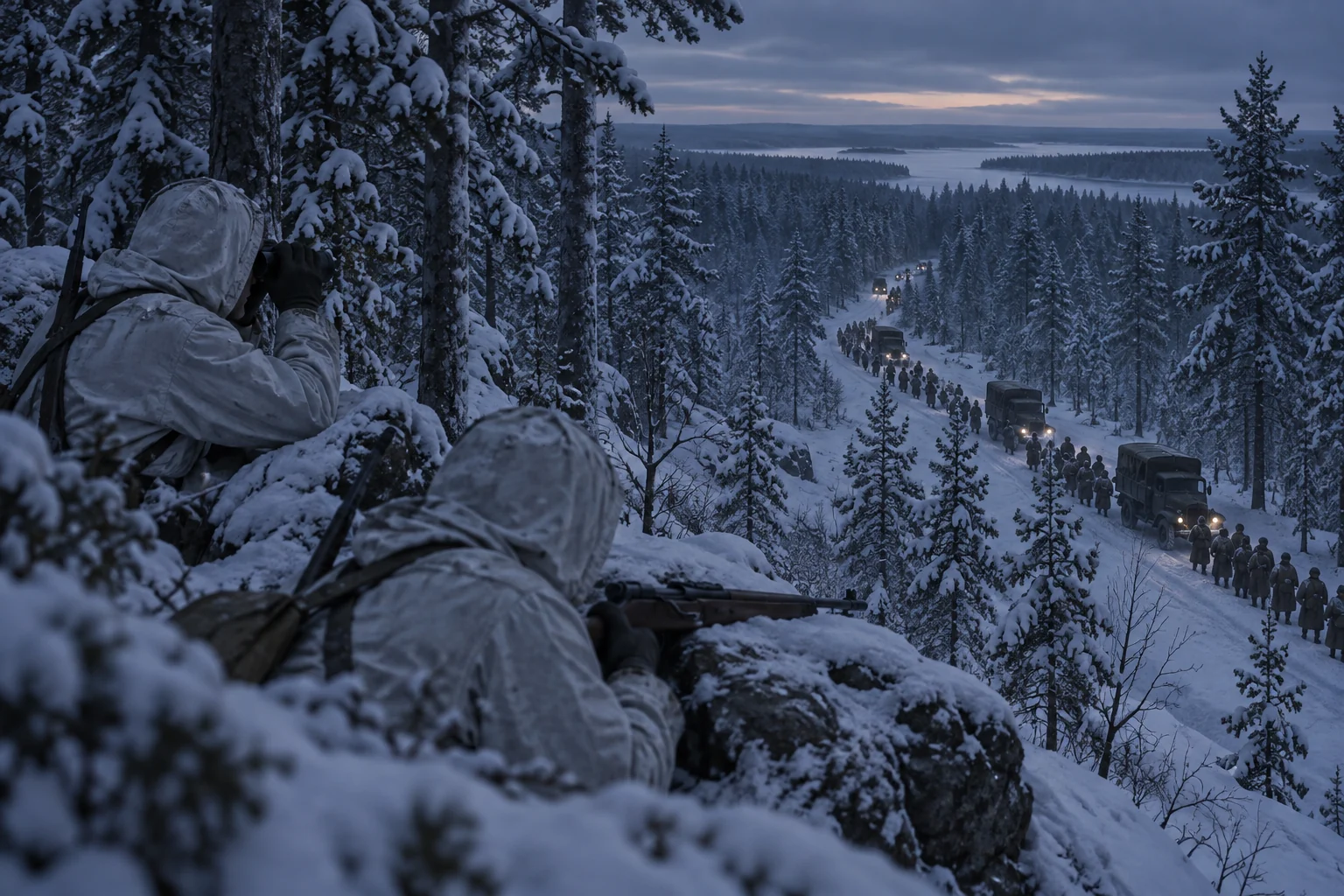
Soviet forces (425,000–760,000 troops, thousands of tanks and aircraft) attacked along the entire border expecting a quick victory. Finnish forces (300,000–340,000, 32 tanks, 114 aircraft) inflicted heavy losses using ski troops, "motti" encirclement tactics, Molotov cocktails, and knowledge of the extreme winter (one of the coldest of the century). The Mannerheim Line held for two months; a massive Soviet offensive in February 1940 broke through, and exhausted Finland sued for peace. The League of Nations expelled the USSR (December 1939).
Casualties — ranges with named sources
- Finland: ~25,904 dead or missing, 43,557 wounded (Wikipedia/YouTube SA-kuva compilation citing Wikipedia); globalsecurity.org: ~25,000 dead, 10,000 permanently disabled, 35,000 wounded — out of a population of 3.5 million. ~70,000 total casualties.
- Soviet Union — contested: official 1940 Soviet figure: 48,475 dead, 158,863 sick/wounded; Grigoriy Krivosheyev (1997): 126,875 dead/missing, 391,783 total casualties; Yuri Kilin (2012): 138,533 dead; Pavel Petrov (2013, Russian State Military Archive database): 167,976 killed/missing; Nikita Khrushchev (memoirs): "over one million" Soviet soldiers killed — widely regarded as an exaggeration (Wikipedia).
- Current scholarly band: 126,875–167,976 Soviet dead or missing; 321,000–391,783 total Soviet casualties (Wikipedia); 5,572 Soviet POWs in Finland (Wikipedia).
- Finnish civilian impact: bombings and displacement; no agreed civilian death total — UNVERIFIED.
Outcome & legacy
- Moscow Peace Treaty (12 March 1940): Finland ceded ~11% of its territory (Karelian Isthmus including Vyborg, Ladoga Karelia, parts of Salla and the Rybachy Peninsula; Hanko leased as a naval base) but preserved its independence — widely seen as a moral victory.
- ~420,000 Karelian evacuees resettled inside Finland (one-eighth of Finland's population lived in the ceded territories, per globalsecurity.org).
- The Red Army's poor performance damaged Soviet military credibility; historians generally consider Hitler's decision to invade the USSR (June 1941) influenced by this perceived weakness (globalsecurity.org). The USSR then undertook military reforms.
- Finland later joined Germany in the Continuation War (1941–1944) to recover lost territory.
- The League of Nations' expulsion of the USSR was one of its few decisive actions.
Historiography pulse
- Academic consensus: a Soviet war of aggression driven by security demands; Finnish defensive success against overwhelming odds.
- Major debates: (a) Soviet casualty figures — 48,475 (official) vs. 127,000–168,000 (post-Soviet research) vs. Khrushchev's ~1 million (Tier 3); (b) the Mainila incident as false flag; (c) whether Stalin intended full annexation of Finland or limited territorial gains.
- Notable scholarship: William R. Trotter, A Frozen Hell (1991), the standard English military history; the SA-kuva.fi Finnish wartime photo archive is a key visual source; documentaries include Finnish YLE productions and the SA-kuva-based compilations.
Validation tier
Tier 1 on causes, course, outcome, Finnish casualties; Tier 2 on Soviet casualties (convergent post-Soviet band 127,000–168,000 dead/missing); Tier 3 on Khrushchev's "one million" claim (flagged as exaggeration).
UNVERIFIED points
- Exact Soviet death toll: 126,875–167,976 is the post-Soviet scholarly band; the 1940 official figure (48,475) is considered an undercount; Khrushchev's figure unverifiable.
- Finnish civilian deaths from bombings: no agreed total.
Sources
- Wikipedia, "Winter War" — https://en.wikipedia.org/wiki/Winter_War
- globalsecurity.org, "1939-1940 - Winter War" — http://www.globalsecurity.org/military/world/war/winter-war.htm
- TIMnovate, "History DOES Repeat Itself: The Winter War 1939-40" — http://timnovate.com/2022/02/27/history-does-repeat-itself-the-winter-war-1939-40/
Images
Sources
- Wikipedia, "Winter War"
- globalsecurity.org, "1939-1940 - Winter War"
- TIMnovate, "History DOES Repeat Itself: The Winter War 1939-40"