Conflict dossier · #59 of 120
World War I (1914–1918)
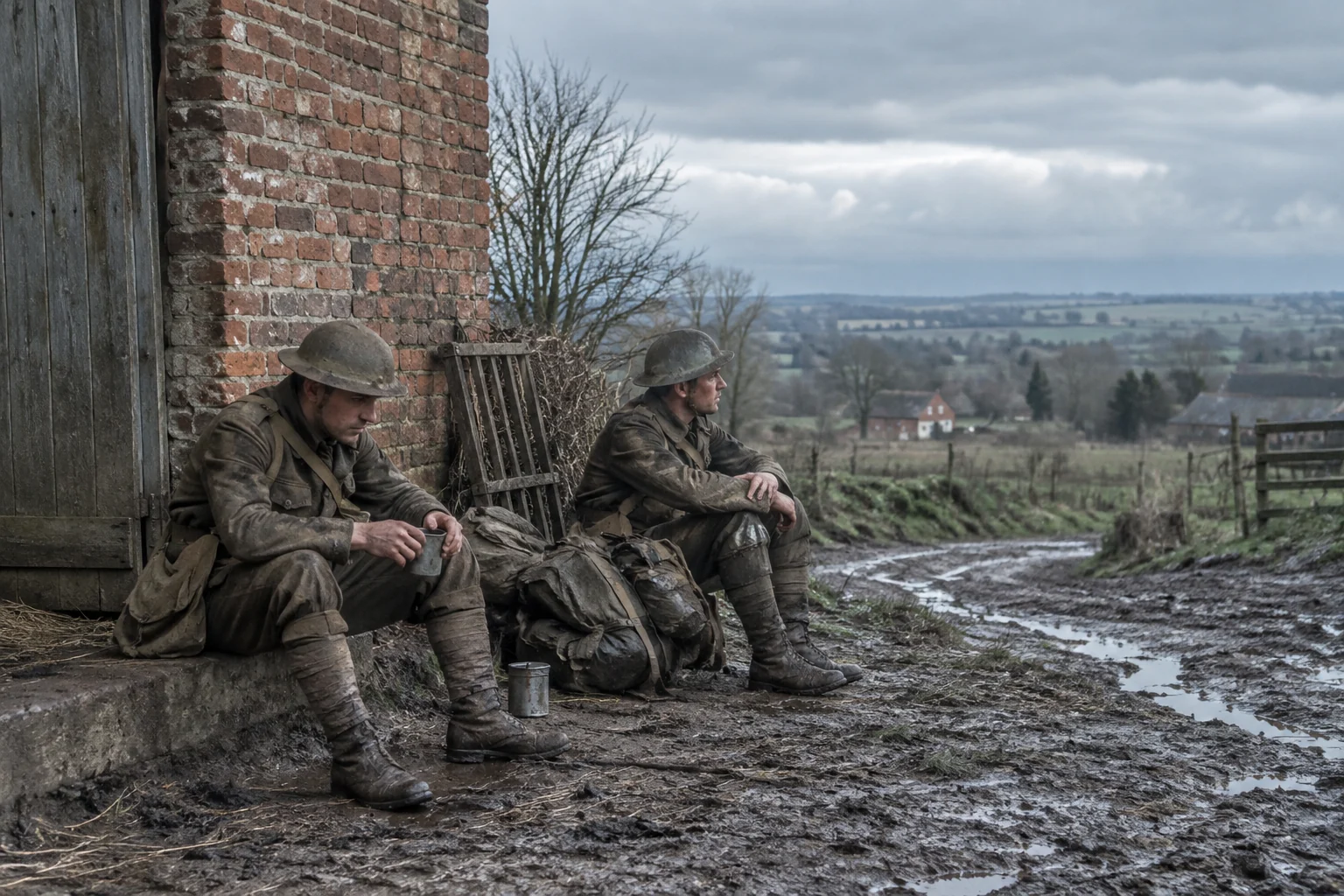
20th Century Tier 1
World War I (1914–1918)
Overview
- Belligerents: Triple Entente / Allies — France, Russian Empire, British Empire, Italy (from 1915), United States (from 1917), plus Serbia, Belgium, Japan, Greece, Romania, Portugal, China and others — vs. the Central Powers — Germany, Austria-Hungary, the Ottoman Empire, Bulgaria.
- Dates: 28 July 1914 – 11 November 1918
- Theater: Western Front (France/Belgium), Eastern Front, Italian Front, Balkans, Ottoman fronts (Gallipoli, Caucasus, Mesopotamia, Palestine), East Africa, and at sea (North Sea, Atlantic, Mediterranean); colonial campaigns in Africa and Asia-Pacific.
Causes — attributed
- The assassination of Archduke Franz Ferdinand in Sarajevo (28 June 1914) by Gavrilo Princip, a Bosnian Serb nationalist, triggered the July Crisis; Austria-Hungary's ultimatum to Serbia, the alliance system, and mobilization schedules turned a regional crisis into continental war.
- Historiography: Fritz Fischer's Griff nach der Weltmacht (1961) argued German expansionism was the driving cause (the "Fischer thesis"), sparking decades of debate. More recent consensus (per the general historiography captured in encyclopedic sources) distributes responsibility across militarism, alliance entanglements, nationalism, the naval arms race, and the July Crisis dynamics; German war guilt remains debated. The plan for this dossier follows the defamation discipline: no single-cause claim is stated as settled fact.
- Scholarly debates also cover: the role of the Schlieffen Plan and German mobilization timetables, Russian mobilization as an escalatory step, British entry via Belgian neutrality, and the question of "short-war illusion."
Course
Germany's Schlieffen Plan opened with the invasion of Belgium and France; the Marne (September 1914) stopped the German advance and entrenched both sides from the North Sea to Switzerland in trench warfare (1915–1917: Verdun, the Somme, Passchendaele). In the East, Russia initially advanced, was crushed at Tannenberg (1914), and collapsed in 1917 under revolution; the Treaty of Brest-Litovsk (March 1918) took Russia out. Italy fought Austria-Hungary in the Alps (Caporetto 1917; Vittorio Veneto 1918). The Ottoman Empire fought on multiple fronts, including Gallipoli (1915–16, an Allied failure). The US entered in April 1917; Germany's spring offensives of 1918 failed; the Hundred Days Offensive and domestic collapse brought the armistice of 11 November 1918. Treaties: Versailles (Germany, 1919), Saint-Germain (Austria, 1919), Trianon (Hungary, 1920), Sèvres (Ottoman Empire, 1920; superseded by Lausanne, 1923).
Armenian genocide (embedded sub-event, per plan)
- The Ottoman government's mass killing and deportation of Armenians (1915–1916, continuing into 1923) is described by most genocide scholars and the International Association of Genocide Scholars (1997 resolution) as genocide — a deliberate campaign of mass deportations and organized killings (per grokipedia.com's summary of the dominant scholarly view).
- Death toll: estimates range from 300,000 to 2 million (gantnews.com, 2015); most estimates fall between 600,000 and 1.5 million (per gantnews.com); Armenian-American historian Richard G. Hovannisian gives 600,000–2 million (per Wikipedia, "Casualties of the Armenian genocide"); recent scholarship suggests around 800,000–1.2 million deported in 1915–1916 with only ~200,000 still alive by end of 1916.
- The Republic of Turkey's official stance denies the intentional/genocidal characterization of the deaths (per worldwithoutgenocide.org); denialist organizations such as tc-america.org dispute both the genocide label and the 1.5-million figure. This dossier presents the majority-scholarly position with the Turkish state's denial attributed; exact death toll UNVERIFIED — no settled consensus figure.
- Additionally, an estimated 500,000 Assyrians and 350,000 Anatolian Greeks were killed (worldwithoutgenocide.org — attributed estimate).
Casualties — ranges with named sources
- Wikipedia ("World War I casualties," citing official published sources): 15–22 million total deaths; 9–11 million military deaths; 6–13 million civilian deaths; ~21 million wounded military personnel. Allies ~6 million military dead; Central Powers ~4 million. At least 2 million died of disease; 6 million missing, presumed dead.
- Reperes Association (via historytools.org): ~20 million deaths total (9.7 million military, ~10 million civilian) plus 21 million wounded.
- Older encyclopedic mirror (ipfs.io): over 17 million deaths, 20 million wounded; ~11 million military, ~7 million civilians.
- Cormac Ó Gráda (The Hidden Victims, cited on tertulia.com): argues war-induced famines may have killed ~30 million, making civilian totals much higher — an attributed revisionist estimate, not consensus.
- Martin Gilbert (The First World War, 1994, cited by facinghistory.org): over 9 million soldiers, sailors and airmen killed; ~5 million further civilians died under occupation, bombardment, hunger, and disease (excluding influenza).
Outcome & legacy
- Collapse of four empires: German, Austro-Hungarian, Russian, Ottoman. The map of Europe and the Middle East was redrawn (new states: Poland, Czechoslovakia, Yugoslavia, the Baltic states; Ottoman partition under Sykes-Picot and the mandates system).
- The League of Nations was created (1920); the Treaty of Versailles imposed the "war guilt" clause and reparations on Germany — a settlement whose harshness historians (e.g., the Keynes school) link to interwar instability.
- Profound cultural impact: the "Lost Generation," modernist literature, the memorial culture of remembrance (Tomb of the Unknown Soldier, poppies); women gained the vote in several combatant nations.
- The war's scale made it "one of the deadliest military conflicts in human history" (Wikipedia).
Historiography pulse
- Academic consensus: causes remain a live field — Fischer thesis (1961) vs. multi-causal/structural accounts (e.g., Christopher Clark, The Sleepwalkers, 2012, on how Europe "sleepwalked" into war); the 2014 centenary produced a wave of revisionist synthesis.
- Major debates: German war guilt; whether the war was inevitable or a contingent accident of the July Crisis; casualty accounting (Ó Gráda's upward revisions vs. official figures); inclusion of the Armenian genocide within war-loss accounting (flagged as debated on the Wikipedia casualty page).
- Notable documentaries/scholarship: BBC The Great War (1964); They Shall Not Grow Old (Peter Jackson, 2018, restored Imperial War Museum footage); Dan Carlin's Hardcore History: Blueprint for Armageddon; academic touchstones include Keegan's The First World War (1998) and Clark's The Sleepwalkers (2012).
Validation tier
Tier 1 — multi-source academic consensus on causes framework (multi-causal), course, and outcome; Tier 2–3 on exact casualty totals (ranges across named sources; Armenian death toll UNVERIFIED).
UNVERIFIED points
- No single agreed total casualty figure: ranges span 15–22 million deaths depending on source and inclusion criteria (influenza, post-war conflicts, Armenian genocide).
- Armenian genocide death toll: 600,000–1.5 million is the commonly cited band, but no settled scholarly consensus figure; Turkish state disputes the genocide characterization.
- Whether the 1918 influenza deaths and the Armenian genocide belong inside WWI casualty accounting is itself debated.
Sources
- Wikipedia, "World War I casualties" — https://en.wikipedia.org/wiki/World_War_I_casualties
- HistoryTools.org, "The Unprecedented Tragedy: World War 1 Casualties by the Numbers" — https://www.historytools.org/stories/the-unprecedented-tragedy-world-war-1-casualties-by-the-numbers
- REPERES module (CVCE / Centre Robert Schuman) — https://b5d7ac.staticwbm.com/20220827080055/http://www.centre-robert-schuman.org/userfiles/files/REPERES%20%E2%80%93%20module%201-1-1%20-%20explanatory%20notes%20%E2%80%93%20World%20War%20I%20casualties%20%E2%80%93%20EN.pdf
- Facing History & Ourselves (Martin Gilbert figures) — https://facinghistory.org/resource-library/brutal-realities-world-war-i
- Tertulia / Cormac Ó Gráda, The Hidden Victims — https://tertulia.com/book/the-hidden-victims-civilian-casualties-of-the-two-world-wars-cormac-%C3%B3-gr%C3%A1da/9780691258751
- GantNews, "8 things to know about the mass killings of Armenians" (2015) — https://gantnews.com/2015/04/23/8-things-to-know-about-the-mass-killings-of-armenians-100-years-ago/
- World Without Genocide, "Armenian Genocide, 1915–1923" — http://worldwithoutgenocide.org/wp-content/uploads/2012/12/Armenian-Genocide-World-Without-Genocide.pdf
Images
Sources
- Wikipedia, "World War I casualties"
- HistoryTools.org, "The Unprecedented Tragedy: World War 1 Casualties by the Numbers"
- REPERES module (CVCE / Centre Robert Schuman
- Facing History & Ourselves (Martin Gilbert figures
- Tertulia / Cormac Ó Gráda, The Hidden Victims
- GantNews, "8 things to know about the mass killings of Armenians" (2015
- World Without Genocide, "Armenian Genocide, 1915–1923"