Conflict dossier · #66 of 120
World War II (1939–1945)
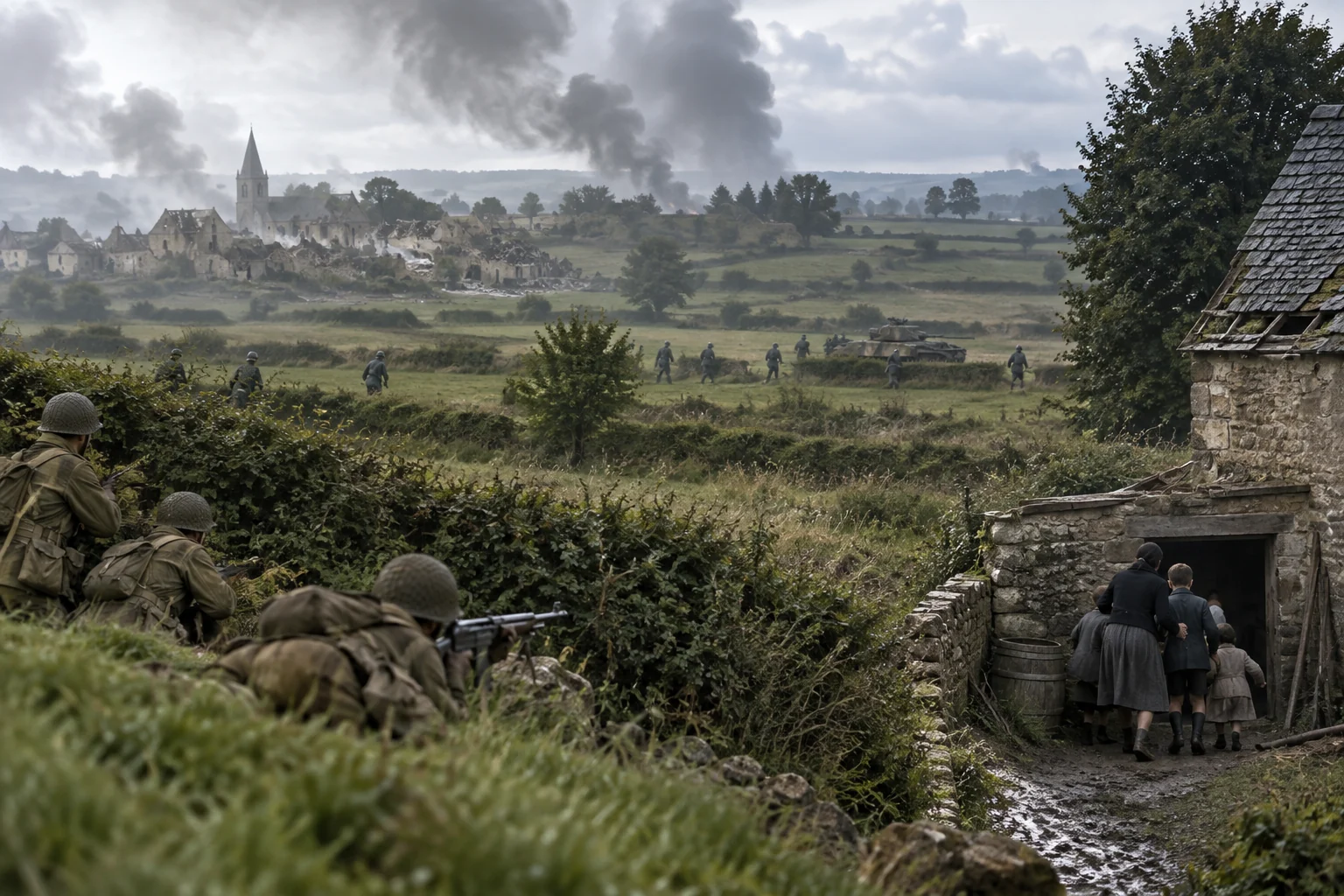
20th Century Tier 1
World War II (1939–1945)
Overview
- Belligerents: Allies — Poland, France, British Empire/Commonwealth, Soviet Union (from June 1941), United States (from December 1941), Republic of China, and dozens more — vs. Axis — Germany, Italy, Japan (plus Hungary, Romania, Bulgaria, Finland as co-belligerents at various points).
- Dates: 1 September 1939 (German invasion of Poland) – 2 September 1945 (formal Japanese surrender); the European war ended 8–9 May 1945. (China's war with Japan began 1937; the 1937–1945 China theater is covered in dossier 64, with figures folded in here where sources aggregate.)
- Theater: Global — Europe (Eastern and Western Fronts, the Atlantic, the Mediterranean), North Africa, the Middle East, South and Southeast Asia, China, the Pacific, and the home fronts.
Causes — attributed
- Academic consensus (HISTORY, 2026; general historiography): Nazi Germany's expansionism (remilitarization, the Anschluss, the Munich crisis, the invasion of Poland), Fascist Italy's imperialism (Ethiopia 1935–36), and Japan's war in China (1937) — combined with the failure of appeasement, the League of Nations' weakness, and the unresolved grievances of the Versailles settlement.
- Historiographic debates: the "appeasement" debate (was war avoidable in 1938?); A.J.P. Taylor's The Origins of the Second World War (1961) argued Hitler was an opportunist rather than a master planner — contested by intentionalist historians; the relative weight of ideology vs. structural factors.
- Triggering events: Germany's invasion of Poland (1 September 1939) brought Britain and France into the war; Operation Barbarossa (22 June 1941) opened the Eastern Front; Pearl Harbor (7 December 1941) brought the US in and globalized the conflict.
Course
- 1939–41: Germany conquered Poland (with the USSR invading from the east), Denmark, Norway, the Low Countries, and France (1940); the Battle of Britain (1940); the Balkans and North Africa campaigns; Operation Barbarossa (June 1941) — the largest invasion in history — reached the gates of Moscow before winter stopped it.
- 1942–43: Stalingrad (August 1942–February 1943) — the turning point on the Eastern Front; El Alamein; Midway (June 1942) turned the Pacific naval war; Guadalcanal; the Allied invasion of Sicily and Italy (1943).
- 1944–45: D-Day (6 June 1944); the Soviet Operation Bagration destroyed Army Group Centre; the liberation of France; the Battle of the Bulge (December 1944); the Soviet drive to Berlin (April–May 1945; Hitler's suicide 30 April; German surrender 8–9 May). In the Pacific: island-hopping, Iwo Jima, Okinawa; the atomic bombings of Hiroshima and Nagasaki (6 and 9 August 1945); Japan's surrender 15 August / formal 2 September 1945.
- The war system: historian Iain MacGregor (quoted by HISTORY, 2026) notes the theaters were "simultaneous, tightly connected and fed by mass mobilization on a truly global scale" — over 50 countries, more than 120 million mobilized.
The Holocaust (embedded sub-event, per plan — defamation discipline observed)
- The Nazi regime's systematic murder of ~6 million Jews (the scholarly consensus figure) alongside millions of others — Soviet POWs (~3–3.5 million), Roma, disabled people, political opponents, homosexuals — via mass shootings, ghettos, forced labor, and extermination camps (Auschwitz-Birkenau, Treblinka, etc.). simple.wikipedia.org's summary cites 6 million Jewish victims and 11 million total murdered by the Nazi regime.
- Perpetrators and responsibility are documented by the Nuremberg trials, the Einsatzgruppen reports, and extensive archival evidence. Holocaust denial is a fringe position rejected by mainstream scholarship; this dossier presents the consensus as settled fact while keeping casualty subtotals attributed where sources differ.
- Also documented: Japanese atrocities in China (Nanjing — see dossier 64; Unit 731) and the Allied strategic bombing of cities (Dresden, Hamburg, Tokyo) and the atomic bombings — the latter's necessity remains debated among historians (attributed debate).
Casualties — ranges with named sources
- Total: 70–85 million deaths, ~3% of the 1940 world population (Wikipedia, via nli.org.il mirror); HISTORY (2026, citing historians): 60–80 million; simple.wikipedia.org: 40–85 million; docsity.com summary: ~72 million (~47 million civilian, ~25 million military).
- Breakdown (Wikipedia): 50–56 million deaths directly caused by the war; an additional 19–28 million from war-related disease and famine; 50–55 million civilian deaths; 21–25 million military deaths, including ~5 million POWs who died in captivity.
- USSR: 26.6–27 million (Russian government figures; 1994 Academy of Sciences conference: 8,668,000 military, 18,000,000 civilian — mackenzieinstitute.com); simple.wikipedia.org: 27 million.
- China: 15–20 million (PRC: 20 million; mackenzieinstitute.com: 15 million); see dossier 64 for the contested sub-figures.
- Germany: ~5.3 million military dead/missing (Rüdiger Overmans, 2000 study) + ~1.1–1.6 million civilians; vocal.media: ~5.5 million soldiers + 1.5 million civilians; total German losses including postwar expulsions estimated higher by some (Overmans' 8.68 million figure including ethnic cleansing — mackenzieinstitute.com).
- Poland: 5.6–5.8 million (Polish Institute of National Remembrance, 2009); including ~3 million Polish Jews.
- Japan: ~2.1–2.7 million military + ~580,000 civilians (vocal.media; mackenzieinstitute.com: 2,120,000 military, 580,000 civilian; Japanese government: 3.1 million total).
- Yugoslavia: ~1,027,000 (mackenzieinstitute.com); Dutch East Indies: over 3,030,000 (mostly famine); British India: ~2.09 million (including ~2 million Bengal famine deaths, 1943); French Indochina: ~1.5 million (famine).
- Holocaust: ~6 million Jews (consensus); ~11 million total Nazi-regime murder victims (simple.wikipedia.org).
Outcome & legacy
- Axis unconditional surrender; Germany and Japan occupied; the United Nations founded (1945); the Nuremberg and Tokyo trials established international criminal law.
- The Cold War began: Europe divided, the Iron Curtain, the USSR as a superpower alongside the US; decolonization accelerated across Asia and Africa.
- The atomic age began; the Geneva Conventions (1949) and the Universal Declaration of Human Rights (1948) responded to the war's atrocities.
- The deadliest conflict in human history by every major accounting (HISTORY, 2026; Wikipedia).
Historiography pulse
- Academic consensus: causes rooted in Axis aggression and the failure of the interwar order; the Eastern Front as the decisive theater of the European war.
- Major debates: (a) casualty totals — 60–85 million band, driven by Soviet/Chinese archival revisions; (b) the atomic bombings' necessity; (c) Allied strategic bombing's morality and effectiveness; (d) the "clean Wehrmacht" myth — refuted by scholarship (e.g., the Wehrmacht Exhibition); (e) responsibility debates within the German Historikerstreit tradition.
- Notable scholarship/documentaries: Richard Overy, Why the Allies Won (1995); Antony Beevor, Stalingrad (1998) and Berlin (2002); Max Hastings, All Hell Let Loose (2011); the BBC's The World at War (1973–74) remains the landmark documentary series; Ken Burns' The War (2007).
Validation tier
Tier 1 on causes, course, outcome, and the Holocaust as historical fact (multi-source scholarly consensus, tribunal documentation); Tier 2 on aggregate casualty bands (ranges across named sources); Tier 3 on some national subtotals (Chinese figures across schools — see dossier 64).
UNVERIFIED points
- Exact total: 60–85 million depending on source and inclusion of famine/disease deaths.
- Chinese deaths: 15 million (some Western estimates) to 20 million (PRC figure) — no settled figure.
- German military deaths: Overmans' 5.3 million is the leading scholarly estimate but revised periodically.
Sources
- Wikipedia, "World War II casualties" (via National Library of Israel mirror) — https://www.nli.org.il/en/authorities/987007553897105171
- HISTORY, "Why World War II Was History's Deadliest War" (2026) — https://www.history.com/articles/world-war-ii-deadliest-war
- Simple Wikipedia, "World War II casualties" — https://simple.wikipedia.org/wiki/World_War_II_casualties
- Mackenzie Institute, "The Full Tally of World War II" — https://mackenzieinstitute.com/2010/12/the-full-tally-of-world-war-ii/
- vocal.media, "Human Cost of the Global Conflict: Casualties of World War II" — https://vocal.media/history/human-cost-of-the-global-conflict-casualties-of-world-war-ii
Images
Sources
- Wikipedia, "World War II casualties" (via National Library of Israel mirror
- HISTORY, "Why World War II Was History's Deadliest War" (2026
- Simple Wikipedia, "World War II casualties"
- Mackenzie Institute, "The Full Tally of World War II"
- vocal.media, "Human Cost of the Global Conflict: Casualties of World War II"