Begin with the wood, the date and the hands
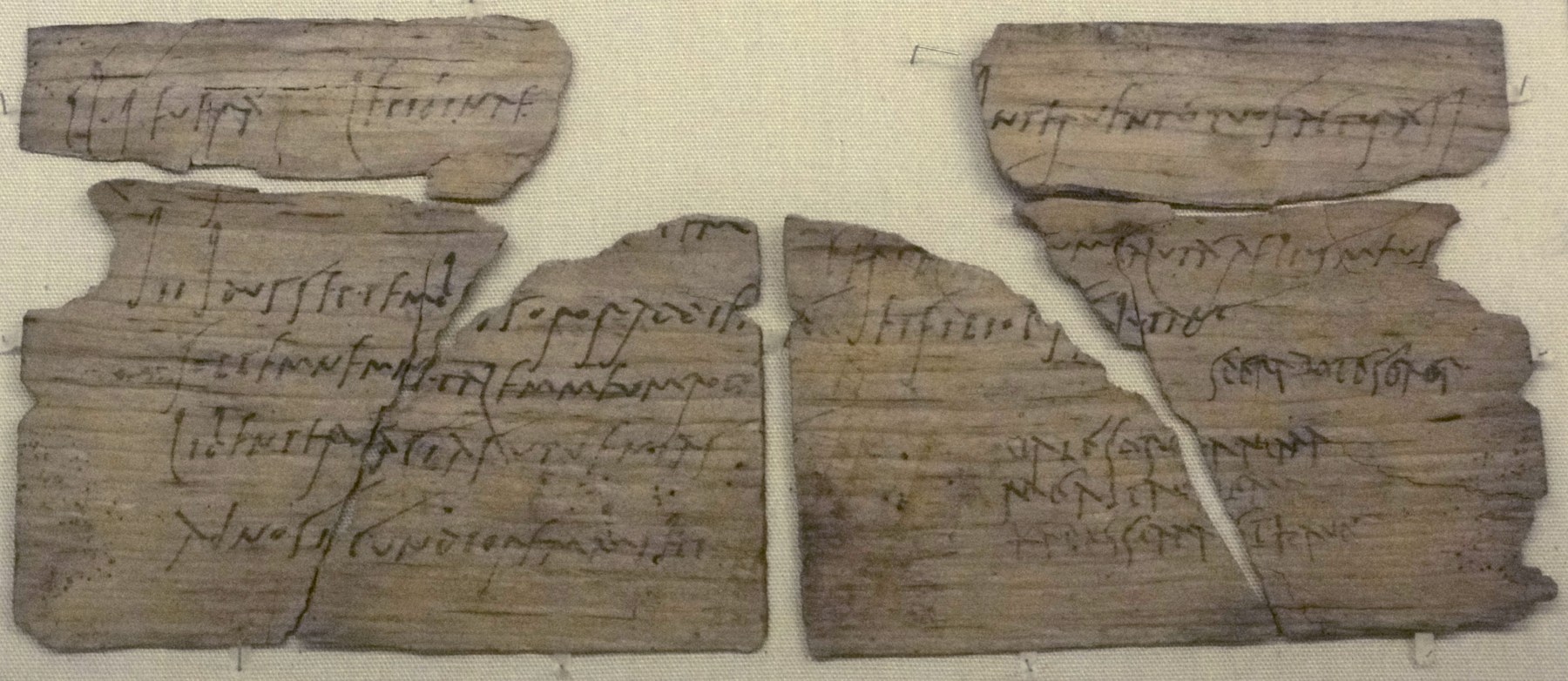
The object is not a later story about Rome. It is a thin wooden writing tablet, excavated at Vindolanda in northern Britain, catalogued as Tab. Vindol. 291 and held by the British Museum. The Roman Inscriptions of Britain edition dates it AD 97–105; the Museum gives a narrower 97–103 range. Either way, the letter belongs to a frontier community before Hadrian’s Wall was built. Calling it a message “from Hadrian’s Wall” would attach the evidence to a frontier work built later.
The surviving leaf carries an invitation from Claudia Severa to Sulpicia Lepidina for Severa’s birthday. The Roman Inscriptions of Britain edition shows both the Latin text and a translation. Most of the message appears in a practiced scribal hand; a brief personal closing is in a second hand identified as Severa’s. The difference is part of the evidence, not a decorative detail. It shows a letter composed through a household writing practice and finished personally by its sender.
What a social note tells us about a garrison
Severa and Lepidina were connected to officers’ households. The letter mentions their husbands and a child while asking Lepidina to visit. The British Museum identifies Lepidina as the wife of Flavius Cerialis, prefect of the Ninth Cohort of Batavians. A fort was therefore more than soldiers and weapons: some families and social networks travelled with military command. The letter’s ordinary purpose helps us see that daily life continued beside the work of occupation.
Its intimacy also sets a limit. The women whose words survive here had unusual access to writing, delivery and preservation. The tablet cannot tell us how most women at the fort lived, nor how local Britons experienced Roman rule. It is evidence for a particular social circle. To turn its warmth into a portrait of a peaceful frontier would let one voice stand in for people whose documents have not survived.
Set the invitation beside a military document
Tab. Vindol. 154, another tablet in the Roman Inscriptions of Britain edition, is a strength report for the First Cohort of Tungrians. Its heading and numerical categories count men present, absent and unfit for service. The editors date it about AD 92–97, so it is not a same-day companion to Severa’s letter. Read them together as different kinds of frontier evidence, with their separate dates attached.
The report organizes people as a unit’s capacity; the invitation organizes them as relationships. Neither is a complete census of Vindolanda. The report does not describe the private feelings of the men it counts. The invitation does not describe the fort’s command structure or the lives of servants and neighbours. Each document becomes more useful when you keep its original task in view.
Read the editor as well as the ancient writer
The visible marks on the tablet are faint and damaged. The edition distinguishes what can be read, what is restored and what remains uncertain. Its translation is an expert interpretation of that evidence, not a transparent window through the wood. Follow the notes before repeating a claim about an exact phrase or relationship. The British Museum’s object record supplies the material, accession number and date range; the edition supplies the reading and commentary.
This is a small but powerful way to study an empire. A frontier was administered through military paperwork and inhabited through correspondence, yet the surviving sample is uneven. Read Severa’s invitation closely for what it records, then place beside it a document written for an entirely different purpose. The distance between the two tells you as much about the archive as either tablet alone.