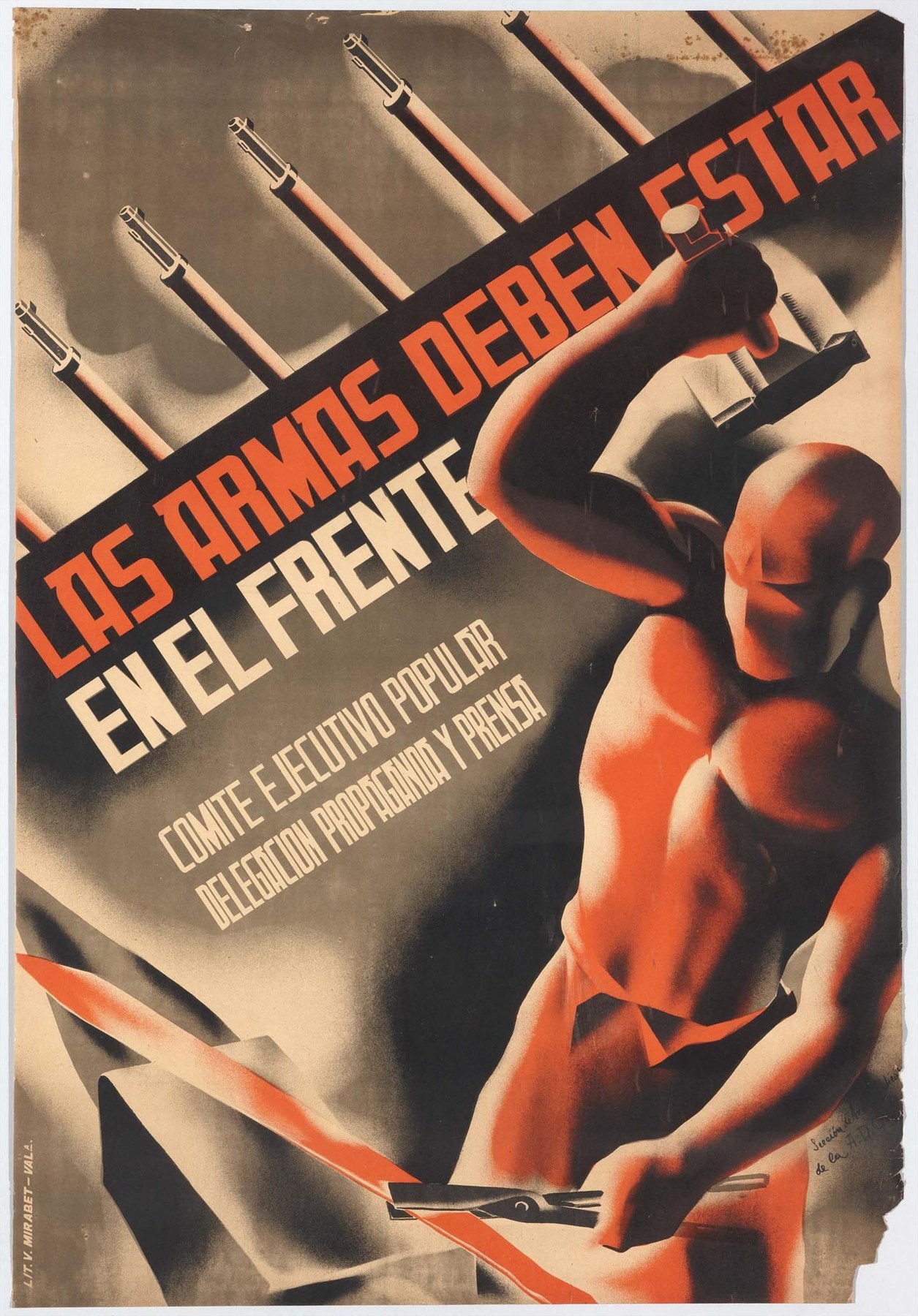
A command printed for public space
The Museo Reina Sofía catalogs “Las armas deben estar en el frente” as a 1937 lithograph on paper, registration AD05525. The title means “Weapons must be at the front.” In the image, red block letters cut across a diagonal field of rifles while a strong-armed figure works at a bench. A smaller line names the Comité Ejecutivo Popular, Delegación de Propaganda y Prensa. The poster’s imperative is visible. Whether a particular viewer obeyed it is not.
The museum attributes the work to the visual arts section of the Alianza de Intelectuales para la Defensa de la Cultura. A Commons scan of this museum object is used for the local preview. The museum’s digital catalog labels the work public domain, while the owner will still review the asset before release. Preserve the institution’s title, credit and year; do not silently replace them with a guessed individual artist.
Follow the eye from factory to front
The repeated rifle barrels and the diagonal text give the words physical momentum. The maker joins production to military need: weapons made or held away from combat are pictured as something that must move forward. This is a persuasive claim inside a war, not a neutral diagram of supply. The poster does not show how many weapons existed, where they went, or what a factory worker thought about the command.
Look at the smaller sponsor text after the large slogan. Posters compress political organization into a surface designed to be read quickly. The name on the print and the institution’s catalog attribution are related but not identical pieces of metadata. One is part of the historical artifact; the other is a later archival description. Keep both visible if you explain who speaks through the image.
Compare demands, not just styles
The Library of Congress holds about 120 Spanish Civil War posters made between 1936 and 1939, mostly from the Republican side but also representing other positions. Its catalog of Ramón Puyol’s 1937 “No pasaran! Julio 1936. Pasaremos! Julio 1937” describes a soldier walking with a farmer. That is a different appeal: a dated promise of endurance and advance. Do not treat the two posters as evidence of one centrally controlled campaign simply because both support Republican war aims.
Comparison can reveal different intended actions. The Reina Sofía poster demands that arms reach the front; the Puyol poster pairs a military figure and farmer with a slogan about passage. Both mobilize viewers through words and compressed imagery. Neither tells us, by itself, how often it was printed, where it was pasted, or whether it persuaded anyone.
Ask what the archive can and cannot save
A museum object record can establish material, dimensions, attribution and cataloged date. The preserved sheet shows a particular design. It cannot recreate the noise, risk or competing posters of the street where a copy may once have hung. The Library of Congress collection overview explains that its holdings came from varied sources and reflect conflicting agendas. A collection is a route into that visual conflict, not a complete sample of what every Spaniard saw.
Read the poster as a historical actor making a demand. Translate the imperative, identify the printed sponsor, check the catalog’s attribution, then describe the composition that carries the demand. The Spanish Civil War dossier supplies military chronology; this artifact supplies a question about mobilization and persuasion within that war.